




This practical guide shows beginner journalists how to turn climate science into compelling, people-centred stories by finding clear angles, testing causation, gathering evidence, following money, examining solutions and reporting from communities where climate change is reshaping daily life and livelihoods.
Climate journalism begins with science, but it becomes journalism through people. For reporters, particularly in the Global South, finding those people often means travelling farther, staying longer in the field and reaching communities whose experiences rarely make it into official datasets. This guide is about how to bring those elements together: people, evidence, science and accountability.
Climate change is global but people experience it locally. You may see it in a farmer standing beside an empty field, a fisher returning with a smaller catch, a family searching for drinking water, a construction worker struggling through extreme heat, a buffalo herder watching grazing land disappear, a migrant trying to survive in a crowded city settlement or a waste worker spending the day beside a methane-producing landfill.
That is where climate journalism begins.
Across much of the Global South, climate change is tied to survival, inequality, adaptation, loss and damage, food, water, health, livelihoods and displacement. Many of the communities suffering the greatest consequences have contributed relatively little to the climate crisis.
The story looks different in the Global North but it is no less important. There, climate journalism may involve energy choices, consumption, industry, finance, historical and present emissions, climate policy and international commitments. Heatwaves, wildfires, floods and storms are also making climate change increasingly local for audiences there.
Good climate journalism needs to move between these two scales. It should show how one person’s experience fits into a global crisis and how decisions made in capitals, boardrooms and international negotiations eventually reach individual households.
Doing that properly is not always cheap. People living on the frontlines of climate change are rarely located next door to a newsroom. They may live on islands, chars, remote coastlines, riverbanks, wetlands, mountains, forests, informal urban settlements or disaster-prone areas. Getting there can involve boats, motorcycles, several changes of transport, accommodation, local guides and days of reporting rather than a few hours.
Some assignments also carry real physical risks. Landfills, industrial zones, cyclone-hit communities, polluted rivers, forests and places experiencing extreme heat may require additional safety precautions. Sources can be scattered. Government records may be incomplete. Scientific evidence may take time to obtain. Sometimes one visit reveals the human story, while another is needed to verify what has actually changed.
Climate reporting can therefore become a form of slow journalism.
A reporter needs time to reach people, listen to what happened, investigate why it happened and then establish whether climate change is genuinely part of the explanation. That last step matters enormously.
First understand what makes a story a climate story
Not every environmental story is a climate story. A polluted river is an environmental story. Illegal logging is an environmental story. Toxic chemicals in soil are an environmental story. Any of them may also have a climate dimension but you have to demonstrate it.
Climate change concerns long-term changes in temperature, rainfall, seasons and interconnected Earth systems along with consequences such as sea-level rise and changing patterns of extreme events. Environmental change is broader and can result from natural processes, human activity or both.
Take waste. At first, waste is a sanitation and environmental story. Then ask what happens when organic waste decomposes in an open landfill. Methane enters the picture. Waste is the third-largest contributor to Bangladesh’s total greenhouse gas emissions, according to the country’s Nationally Determined Contribution (NDC 3.0).
Ask whether discarded material blocks drainage and worsens urban flooding. Ask about open burning and black carbon. Suddenly the climate connections become clearer.
In my waste journalism training, I use exactly this approach: follow waste through methane, open burning, flooding, health, economics and urban governance.
The lesson for a beginner is simple: Never insert “climate change” into a story simply because it seems relevant. Establish the pathway.
Ask yourself: What changed? What caused it? What evidence shows the change? What does the science say? What else could explain it? Climate change is often one driver among several.
Before thinking about climate, think about your audience
One of the first messages in my introductory climate journalism training is: rethink your audience. Before reporting, think about who will eventually read, watch or listen to the story.
Are they a general audience or specialists? What do they already know? What interests them? What language will they understand? What do they expect from the story?
A scientist and a farmer may understand salinity very differently. A policymaker and a teenager may react differently to a story about emissions. Someone who already follows climate change closely needs a different level of explanation from someone who sees it as remote from everyday life.
Your job is not to impress readers with scientific vocabulary. Your job is to make something complicated understandable without making it inaccurate. If your audience is worried about food prices, explain climate through food. If people are concerned about children’s health, investigate heat, air pollution, water, disease or nutrition.
If jobs matter, examine what changing environmental conditions mean for farmers, fishers, factory workers or construction workers.
If culture matters, investigate what communities may lose when an ecosystem changes.
Climate journalism becomes much more powerful when a reader begins to think: this has something to do with my life.
Find the story before gathering everything
Climate change itself is too big to be a story idea. “Sea-level rise” is not yet a story. Climate migration” is not yet a story. “Extreme heat” is not yet a story.
These are subjects. The journalist’s job is to find a specific question inside the subject. In my training, I often put the issue at the centre and ask reporters to look in four directions: What is the specific problem? Is there a solution? Who benefits? And, most importantly, so what?
That exercise can turn a broad topic into something reportable.
Instead of: Climate change is affecting coastal Bangladesh.
Ask: Why are buffalo disappearing from a particular coastal island?
Or: Why are families leaving one river-eroded community repeatedly rather than only once?
Or: Why does a city continue dumping organic waste when its climate plan promises methane reductions?
Or: Are government adaptation investments reaching the communities facing the highest climate risk?
A slighter question can often lead to a much bigger story.
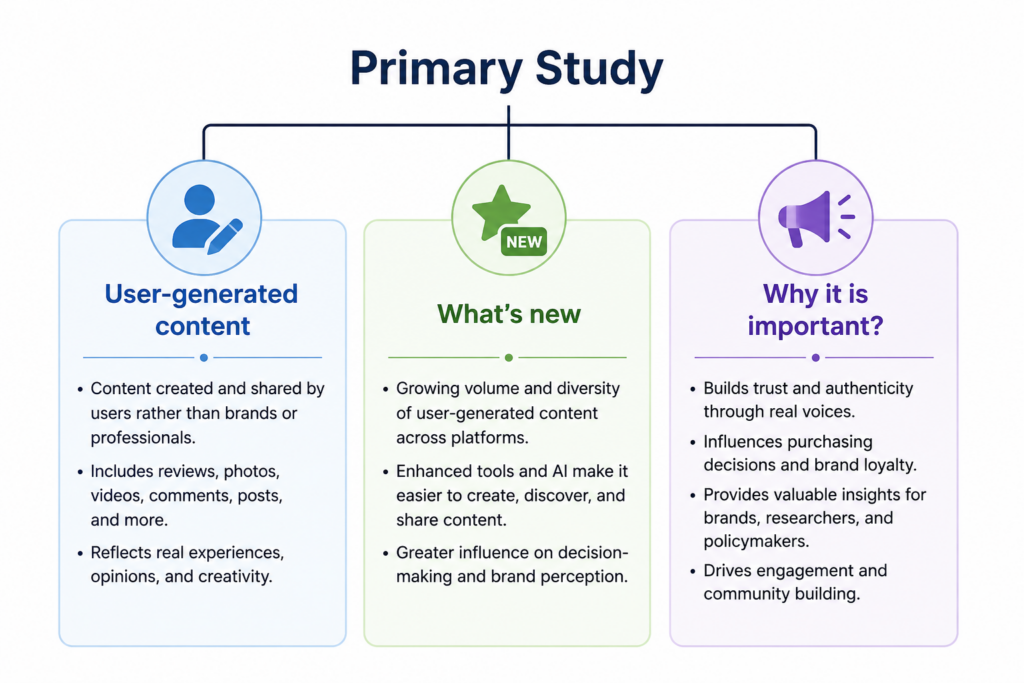
Two questions should come very early in your reporting: What is new? Why does it matter?
If you cannot answer them clearly, your angle probably needs more work.
Start with people, stay with people
One principle sits at the centre of my storytelling approach: Start with people, stay with people. Climate reporting can become abstract very quickly. There are gigatonnes of carbon dioxide, millimetres of sea-level rise, parts per million, temperature anomalies, computer models, adaptation plans, COP decisions and billions of dollars in climate finance.
All of that matters. But people remember people. One climate migration story I use in my training begins before dawn in Dhaka. Abdul Aziz wakes inside a roughly 100-square-foot shack and goes out to pedal a rickshaw. Before moving to the city, he was a farmer in Sylhet. Flooding destroyed his property and cattle and eventually pushed him into an urban settlement.
From there, the story expands into housing, health, urban vulnerability, displacement statistics and climate science. Abdul Aziz is not an emotional decoration placed on top of a data story. He is the way into the story. But remember the second half of the rule: stay with people.
Do not introduce a vulnerable woman in your opening paragraph, abandon her for the next 1,500 words while you discuss statistics and policy and then suddenly bring her back for an emotional ending.
Keep asking what every scientific finding, government decision and financial commitment actually means for the people at the centre of your reporting. Begin one person’s lived experience, then widen lens with data, science and policy. The person should part of the story as the reporting expands.
| FROM THE FIELD | START WITH PEOPLE |
| Abdul Aziz: from a flooded farm to a Dhaka rickshaw The reporting starts with Abdul Aziz’s daily life in Korail, then widens to the flash flood that destroyed his farm and cattle, urban displacement, slum conditions, groundwater pressure and the vulnerability of the cities where climate migrants seek safety. Lesson for beginners: Begin with one person’s lived experience, then widen the lens with data, science and policy. The person should remain part of the story as the reporting expands. Related reporting: Stability eludes climate refugees in Bangladesh’s sinking cities | Moving migrants |
A human angle is not enough
A moving story is not necessarily a strong climate story. I repeatedly ask reporters three questions: Is it evidence-based? Is it supported by science? Does it examine solutions? In my waste journalism training, I reduce the basic ingredients to four: human angle, evidence and data, science and solutions. Think of them as the four legs holding up the story.
Take away the human angle and you risk writing something that reads like an academic paper. Take away the evidence and you may have little more than anecdotes. Take away the science and you may wrongly blame climate change for something it did not cause. Take away solutions and accountability and you may leave readers with catastrophe but no understanding of who is responsible or what can change.
Build a climate-impact pathway
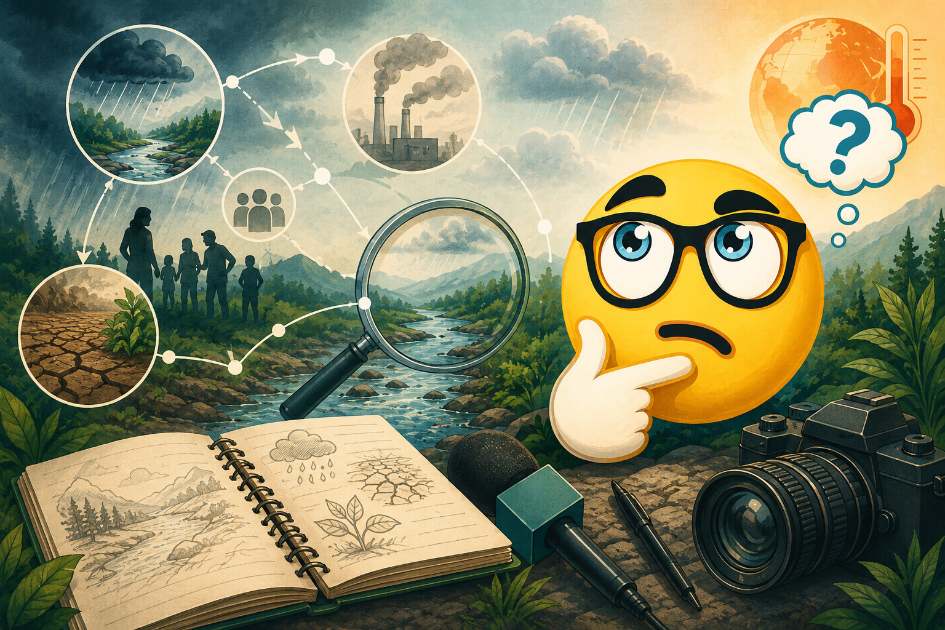
One of the most useful things a beginner can do is draw the story as a chain before beginning to write. For example: Changing climate condition → environmental change → livelihood or health impact → household consequence → wider social or economic consequence → policy response.
I have used this method while reporting on buffalo in coastal Bangladesh.
The story did not stop with declining buffalo numbers. It followed the possible pressures behind that decline: shrinking grazing and swamp land, salinity, cyclones, other extreme weather and human activity.
Then it followed the consequences. What happened to reproductive health? What happened to disease? What happened to drinking water? Did people change occupations? What happened to buffalo milk?
What happened to the traditional sweets made from that milk? In Kutubdia, one example compared the decline in buffalo with the expansion of salt cultivation. The figures used in the presentation showed buffalo numbers falling from 8,000 in 1990 to 369 in 2010 and just 102 in 2020, while salt cultivation expanded considerably.
Whether every part of that change can be attributed to climate change remains a scientific question. A journalist must verify that.
But the reporting technique is useful because it forces you to follow the consequences beyond the obvious. The buffalo is a biodiversity story. It is a food story. It is a livelihood story. It is a health story. It can be an adaptation story. And when buffalo-milk sweets, livelihoods and ceremonial traditions begin disappearing, it becomes a cultural story too. That is one of the great strengths of climate journalism. A single environmental change can lead you into many parts of society.
| FROM THE FIELD | FOLLOW THE CONSEQUENCES |
| From buffalo decline to disappearing sweets, livelihoods and names The buffalo reporting followed salinity, loss of grazing land, disease, extreme weather and land-use change into declining herds, shrinking milk supplies, changing occupations and the fading tradition of buffalo-milk sweets. A separate coastal story followed ecological loss into culture itself, including the declining use of nature-based names such as Mukta, Shukti and Jhinuk as the marine resources behind those names became scarcer. Lesson for beginners: Do not stop at the first visible impact. Follow ecological change into food, work, health, identity, language and culture. Some of the most important climate losses cannot be measured only in money. Related reporting: As water turns saline buffalo herding suffers | Will buffalo milk sweets disappear? | Gone with shifting tides |
Do not confuse correlation with causation
A farmer tells you rainfall has changed. That observation matters. But it does not prove climate change. Buffalo numbers are declining while salinity is increasing. That may be an important relationship. But you still need to investigate other explanations: conversion of grazing land, disease, industrialisation, changing markets, livestock policies or other pressures.
Climate journalism requires reporters to move through different layers of evidence. Start with observation: what are people noticing? Then look at records: what do historical data show? Move to science: is there credible research that explains the relationship? Then seek expert interpretation: how do researchers interpret the evidence? Finally, examine competing explanations: what else might be causing the same change? Only then should you make the strongest conclusion that the evidence allows. Your job is not to prove the idea you had before reporting. Your job is to discover what is true.
| FROM THE FIELD | TEST CAUSATION |
| The Halda River: climate change was not the only driver Reporting on the Halda River showed why climate stories must examine interacting causes. Rising salinity and climate pressures mattered, but so did reduced upstream freshwater, dams and sluice gates, river modification, water extraction and industrial pollution. The livelihood crisis of fishers could not be explained by a single factor. Lesson for beginners: A stronger climate story identifies competing and reinforcing causes. Do not force a complex environmental crisis into a one-cause climate narrative. Related reporting: Salt and pollution hit crucial fish breeding grounds in Bangladesh | Halda’s sorrow from climate change, human action |
Connect the local story to the global climate story
A deeply local story can become internationally important when readers understand that the experience of one community is part of a much larger pattern. In my climate storytelling training, I encourage journalists to look for cross-border perspectives, credible experts, research and data while keeping a human face at the centre. A cyclone, for example, can be examined alongside scientific projections about changing cyclone intensity. Losses of crops, livestock and homes can connect to the international debate over loss and damage. A family’s displacement can be compared with data from the Internal Displacement Monitoring Centre. Coastal erosion can be examined alongside scientific evidence on sea-level rise. That is how you move from: “One family lost its home.” to: “What this family’s experience tells us about climate displacement.”
The local story gives you reality.
The wider evidence gives you scale.
| FROM THE FIELD | WATER AND CLIMATE JUSTICE |
| When industries and households compete for diminishing water A Chattogram investigation connected groundwater decline, salinity and rising industrial demand with the daily water problems faced by residents and farmers. It showed that climate vulnerability is also shaped by development choices and unequal access to a limited resource. Lesson for beginners: Climate justice is not only a Global North versus Global South question. Ask who gets the water, land, protection and finance inside a city or country, and who bears the cost when resources become scarce. Related reporting: Thirsty Ctg industries dry up water level |
Let people lead, but let evidence carry the story
A good climate story usually requires several kinds of sources. Affected communities tell you what is happening. Scientists help explain why it may be happening. Data show how widespread, unusual or significant it is. Government officials explain what the state is doing, or failing to do.
Companies may have to explain their role and responsibility.
Civil society organisations may identify injustice, gaps in policy or alternative approaches.
Documents show what was promised.
Budgets show what was funded. Field reporting shows what actually happened. The strongest journalism comes from comparing these sources rather than depending on any one of them.
For waste investigations, for example, I recommend comparing city corporation records with World Bank or UN documents, NGO research, landfill visits, worker interviews and satellite or Google Earth imagery. Follow the money. Use information requests. Find the documents.
The same principle applies to almost any climate beat. And if three datasets tell you three different things, do not immediately see that as a reporting problem.
The disagreement itself may be the story.
| FROM THE FIELD | DOCUMENTS AND ACCOUNTABILITY |
| Mirsarai: field evidence showed the loss, documents showed what officials knew In the investigation into forest clearing for the Mirsarai economic zone, field reporting documented ecological and livelihood impacts while records obtained through the Right to Information Act showed that forest officials had repeatedly warned against the project. The documents changed the story from one about environmental damage into one about decisions and accountability. Lesson for beginners: Interviews show experience. Data show scale. Documents can establish who knew what, what was promised and which warnings were ignored. Related reporting: Factories rise as forest falls: Mirsarai’s troubling trade-off | Mirsarai Economic Zone: A trade-off between development and environment destruction |
The waste chain is a useful model for almost any climate investigation
In my waste reporting training, I use this chain:
Waste source → management failure → climate impact → human impact → policy/accountability → solution
Change the first subject and the same framework works elsewhere.
For heat: Rising heat → unsafe working conditions → illness or productivity loss → labour protection gap → employer or government responsibility → adaptation
For coastal salinity:
Saline intrusion → drinking-water and agricultural impacts → health and livelihood consequences → infrastructure or policy gap → adaptation
For a forest project:
Public investment → promised restoration → implementation → actual tree or forest change → community and ecological impact → accountability
For climate finance:
Climate risk → promised allocation → geographic distribution → who receives money → who remains underserved → policy explanation → reform
This structure stops you from producing a story that merely says a problem exists. It forces you to ask: Who created the problem? Who suffers? Who benefits? Who is responsible for responding? What was promised? What actually happened?
Go where the data cannot go
Data are essential, but they cannot tell you everything. A government spreadsheet may say an embankment has been completed. A visit to the village can show you whether people are still being flooded by tidal water. A project report may say hundreds of thousands of trees were planted. Satellite imagery, forest inventories and interviews with local people may raise a completely different question. A city database can tell you how many tonnes of waste were collected. A landfill visit shows where that waste ends up and who spends their working day inside it. This is one reason climate journalism can become expensive. Field reporting still matters. Going to a remote community is not simply about collecting emotional quotations. It is one of the best ways to test official claims against reality.
Prioritise people who are usually missing from the records
Those facing the greatest environmental risks are often the least visible in official documents. That means reporting beyond the people who usually appear in press releases. Talk to women farmers, not only agricultural officials. Talk to waste pickers, not only city corporations.
Talk to Indigenous communities, not only forest departments. Talk to fishers, not only fisheries researchers.
Where relevant, speak to children, people with disabilities and elderly residents rather than treating “the community” as if everyone experiences a crisis in the same way.
My training also encourages reporters to collect data from the ground, build local networks, follow new research, track climate plans, investigate migration into urban settlements and examine hospital records for changes in disease patterns.
But do not treat vulnerable people as helpless victims whose only function is to give you a dramatic opening. Ask about their knowledge. Ask how they adapted. Ask what they tried. Ask what worked. Ask what failed. Ask what they want policymakers to understand.
And when interviewing someone who has survived a disaster, displacement or serious loss, do not force trauma from them just to make your story more emotional.
Explain who you are. Explain why you are asking questions. Explain how their testimony may be used. Respect is part of accuracy.
Learn to read climate policy
Field reporting tells you what people are experiencing. Policy documents tell you what governments said they would do about it. Over time, a climate reporter should become familiar with Nationally Determined Contributions (NDC), national adaptation plans, the Paris Agreement, Global Stocktake outcomes, loss-and-damage mechanisms and important national climate policies.
Do not open these documents only when a COP begins. Treat them as accountability documents throughout the year. If an NDC promises methane reductions, go to the landfills. If an adaptation plan identifies coastal drinking-water risks, visit communities living with salinity. If a government promises renewable-energy expansion, investigate actual installations, investment, grid access and fossil-fuel development. If climate finance is supposed to reach the most vulnerable communities, map where the money actually went. A policy promise becomes journalism when you compare it with implementation.
Develop a network of data sources
New climate reporters sometimes believe they need to become experts in every part of climate science. They do not. What they need is to know where reliable evidence can be found and whom to call when they do not understand it.
My introductory materials point reporters towards sources such as the Internal Displacement Monitoring Centre for displacement (IDMC), icddr,b and hospital records for health, Bangladesh’s Soil Resource Development Institute for salinity, The Center for Environmental and Geographic Information Services (CEGIS) for geographic and coastal change and Global Forest Watch for forest monitoring.
Build your own source map over time. Know the climatologists. Know the hydrologists. Know the public-health researchers. Know the agricultural scientists. Know the economists. Know local reporters and community organisers. Know which government agency controls which dataset. Reporting becomes much faster once you know where the evidence lives.
Look for climate stories in ordinary things
You do not need a cyclone every week to find a climate story. One slide in my training asks journalists to look at materials around them: steel, cement and sand for building materials but now to keep temperature in an expected level needs ice to mix with it.
That simple exercise can open dozens of reporting possibilities. Look at the building beside you. Where did the cement come from? How carbon-intensive was its production? Where was the sand extracted? What happened to the river from which it came? Look at your food. Where was it grown? How much water did it require? What happens to that crop during drought or salinity?
Look at an air conditioner during a heatwave. Who can afford one? Who cannot?
What happens to people without access to cooling? How much additional electricity is being consumed? Look at solar panels. What happens when millions of them eventually reach the end of their useful lives? Climate stories are often hidden inside ordinary systems.
| NEW ADDITION | FROM THE FIELD | DIGITAL INFRASTRUCTURE |
| When the cloud becomes a climate story: Digital Dreams, Parched Reality One of the clearest examples of finding a climate story inside an apparently non-climate sector is my 2025 investigation into Bangladesh’s data-centre boom. The story began with digital sovereignty, artificial intelligence and new investment, but the reporting followed the physical resources hidden behind the word “cloud”: electricity for servers, water for cooling, groundwater extraction, dependence on a largely fossil-fuelled grid and the pressure this expansion could place on already water-stressed communities. It also examined what was missing: public disclosure of energy and water use, clear environmental rules and a strong framework for balancing digital growth with energy and water security. Reporting pathway: digital demand → data-centre expansion → electricity and cooling-water demand → fossil-energy and groundwater pressure → community and climate impacts → disclosure and regulation → cleaner, water-efficient alternatives Lesson for beginners: Do not assume technology stories are separate from climate journalism. Follow the energy, water, land, materials and public money behind digital infrastructure. The environmental footprint of modern life is often invisible until a reporter traces the resource chain. Why it also matters globally: The story raises a wider climate-justice question about whether the rapid growth of AI and digital infrastructure can shift energy and water burdens towards countries in the Global South that are already struggling with climate vulnerability and resource stress. Read the investigation in The Climate Watch |
Do not ignore environmental history
Sometimes the only way to understand today’s crisis is to ask what happened decades earlier.
One example in my training starts on 29 September 1948, when farmers gathered beside the Halda River to cut an oxbow bend in an effort to protect agricultural land from flooding.
That intervention became part of a much longer history of human actions and consequences affecting a unique river ecosystem.
What appears to be a sudden environmental crisis today may actually be the result of decisions accumulating over decades. Read old newspapers. Find historical maps. Look for earlier environmental assessments. Compare satellite images. Interview elderly residents. Sometimes a climate story is really a story of change over 30, 50 or even 100 years.
Solutions journalism does not mean positive journalism
I encourage reporters to investigate solutions. But a “solution” is not an NGO project you add near the end of the article so the story finishes on an optimistic note. Solutions need scrutiny too. Who pays? Who benefits? How many people does it actually reach? Is there evidence that it works? Can it operate at scale? What are its environmental costs? Who might lose? Can communities maintain it after donor funding ends? Is a government presenting a pilot project as though it solved a national problem? In waste reporting, possible responses include composting, biogas, recycling, extended producer responsibility, circular-economy approaches and methane reduction.
Every one of those can become a reporting question rather than a promotional conclusion.
Good solutions journalism remains sceptical journalism.
Investigate green claims
As public awareness of climate change grows, climate branding grows with it. Businesses increasingly describe products and projects as green, sustainable, carbon-neutral, circular, climate-friendly or net zero.
A journalist should never repeat those labels automatically. My waste reporting materials identify corporate waste collection, CSR programmes, green factories, extended producer responsibility and industrial environmental claims as areas where reporters should be alert to greenwashing.
Whenever you hear a green claim, ask: What evidence supports it? What is the baseline? What exactly is being measured? Which emissions are included? Which are excluded? Who verified the claim? Is the company reducing environmental harm in a meaningful way, or compensating for a small part of a much larger impact? Climate journalism increasingly requires business and financial literacy alongside environmental knowledge.
| FROM THE FIELD | TEST THE WORD ‘GREEN’ |
| Bangladesh shipbreaking: follow the claim over time Shipbreaking offers a useful way to teach reporters how to test environmental claims. In 2020, reporting found only one of roughly 150 yards had become a green facility. By 2025, the sector had entered a new compliance era under the Hong Kong Convention, with operating yards required to meet international standards. Certification, however, should be the beginning of further reporting rather than the end. Lesson for beginners: Track claims over time. Compare certification and policy with worker safety, hazardous-waste handling, pollution control, monitoring and enforcement before describing a project or industry as genuinely green. Related reporting: How ‘green’ are Bangladesh’s shipbreaking yards if workers keep dying? | Green ship-breaking yards still a far cry | Turning the tide: Bangladesh shipbreaking sheds hazardous past for green future |
Writing the story
Once the reporting is finished, return to the fundamentals of journalism. My introductory training begins with the inverted pyramid: put the most important information high in the story, follow it with crucial evidence and explanation and leave secondary context for later.
That remains useful for breaking climate news. Features and investigations often need something different. I usually combine narrative storytelling with the discipline of the inverted pyramid.
You might begin with a person, a scene, a major finding or an obvious contradiction. But do not leave readers wondering for too long why they should care. Establish the significance quickly. Then bring in the evidence. Introduce the science early enough that readers understand why the climate connection is legitimate.
Move from the individual to the community, from the community to the data and from the data to policy, systems and accountability. Return to the people affected throughout the story.
Then investigate responses and possible solutions.
The journey may look like this:
person → problem → evidence → science → scale → responsibility → solution → person
That structure allows you to keep both the human story and the investigation alive.
Use multimedia where it adds evidence
Climate change is often visual and spatial. A photograph can show a disappearing shoreline.
A map can reveal where adaptation money went. Satellite imagery can document land-use change. A graph can reveal a temperature trend. An animation can explain sea-level rise.
A timeline can reconstruct decades of policy decisions or failures. My training introduces journalists to tools including 360-degree journalism, AI, virtual reality, infographics and interactive graphics. But technology should never be added simply because it looks impressive. Every graphic should answer a question. Every map should reveal something.
Every use of AI should be checked against original sources. Technology can make reporting faster and help journalists discover patterns. It cannot replace verification. And it cannot replace going to the field.
Remember the “so what?”
This may be the most useful question in climate journalism. The temperature increased.
So what? A glacier retreated. So what? A government allocated $500 million. So what?
Methane emissions increased. So what? The “so what?” question pushes the reporter towards consequences. What happened to food? What happened to water? What happened to health? To income? To a species? To culture? To migration? To public spending? To inequality?
To the next generation?
If you cannot explain why your finding matters to people, you may have interesting data.
You may not yet have a story.
Climate journalism is ultimately journalism about change
Climate reporting is sometimes treated as a specialist subject for journalists who understand atmospheric science. I see it differently.
Climate change is increasingly a health story. It is an agriculture story. A migration story. A labour story. A biodiversity story. An energy story. An urban story. A business story. A cultural story. A development story. And a political accountability story.
The challenge for journalists is to connect those worlds without exaggerating what the science can prove. That requires leaving the newsroom. It requires reaching people who often appear in official statistics only as numbers.
It means sitting with scientists until complicated research becomes understandable. It means comparing promises with budgets and budgets with reality. It means returning to communities after the television cameras have gone.
And sometimes it means spending far more time and money than conventional daily reporting because the real climate story may be hundreds of kilometres away, followed by a boat journey and then a long walk.
But that distance is part of the reason the reporting matters. People living on the frontlines of environmental change should not remain distant from those who make policy, control finance or consume the final story. Climate journalism can help close that distance.
Start with people. Find the evidence. Understand the science. Follow the money and the policy. Ask who benefits and who loses. Investigate the solutions. Then go back to the people. That is where the climate story usually begins. And, more often than not, that is where you discover what it really means.




