

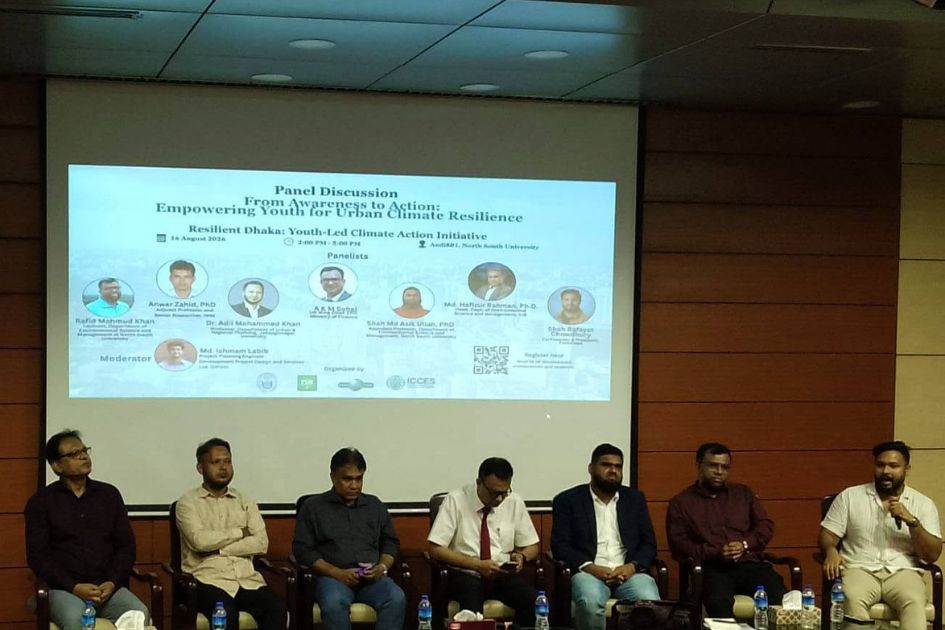



At the NSU seminar, experts stressed youth-led action on groundwater depletion, rainwater harvesting, sustainable water use and climate-resilient urban planning in Dhaka.
Young people must play a leading role in tackling Dhaka’s environmental and climate challenges, with greater emphasis on low-carbon infrastructure and the life-cycle carbon emissions associated with road and bridge construction, speakers said at a seminar in Bangladesh’s capital on Sunday.
They also called for greater youth involvement in addressing urban waste management problems, promoting nature-based solutions and expanding urban rainwater harvesting, stressing that young people should move beyond acquiring knowledge about environmental and climate issues to applying it in practice.
The remarks were made on Sunday afternoon, August 16, at a seminar titled “Resilient Dhaka: Youth-Led Climate Action Initiatives”, organized by the Institute of Climate Change, Environment and Sustainability (ICCES) at North South University (NSU), in collaboration with the NSU Earth Club and the university’s Department of Environmental Science and Management.
The event began with a panel discussion titled “From Awareness to Action: Empowering Youth in Urban Climate Resilience”, chaired by ICCES Chairman Engr. Sheikh Tajul Islam Tuhin.
Representatives from academia, professional bodies, government institutions and youth-focused social initiatives took part in the discussion, which focused on Dhaka’s climate vulnerabilities and the role of young people in addressing them.
The panel included Prof. Dr. Dipak Kumar Mitra, Dean of the School of Health and Life Sciences at North South University; Dr. Mohammad Sujauddin, Professor and Chairman of the Department of Environmental Science and Management at NSU; A. K. M. Sohel, Additional Secretary at Bangladesh’s Economic Relations Division; Dr. Anwar Zahid, Senior Researcher at the Institute of Water Modeling; Dr. Adil Mohammad Khan, Professor of Urban and Regional Planning at Jahangirnagar University and former President of the Bangladesh Institute of Planners; Md. Hafizur Rahman, PhD, Professor and Head of the Department of Environmental Science and Management at Independent University, Bangladesh; Shah Rafayat Chowdhury, Co-founder and President of Footsteps Bangladesh; Rafid Mahmud Khan, Lecturer in the Department of Environmental Science and Management at NSU; and Shah Md. Ashiq Ullah, PhD, Associate Professor in the Department of Environmental Science and Management at NSU.
Speakers highlighted the links between Dhaka’s geology, groundwater levels and environmental pressures. They stressed the urgency of addressing declining groundwater levels, promoting sustainable water use and enforcing existing policies effectively.
They also called for greater use of rainwater harvesting and urged urban planners to incorporate groundwater recharge into planning.
Speakers further urged young people to actively engage in addressing these environmental and climate challenges facing Dhaka.




