




“Catching the Wind: Why Bangladesh Still Fails to Harness Its Coastal Power?”
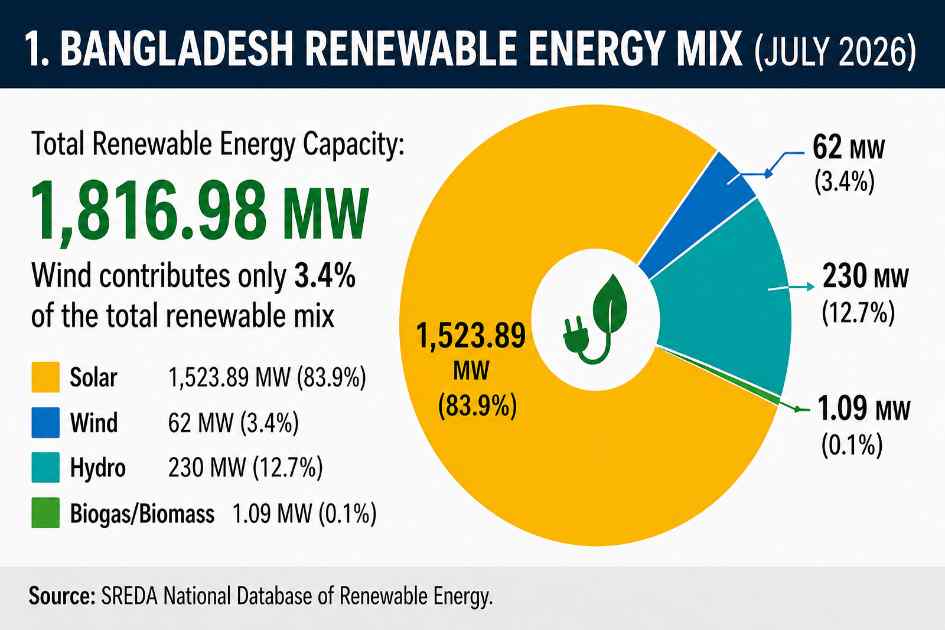
Bangladesh still has only 62 MW of installed wind capacity-3.4% of its renewable mix-even as official data point to a much larger project pipeline and a gross wind resource above 30 GW
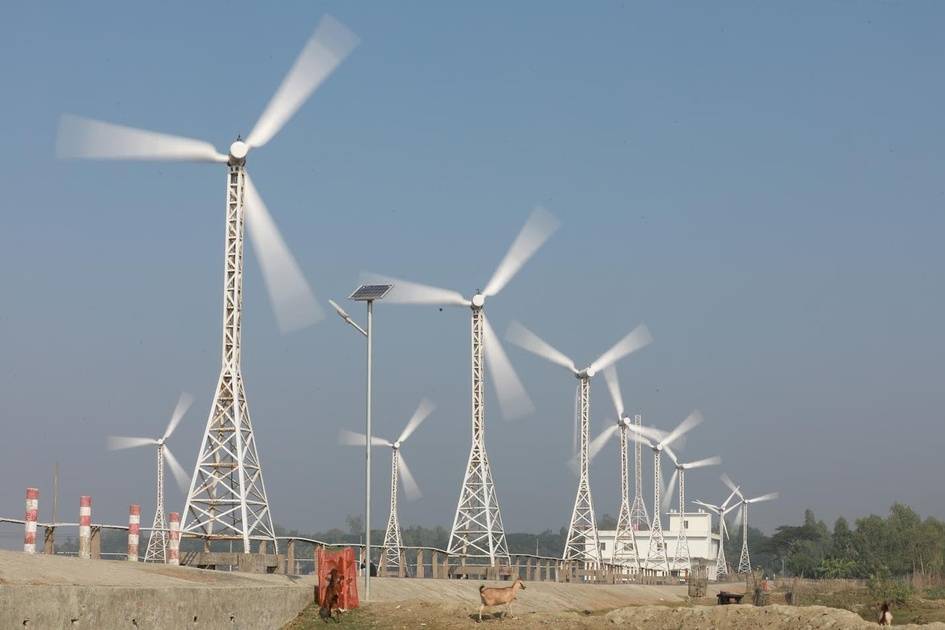
Abdul Haque sits cross-legged in the courtyard of his home in Chakaria, Cox’s Bazar, watching giant wind turbines turn slowly against the morning sky.
The fisherman and farmer has spent his life along Bangladesh’s southern coast, where cyclones and power cuts are both part of daily life. Yet seeing electricity generated from wind, not diesel or imported fuel, still feels extraordinary to him. “I couldn’t believe these huge fans could generate electricity just from wind,” he says, looking toward the towering turbines near his village. “The world has changed a lot.”
The nearby 60 MW Cox’s Bazar wind plant, commissioned in 2024, remains Bangladesh’s largest wind-energy project. But for Haque and millions of others in coastal Bangladesh, electricity supply can still be unreliable. “Sometimes there’s power, sometimes not,” he says. “It goes out for hours.”
Despite a long coastline and promising wind resources, Bangladesh remains one of South Asia’s weakest performers in wind development. Experts point to slow approvals, weak grid infrastructure, policy uncertainty, fossil-fuel dependence and financing pressure at a time of rising energy-security and climate risks.
SREDA’s (National Database of Renewable Energy) showed 1,816.98 MW of installed renewable capacity on 17 July 2026. Wind remained fixed at 62 MW, just 3.4% of the renewable mix.
Solar dominated with 1,523.89 MW, or 83.9%, while hydropower contributed 230 MW, or 12.7%. Biogas, biomass and other small sources together supplied about 1.1 MW.
BPDB’s broader national installed-generation tally reached 33,092 MW on 30 June 2026. On a simple capacity comparison, renewables equalled about 5.5% of that total and wind only 0.19%. The Renewable Energy Policy 2025 separately targets renewable supply equal to 20% of power demand by 2030 and 30% by 2040.
Vast Potential, Minimal Progress
The contrast between Bangladesh’s wind resource and its operating fleet remains stark.
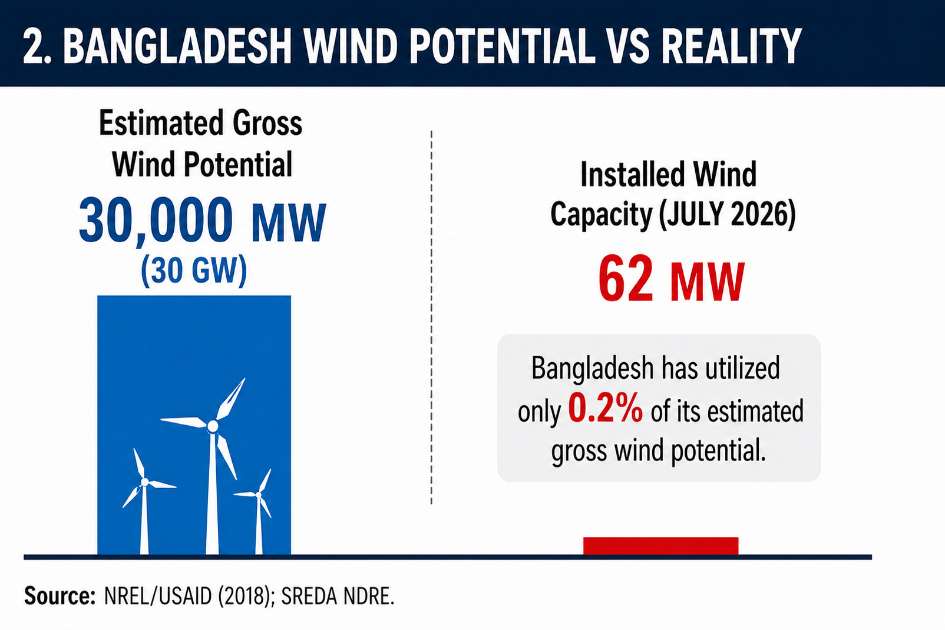
A USAID-funded 2018 assessment led by the US National Renewable Energy Laboratory identified more than 20,000 square kilometres with modelled wind speeds of 5.75–7.75 metres per second and a gross wind potential above 30,000 MW.
But the study explicitly warned that this was a preliminary gross estimate, not a developable forecast. It did not screen out built-up areas, environmentally sensitive land or sites unsuitable for other reasons. Detailed resource measurement, land and marine-use screening, grid studies and project economics are still required.
“There is huge potential for wind energy in the coastal region,” says M Zakir Hossain Khan, Co-founder and Chief Executive of Change Initiative a Dhaka based think-tank. “The government can easily move forward with at least 3,000 MW of wind power projects with foreign investment if transmission and substation facilities are ensured.”
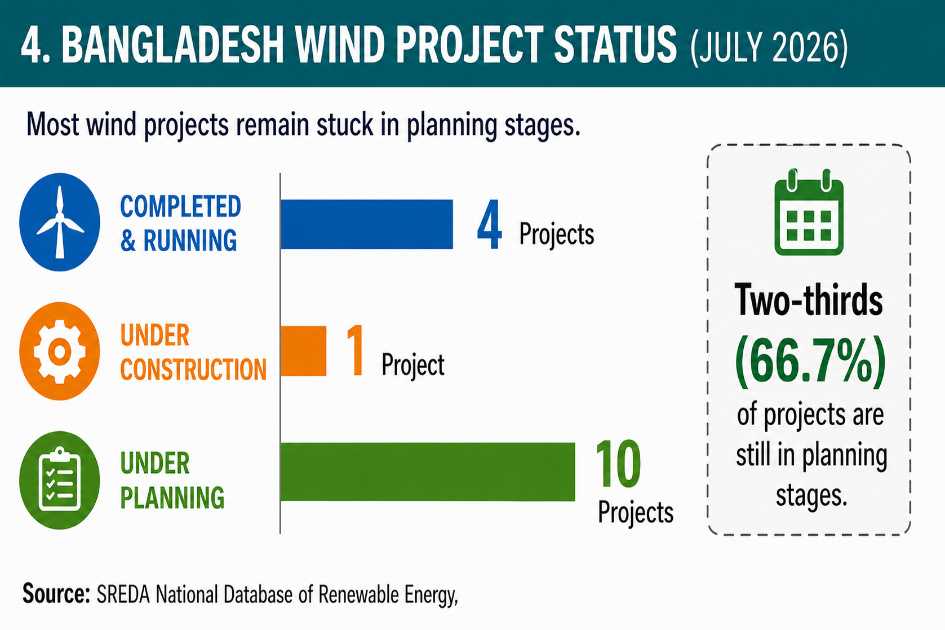
SREDA’s current wind-project registry lists 15 projects with a combined capacity of 779.9 MWp:
· Four projects are completed and running
· One project is under construction
· Ten projects remain under planning
That means two-thirds of the listed projects are still at the planning stage. The gap is no longer a lack of proposals; it is the slow conversion of proposals into financed, grid-connected generation.
The 60 MW Cox’s Bazar plant accounts for almost all operating wind capacity. SREDA now lists the long-delayed 2 MW Sirajganj wind plant among completed and running projects.
Even after those additions, Bangladesh’s installed wind fleet remains 62 MW and has not moved beyond 3.4% of the renewable mix.
Compared with NREL’s gross estimate of more than 30,000 MW, the installed fleet represents only about 0.2%, a useful illustration of the gap, provided the estimate’s land-screening caveat is kept in view.
Energy Security Crisis Deepens
Bangladesh’s slow renewable transition comes amid intensifying concern over fossil-fuel dependence, high power costs and exposure to global supply disruptions.
A May 2026 report by the Institute for Energy Economics and Financial Analysis, Fostering Bangladesh’s Energy Transition, argues that the country’s fuel import dependence and structural inefficiencies are placing increasing pressure on public finances.
Renewables contribute about 2.3% of Bangladesh’s grid-based electricity generation, the report says, compared with a global average of around 33.8%. This generation share is different from the 5.5% capacity comparison above because renewable plants do not produce at full nameplate capacity all the time.
Bangladesh’s dependence on imported primary energy rose from 47.7% in FY2020–21 to 62.5% in FY2024–25, increasing its exposure to geopolitical shocks, shipping disruption and foreign-currency pressure.
IEEFA estimates that average power-generation costs rose by 83% over the same four-year period, driven by imported fuel prices and currency depreciation, as well as capacity payments and expensive peaking plants.
The report calculates average capacity payments in FY2024–25 at about Tk9.5 per kilowatt-hour for private oil-fired plants and Tk5.9 per kilowatt-hour for private coal-fired plants, substantially increasing overall costs.
It also estimates that Bangladesh’s reserve margin reached 61.3% in FY2024–25, leaving the state paying for capacity that could not always be used because of weak demand growth, fuel shortages and system constraints.
Oil-fired generation still supplied 10.7% of electricity, far above the shares reported for India, Pakistan and Vietnam, creating a clear opportunity for renewables to displace costly daytime generation.
The risks became more immediate in 2026 as conflict in the Middle East disrupted fuel markets and renewed pressure on Bangladesh to diversify its energy supply.
In May, BPDB floated tenders for 10 grid-connected solar projects totaling 495 MW near existing substations. Bids were due on 28 June. The move signaled new urgency on renewables, but it did not include a comparable near-term wind procurement programme.
IEEFA’s May report modelled a severe LNG-cost scenario: if Bangladesh had imported the same April–June volume as in 2025 at a spot price near US$20 per million British thermal units, the subsidy requirement could have reached about US$1.07 billion. The figure was a conditional estimate, not a final audited bill.
“With Bangladesh ranked among the world’s most climate-vulnerable countries, delaying renewable expansion carries serious economic risks,” says Hasan Mehedi, chief executive of environmental organisation CLEAN.
Offshore Wind Remains an Early-Stage Frontier
Bangladesh is still trying to enter the offshore wind sector for the first time.
A proposed 500 MW project off Cox’s Bazar, led by Copenhagen Infrastructure Partners with partners including Copenhagen Offshore Partners and Summit Group, remains the country’s most ambitious wind proposal.
The consortium submitted its investment proposal in July 2023. In November 2023, the government gave an in-principal nod for a detailed feasibility study and the first phase of development, with site exclusivity for three years. That was an early-development approval, not a construction go-ahead.
As of July 2026, the project is still described by its backers as being in early-stage development. If development succeeds, operations are expected to begin in 2030.
At roughly eight times Bangladesh’s current installed wind fleet, the project could transform the sector. It could also provide a test of whether the country can move from resource assessment to a bankable, permitted and grid-connected offshore project.
Before construction can proceed, developers still need detailed wind measurements, seabed and environmental studies, a viable grid connection, financing and long-term commercial arrangements.
Barriers to the Breeze
Despite renewed interest, the constraints remain substantial.
Bangladesh’s coastal geography exposes turbines and electrical equipment to cyclones, salt corrosion, flooding and difficult maintenance conditions. Offshore development also requires suitable ports, vessels and supply-chain capacity.
These challenges do not make wind impossible, but they raise the importance of site-specific engineering standards, long-term wind data, transparent environmental review and realistic cost assumptions before projects are tendered.
The national grid also needs stronger transmission links, substations, forecasting and system flexibility to absorb larger volumes of variable renewable power.
Transmission bottlenecks, ageing equipment and limited storage can delay connections or force operators to curtail output even after a renewable project is built.
IEEFA calls for technical grid losses to fall to about 8% by 2030 and 6% by 2035, alongside efficiency improvements and investment in grid reliability and flexibility. “Bureaucratic complexity is one of the biggest obstacles,” says Mehedi. “Projects move slowly because approvals, permits and institutional coordination remain weak.”
Financing remains another major challenge. Offshore wind is especially capital-intensive and cannot be priced credibly without bankable resource data, seabed studies, a clear permitting route and a long-term power-purchase framework.
Analysts say Bangladesh needs predictable tariffs, payment security, transparent procurement and access to concessional or blended finance to bring both onshore and offshore projects to financial close.
IEEFA also recommends reducing or waiving high import duties on distributed renewable-energy systems. It estimates that 100 MW of rooftop solar could save more than 30 times the one-off duties over the systems’ lifetime by reducing furnace-oil imports. “To attract investment, Bangladesh must provide long-term policy certainty,” says Anjal Prakash, professor at the Indian School of Business and a lead author for the Intergovernmental Panel on Climate Change. “Investors need confidence that policies, tariffs and approvals will remain stable over time.”
Falling Behind South Asia
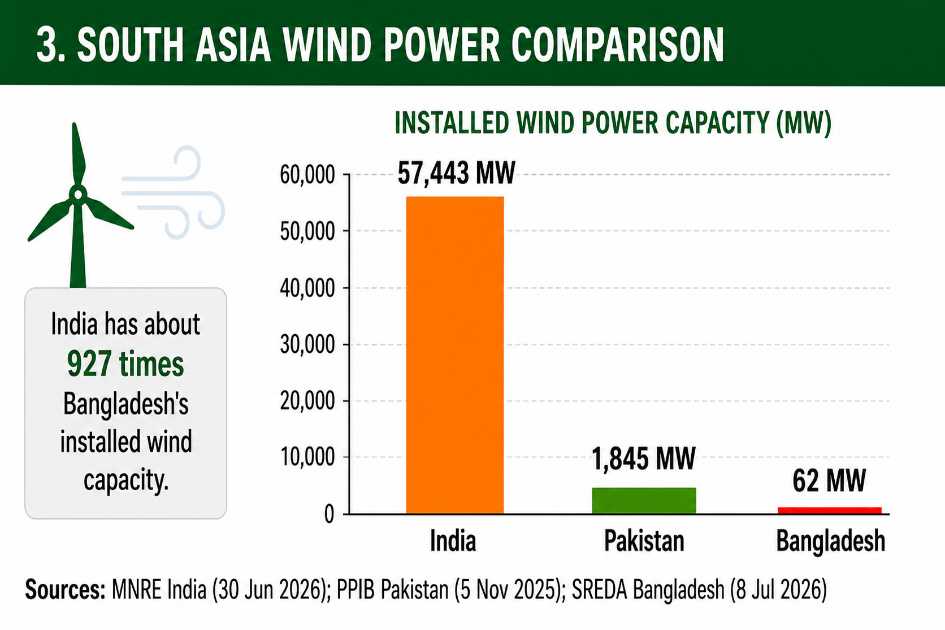
While Bangladesh remains at 62 MW of installed wind capacity, neighbouring countries have built far larger fleets.
India’s Ministry of New and Renewable Energy reported 57,443.39 MW of installed wind capacity on 30 June 2026, up from about 48 GW cited in earlier comparisons.
Pakistan’s Private Power and Infrastructure Board listed 1,845.47 MW of operational wind capacity on 5 November 2025.
India therefore has about 927 times Bangladesh’s installed wind capacity, while Pakistan has nearly 30 times as much. The comparison is about installed capacity, not electricity generated in a particular year.
“India expanded wind power through feed-in tariffs, concessional loans and strong public incentives,” says climate activist Harjeet Singh, founding director of Satat Sampada Climate Foundation. “Bangladesh needs targeted policies specifically designed for wind energy, not just broad renewable ambitions.”
Regional electricity trade could complement, not replace, faster development of domestic wind and solar resources.
IEEFA estimates that importing a combined 6,000 MW of hydropower from Nepal and Bhutan during the high-demand March–September period after 2030 could reduce Bangladesh’s annual gas consumption by as much as 257 billion cubic feet.
A Narrow Window
For coastal communities already experiencing rising temperatures, cyclones, saline intrusion and unreliable electricity, the stakes are growing higher.
Unless Bangladesh converts more of its wind pipeline into operating plants, it risks remaining trapped in costly fossil-fuel dependence while falling behind the 2025 policy targets of 20% renewable power demand by 2030 and 30% by 2040.
IEEFA recommends expanding domestic solar and wind, modernising the grid, reducing oil-fired generation, improving efficiency, containing system losses and strengthening regional energy cooperation.
Shafiqul Alam, IEEFA’s lead energy analyst for Bangladesh, says the solutions lie closer to home: scale up domestic renewables while limiting new fossil-fuel capacity that would deepen overcapacity.
“Without urgent reforms and grid investment, Bangladesh risks missing both its energy security and climate targets,” says Zakir Hossain Khan.
For Abdul Haque in Chakaria, the turbines above the coastline represent more than technology.
They represent a possibility Bangladesh has mapped, proposed and discussed, but has yet to build at meaningful scale.




