




Coastal salinity is reshaping women’s health, labour and household survival, exposing how climate change, shrimp farming and policy failures leave reproductive risks and unpaid water work outside national planning.
When we think of disaster, we usually picture something sudden. A cyclone bearing down, a tidal surge, a flood. These things happen in front of our eyes and make headlines. Relief trucks arrive, allocations get announced, parliament debates it. But along the southwest coast of Bangladesh, a different kind of disaster has been unfolding, one with no dramatic entrance, no single date anyone can point to and say this is when it started. The environmentalist Rob Nixon called this slow violence, a form of destruction that plays out over years, almost invisibly, and is therefore easy to overlook. The people bearing the brunt of this slow violence are coastal women. Salinity is quietly, destructively consuming their lives.
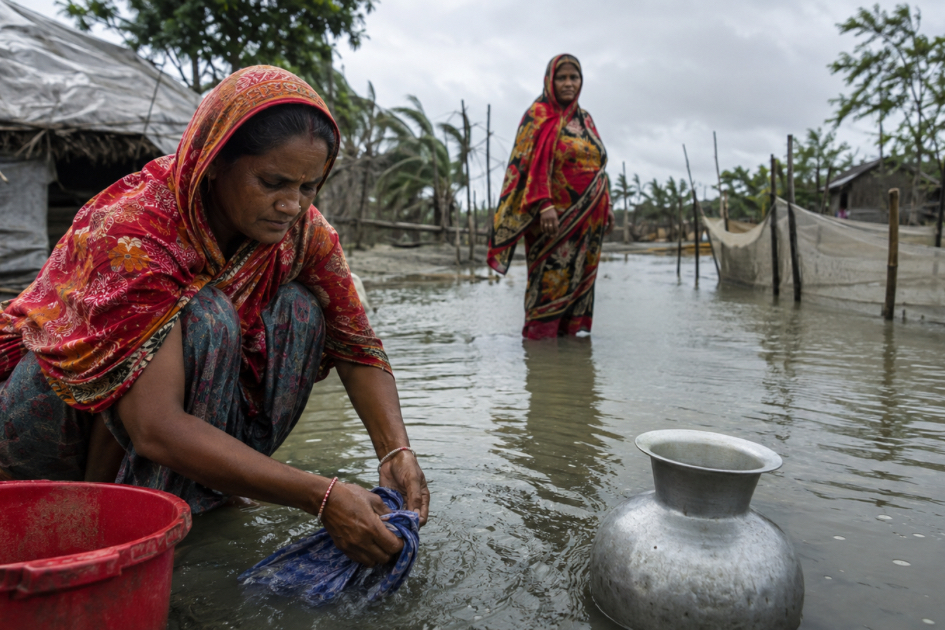
With freshwater in such short supply, women are forced to wash menstrual cloths in dirty, saline water. Sanitary pads are alarmingly hard to find and even harder to afford. Many women also wade into saline river water with nets to catch fish fry for a living. These unhygienic conditions are giving rise to a range of gynecological illnesses. Urinary tract infections have become an everyday occurrence in nearly every household. Most alarming of all, chronic infections are forcing many women into hysterectomies. Investigations found that nearly 10 percent of all surgeries performed annually at the Shyamnagar hospital are related to uterine conditions, and most of them end in the removal of the uterus. A large share of these women are young, many losing their uterus before they even turn thirty. To cover the cost of surgery, many families end up selling their fishing boats, since a single operation can cost hundreds of times a family’s daily income.
Pregnancy complications make things even worse. Drinking and using saline water for daily chores is sharply raising the risk of high blood pressure among pregnant women. A study published in the Journal of Migration and Health in 2024 surveyed two upazilas along the southwest coast and found that more than half the women reported infections or inflammation of the vagina, uterus or ovaries. Another study conducted in Dacope upazila in Khulna found that as sodium levels in water rise, so does the risk of pre-eclampsia and hypertension, with women drinking the most saline water facing up to five and a half times the risk. This is driving up rates of maternal death and premature birth. On top of that, spending long hours working in saline water every day has made skin disease an inseparable part of women’s daily lives. They carry the marks of this slow violence on every part of their bodies.
The task of fetching drinking water for the household falls on women. To bring home a single pitcher of water, a woman may have to walk anywhere from two to five kilometers a day, on average. Covering that distance and standing in line for hours at a time is creating a brutal kind of time poverty. The hours spent solely on fetching water could have gone toward a woman’s education, her income, or simply her rest. Instead, the cruelty of both nature and the systems around her strips her of that right. On top of this comes male migration. With farming no longer profitable, men are leaving for the cities in search of work, leaving the entire burden of running the household, raising children and meeting basic needs like water squarely on women’s shoulders alone. This labor is never given any economic value by society.
What is most disheartening is that a crisis this large barely registers in national conversation. Deep taboos still surround menstrual and reproductive health in our society. Women hesitate to speak publicly about these intensely personal struggles with their own bodies. This social taboo has kept the crisis nearly invisible, which means it never gets counted as a serious issue in state records. The lack of adequate data or statistics is itself strong evidence of this silence.
That is not to say there is no policy effort at all. Under the Delta Plan 2100, there is talk of a mega project to increase river navigability and redirect freshwater flow to the south. Salt-tolerant rice varieties have also been developed, offering some relief for farming. But at the center of these projects sit crops and infrastructure, not women’s health. There are indices for measuring soil salinity, plans for river navigability, yet no national index exists for how much risk a woman’s uterus is under, or how many hours of her day disappear into fetching water.
It would be too easy to blame this crisis on climate change alone. It is well known by now how unplanned shrimp farming, which began along the coast in the 1970s, has destroyed local ecosystems. What was once called white gold has turned into a curse for coastal communities. The practice of deliberately cutting embankments to let in saline water for shrimp enclosures, chasing higher profits, has accelerated the spread of salinity many times over. Ordinary women are the direct casualties of this profit driven structure.
Then there is the failure of the polder system built in the 1960s. These structures disrupted the natural flow of rivers, and today they are one of the leading causes of waterlogging and rising salinity. Rising sea levels from climate change combined with these man-made policy failures have created a double disaster.
This disaster does not strike everyone equally. There are clear lines of class and caste running through it. Looking at the most marginalized groups, Dalit women and women working as sanitation workers are the most exposed of all. They cannot afford alternative water sources, and they have almost no social access to healthcare. They are harmed by climate change on one hand, and pushed further into deprivation by caste and economic inequality on the other.
Every moment of daily life for coastal women is now under the grip of salinity. And yet there is a severe shortage of the research and funding needed to address this crisis. In the mega projects designed to tackle climate change, women’s reproductive health and the burden of time poverty remain an afterthought. How much longer are we going to keep treating this silent devastation as normal?
The writer is an environmental writer focusing on climate change and environmental justice in Bangladesh.




