

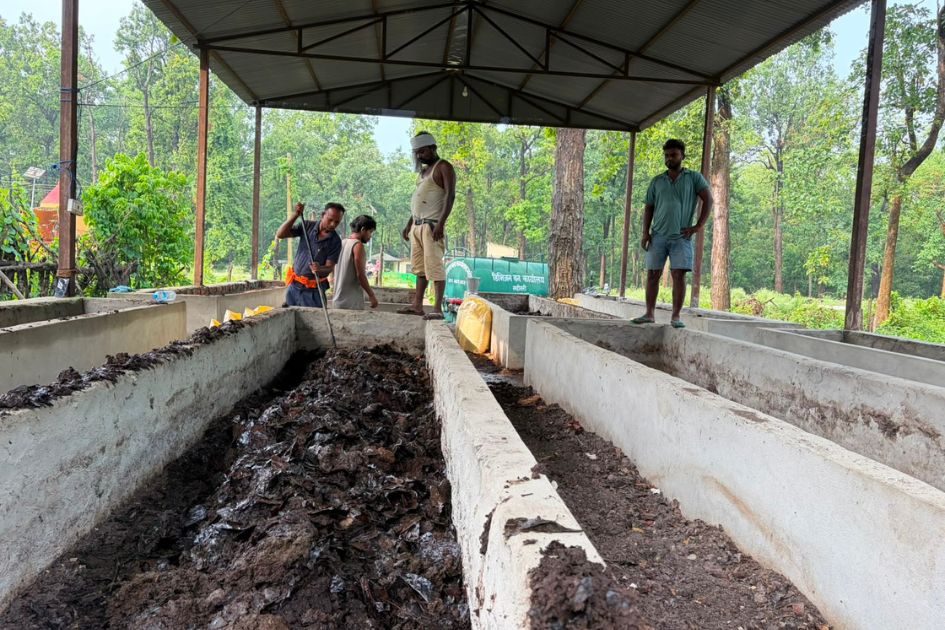



Nepalese forest communities are turning fallen leaves into organic compost, helping curb forest fires, create jobs, improve soil health and reduce reliance on chemical fertilisers.
Every year, Nepal faces forest fires. From January onward, fires begin to appear in forest areas and intensify, spreading upstream between March and May. Controlled burning is not inherently harmful. It is a natural process needed by ecosystems. However, Nepal is facing uncontrolled forest fires every year and their severity is increasing. This is a major concern because forest fires not only burn forest fuel deposits but also destroy biodiversity and emit various gases. They likewise reduce soil productivity and cause other forms of damage.
In this article, some nature-based solution examples are discussed in which forest fires have been controlled through community initiatives. One example is Mahottari District in eastern Nepal, located 200 kilometres south of Kathmandu, the capital of Nepal.
The Tuteshwornath Collaborative Forest Management (CFM) is located in Ward 5 of Bardibas Municipality in Mahottari District. Covering parts of 37 wards across nine local governments, the forest serves around 600 households and is rich in valuable sal trees.
The Tuteshwornath Collaborative Forest Management (CFM) started collecting fallen leaves from forests to produce organic compost fertilizer. The initiative is expected to reduce the use of chemical fertilizers, lower the risk of forest fires and help protect biodiversity. With financial support of NPR 1.6 million from the Forests for Prosperity Project of the REDD Implementation Center, the group has started turning forest leaves that would otherwise rot on the forest floor into compost. This is the first such initiative in the partnership forest. The group has already produced 40 quintals of organic fertilizer and plans to increase production based on farmers’ demand.
For many years, local communities have managed the forest through tree planting, forest fire prevention and efforts to stop illegal logging. They also use forest products such as firewood, grass and leaves in a controlled and sustainable way.
The forest user group added a new activity: producing organic fertilizer from fallen leaves.
Due to the initiative of the Binayi Community Forest Users Group in Nawalpur, forest fires have been controlled in their area for 10 years. In the beginning, the community decided to clear bushes to control wildlife attacks because two people had already lost their lives due to tiger attacks.
This incentive created a good example of forest fire control and income generation for the community. In the beginning, they produced 6,000 kg of organic fertilizer. This year, they sold 50 tons at NPR 25 per kilogram. According to them, more than 10 people have obtained full-time jobs.
Nepal’s forests cover 46% of the total land area. If this type of initiative is adopted more widely, it could improve forest fire control as well as create job opportunities at the local level. The idea and implementation differ between the two forest user groups.
The Tuteshwornath Collaborative Forest Management (CFM) makes compost. Fallen leaves are collected from the forest and stored in a deep pit for about one month. The leaves are watered every morning and evening until they begin to decompose. The compost pit is then filled in layers. First, about four inches of cattle manure is added, followed by four inches of decomposed leaves. These layers are repeated until the pit is full. Finally, a layer of earthworms is placed on top. The earthworms gradually feed on the decomposed leaves and turn them into nutrient-rich compost.
The process takes about three to four months and the finished fertilizer is sold for NPR 40 per kilogram. It has contributed to the environment. According to the experience of the Collaborative Forest Management Committee, forest fires were controlled this year in areas where fallen leaves had been collected.
Using forest leaves to make compost has many advantages. Organic fertilizer improves soil fertility, increases the soil’s ability to retain water and makes the soil softer. It slowly releases nutrients, helping crops grow healthier and stronger.
It also supports beneficial microorganisms in the soil and reduces the harmful effects of excessive chemical fertilizer use. Organic fertilizer helps reduce pollution, promotes sustainable farming and maintains soil quality for the long term.
The compost also supports organic farming, which avoids chemical fertilizers and pesticides. Organic crops are considered healthier and safer for consumers and often receive higher prices in the market. Organic farming also helps protect the environment and preserves fertile land for future generations.
Reducing Health Risks
Many studies have shown that the excessive and improper use of chemical fertilizers and pesticides can leave harmful chemical residues on fruits, vegetables and other food products. Long-term consumption of food containing these residues may increase the risk of cancer, hormone disorders, nervous system problems, reproductive health issues and developmental problems in children.
The World Health Organization (WHO) and the Food and Agriculture Organization of the United Nations (FAO) recommend using pesticides carefully, following approved application rates and waiting periods and regularly testing food for chemical residues. Experts also encourage integrated pest management, organic farming and other safe agricultural practices to protect both human health and the environment. Collecting fallen leaves, dead branches and dry wood also helps keep forests clean. It creates better conditions for young plants to grow and reduces the amount of dry material that can fuel forest fires during the dry season. As a result, forests, wildlife, medicinal plants and biodiversity are better protected.
The compost facility can produce 40 quintals of organic fertilizer every three months, or about 160 quintals each year. The forest user group plans to establish five to six additional compost production sites, creating more local jobs while reducing the demand for imported chemical fertilizers.
Local farmer Ramji Mahato, who has been using only organic fertilizer on his farm, says his crop yields have increased and the quality of his soil has improved. He hopes to use organic fertilizer on all of his farmland but says current production is not enough to meet demand. Many other farmers share the same view, showing that demand for organic fertilizer is growing rapidly.
The compost plant, built with NPR 1.2 million in support from the Forests for Prosperity Project in Gaushala Municipality, Mahottari District, has become a successful model that could be expanded to other parts of Nepal.
Producing organic fertilizer from forest waste not only supports healthy soil and healthier food but also creates local employment, reduces forest fire risks and helps replace imported chemical fertilizers. It is a practical step toward sustainable agriculture, environmental conservation and a greener future.
Samjhana Wagle Bhattarai is a PhD researcher at Tribhuvan University and a faculty member at Kathmandu University. She also has over a decade of experience as a GESI expert as well as a writer.




