




Household seed stores in Satkhira are helping families recover after floods, but farmers and researchers say quality control, backups and public support are needed to build resilience under salinity.
In Bangladesh’s saline southwest, farmers are using household seed stores to restart after floods. The challenge is to turn scattered collections into a reliable public adaptation system.
Ten seeds in salty soil
Amena Begum measures agricultural risk in handfuls. In the small containers kept inside her home in Tengrahali, Shyamnagar, are seeds selected from crops she has watched grow in a difficult coastal field. She knows where they came from, how they were dried, and what happened in the previous season. That history matters in a place where salinity can turn a normal planting decision into a wager.
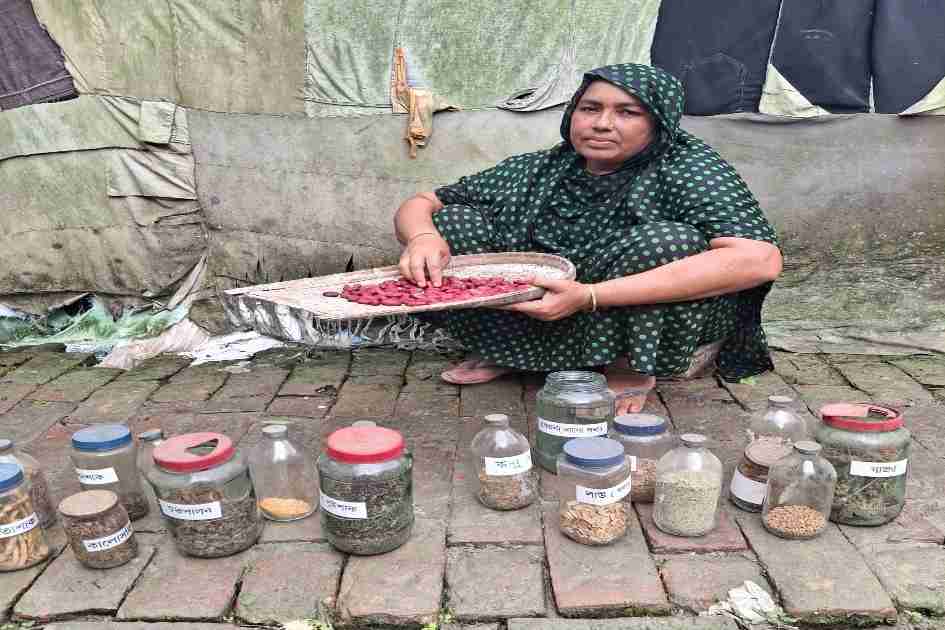
Photo: Courtesy
‘This is a salty area,’ she said, speaking in the regional dialect of southwest Bangladesh. ‘It is very difficult for seed to sprout here.’ In her experience, nearly all ten home-saved seeds may emerge, while only four of ten bought from the market sometimes germinate, and some seedlings do not survive. This is Amena’s observation rather than a laboratory comparison. It points to two possible advantages that are easy to confuse: adaptation to local conditions and confidence in seed quality.
A packet from a market is not automatically unsuitable. Seed saved at home is not automatically strong. Age, moisture, storage temperature, disease and counterfeit labelling can decide whether either seed lot succeeds. But the contrast tells us why coastal households value control. A seed source that can be inspected, remembered and reproduced at home reduces dependence on cash and transport at precisely the time both may be scarce.
“I trust that my seed will not be wasted. When I put it into the soil, I know what I am planting”, said Amena Begum from Tengrahali village of Shyamnagar.
The crop was ready to flower. Then the water came
One season, Amena had planted her vegetables and the crop was close to flowering. Floodwater covered the field and rose to within a few inches of her veranda. Everything in the plot was lost. The disaster removed food and the prospect of income, but it did not remove the seed stored inside the house. After the water withdrew, Amena sowed again and shared seed with neighbours.
A household seed store cannot stop a cyclone or repair a broken embankment. It can change the first decision after a shock. Instead of waiting for a trader, a relief package or borrowed cash, a family can begin again with material already in its possession. In disaster management language, that is a reduction in recovery time. In Amena’s language, it is the difference between an empty plot and another crop.
The southwest coast faces several problems at once. Saline water can enter through tidal surges, damaged polders, brackish aquaculture, and dry-season river conditions. Drainage congestion leaves land waterlogged. River erosion and cyclones repeatedly damage homes and fields. A World Bank analysis of salinity in coastal Bangladesh projected a substantial rice-yield penalty in the most affected upazilas, while a later World Bank study of climate and welfare on the coast described how Cyclone Aila pushed salinity beyond crop tolerance in parts of Satkhira.
Those studies describe regional risk, not the fate of every field. Salinity varies across seasons and even within a village. That is precisely why variety choice matters. A crop that survives moderate salt, matures before freshwater runs out or tolerates short waterlogging may offer a household a margin that a poorly matched variety does not.
The food-security warning has moved forward
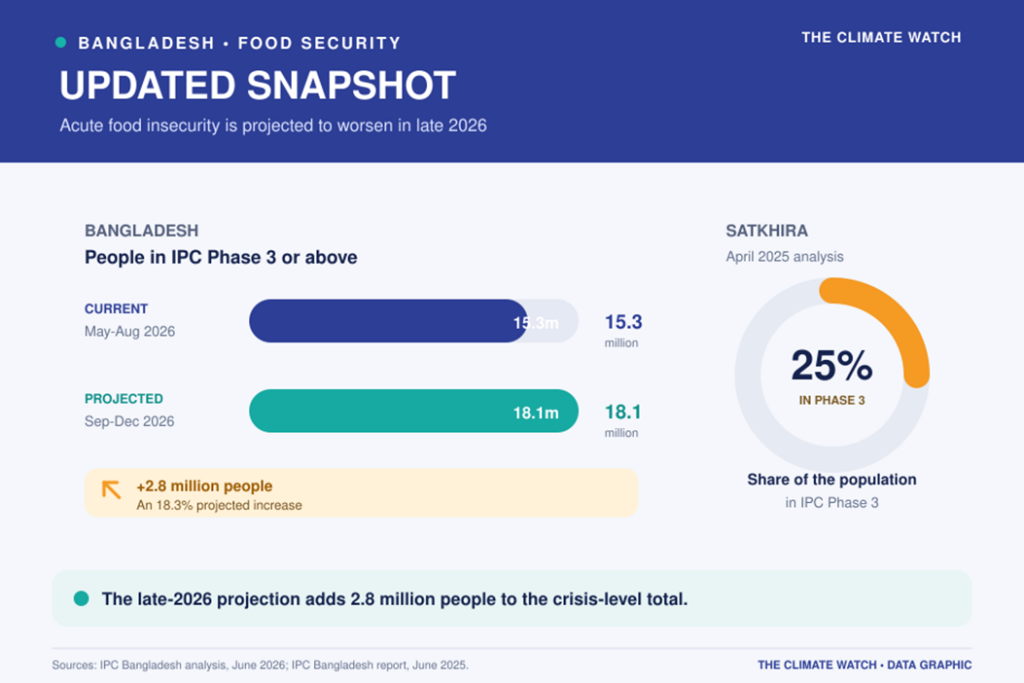
The original Bangla draft cited a 2025 food-security report, but the publication date and context needed correction. The IPC analysis published on 4 June 2025 estimated that about 16 million people, 17 percent of the population analysed, would face Crisis or worse acute food insecurity between May and December of that year. Its April snapshot classified Satkhira in IPC Phase 3, Crisis, and estimated that roughly one in four people in the district was in Phase 3.
The latest national picture is different but no less serious. IPC’s analysis released on 30 June 2026 estimated that 15.3 million people, 15 percent of the population covered, were in Phase 3 or above from May through August. It projected 18.1 million people, 18 percent, in Phase 3 or above from September through December, including 787,000 in Phase 4, Emergency. The figures cover analysed districts and special areas, so they should not be read as a census of every Bangladeshi household.
The recommendations are as important as the headline. IPC called for urgent food and nutrition assistance, but also for stress-tolerant varieties, homestead gardening, stronger markets, repaired waterways and embankments, animal-health support, disaster preparedness and social protection that expands when shocks arrive. Seed appears in that list as one component of a larger system.
That distinction matters for journalism. Food security is not simply whether food exists in a district. It includes whether a household can obtain it, afford it, prepare it safely, absorb its nutrients and continue to do so when prices rise or a cyclone hits. A jar of seed helps with availability, stability and control. It cannot on its own solve poverty, unsafe drinking water, disease or debt.
Sources: IPC’s June 2026 Bangladesh analysis and the IPC’s June 2025 Bangladesh report.
A living library of 164 kinds of rice
In West Kaikhali village, Habibur Rahman has taken the household seed store to another scale. He says he conserves 164 local rice varieties; exchanges seed and encourages neighbours to keep their own. The figure comes from his collection, as reported to The Climate Watch‘s contributor. A scientific inventory would still need to record names, origins and traits, and it might find that some names refer to the same genetic material. What is already visible is the depth of local stewardship.
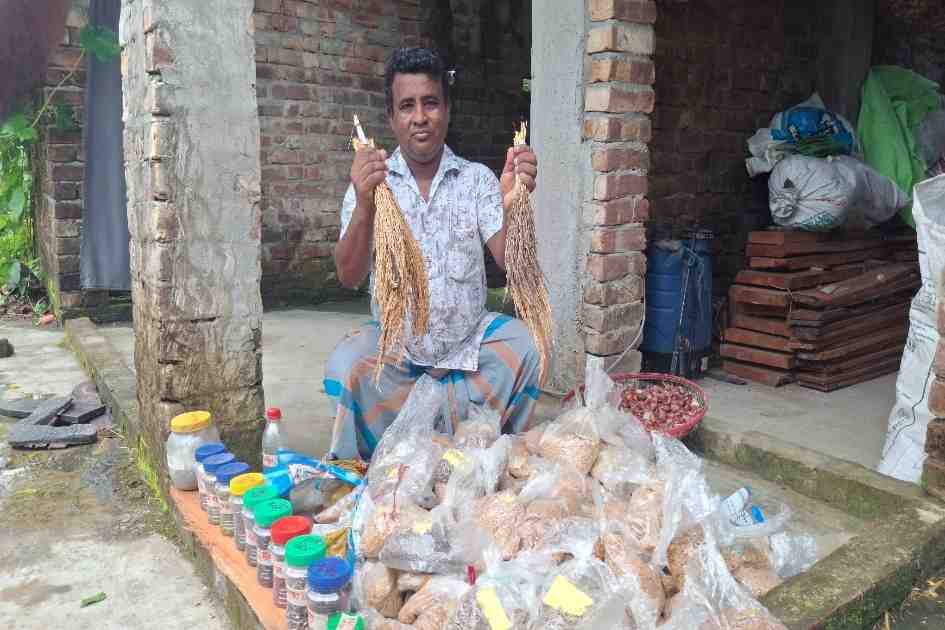
Habibur calls the varieties ‘mother seed’. The phrase is both emotional and technical. Seed creates the next crop, but diverse rice also carries parental traits that breeders can use. The Food and Agriculture Organization’s plant genetic resources programme says crop diversity underpins the capacity of farming systems to cope with environmental and economic change. It warns that the replacement of many locally adapted varieties by a narrow range of modern ones can cause genetic erosion.
A farmer collection is therefore more than a museum. Because seed is planted and selected, the population remains connected to real fields and farmer preferences. A cook may keep a variety for flavour. A household may value straw for livestock. An early rice can escape a late drought. Another may tolerate temporary flooding. These traits may not appear in a yield statistic, but they can decide whether a variety remains useful.
On-farm conservation also carries risk. A cyclone can destroy an entire store. Insects, mould and poor regeneration can quietly erase viability. The best protection is layered: keep seed in farmers’ fields, maintain community backups and place safety duplicates in public gene banks. The Kunming-Montreal Global Biodiversity Framework calls for both in-situ and ex-situ action to maintain genetic diversity in domesticated species. Bangladesh’s own national biodiversity targets have also recognised the need to strengthen facilities for conserving cultivated-plant diversity.
Not a miracle seed
The strongest argument for local varieties is not that all of them outperform every improved seed. They do not. Some yield less. Some lodge in storms, mature too late or carry disease. Local does not mean genetically uniform, and a familiar name does not guarantee high germination. The value lies in a portfolio of traits and in the knowledge that tells farmers where each variety fits.
Dr Md Babul Akhtar told the reporter that salinity and waterlogging are among the central constraints in Satkhira. The draft identified him as a principal scientific officer, while the current BINA officers list lists him as chief scientific officer and head of Crop Physiology. He said local varieties often have lower yield but may have strong tolerance because they have persisted under difficult conditions. Breeders can cross that material with productive lines and select offspring that combine resilience and yield.
This is already how public breeding works. The Bangladesh Rice Research Institute publishes information on salt-tolerant releases for coastal farmers. The International Rice Research Institute explains how salt-tolerance genes are screened and moved into breeding lines. A local landrace, a public improved line, and a modern genetic tool are not opposing camps. They can be parts of one chain.
That chain needs evidence. Farmers can identify unusual survivors after a saline flood, but a promising observation should lead to replicated trials. Researchers need to compare yield, maturity, salt response, grain quality and disease over several locations and seasons. Negative results should remain visible. A variety useful under moderate salinity may fail under severe salinity and still be valuable when its limits are clear.
The hybrid argument needs a correction
Habibur worries that hybrid seed makes farmers return to companies with cash every season. The concern about recurring cost is real, but one widespread explanation is technically wrong. Seed harvested from an F1 hybrid can germinate. The problem is that its offspring may segregate, producing uneven plants and losing the yield, timing or quality of the purchased hybrid. Farmers usually buy fresh F1 seed when they want the same uniform performance. The FAO handbook on seed in emergencies distinguishes this specialised hybrid production from the saving of non-hybrid cultivars.
Public improved varieties released by institutes such as BRRI, BARI and BINA are often non-hybrid. Farmers can generally save seed from self-pollinated, non-hybrid crops if they maintain purity, remove diseased plants, dry the seed and store it safely. They may still need to renew the stock when germination or varietal quality declines.
The practical question is choice, not ideology. A hybrid may be worth buying when it delivers an advantage that covers its cost. A local variety may be best when it is reliable, culturally valued and easily saved. A public variety may combine stress tolerance with a predictable seed system. Farmers need honest labels, protection from counterfeit seed and advice that explains the trade-offs.
There is also a rights dimension. The International Treaty on Plant Genetic Resources for Food and Agriculture recognises Farmers’ Rights, including the space to save, use and exchange farm-saved seed subject to national law. Bangladesh ratified the treaty in 2003, and it entered into force in 2004. Protecting farmer knowledge should sit alongside seed quality and biosafety, not be used as a reason to abandon them.
The women behind the seed network
Amena is not alone. In Dhumghat, Alpona Rani has created a household collection of local crop seed. She says the varieties she maintains perform better than many market options under local stress. Like Amena’s germination comparison, this is testimony. Its significance is practical: a collection becomes community infrastructure when seed and experience move to another household.
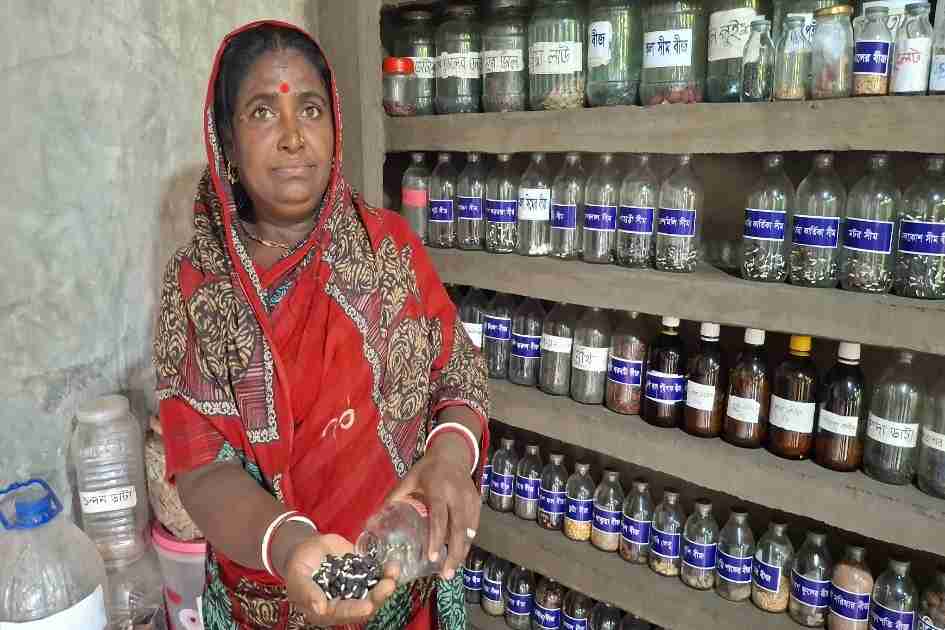
The labour behind that movement is often invisible. Someone selects plants, separates varieties, dries seed, checks for insects, finds containers, remembers names and keeps enough grain out of the cooking pot for the next season. Women frequently do much of this work while having less access to land titles, agricultural training and committee decisions.
The FAO study of community seed banks describes their potential to conserve adapted varieties, maintain reserves and improve local access. But a bank is more than a room full of jars. It needs a register, germination tests, regeneration plots, distribution rules and backups. It also needs governance that does not take women’s knowledge while giving authority to someone else.
A serious programme would pay women for technical roles, schedule training around their workloads, make them signatories to collection records and ensure they help decide which seed is shared with breeders. If farmer material contributes to a released crop, origin and knowledge should be credited and benefits returned in a form the community values.
Soil does not read labels
Alpona told the reporter that she uses organic fertiliser and biological pest control with her local seed. In Shibpur village of Tala, Morol Abdul Malek has established a large organic fertiliser farm and wants government support to put more soil-building material in farmers’ hands. Their emphasis on soil health is well placed. The FAO guidance on soil organic carbon links soil organic matter with structure, nutrient cycling and water-holding capacity.
The source draft said nitrous oxide has almost 300 times the warming power of carbon dioxide. A newer FAO and UNEP assessment uses approximately 270 times over a 100-year period. The gas is still a major climate concern. It is emitted when microbes transform nitrogen in soils, particularly after nitrogen is supplied through synthetic fertiliser or manure. Bangladesh’s updated nationally determined contribution includes agricultural nitrous oxide in national emissions accounting.
This is not a clean contest between chemical and organic. Compost and manure can build soil, but they can also lose nitrogen as nitrous oxide. Poorly managed manure can emit methane. Synthetic fertiliser can cause large losses when overapplied, but a carefully measured amount may be needed to meet a crop’s nutrient demand. Soil does not respond to the moral reputation of a bag. It responds to nutrients, carbon, moisture, timing and biology.
The more defensible approach is integrated soil fertility management: test the soil, recycle crop residues where safe, use legumes, apply mature compost or manure at appropriate rates, and add mineral nutrients when needed. The climate principle is the right source, right rate, right time and right place. The food-safety principle is equally specific: use clean water, treat manure, monitor pesticides, observe pre-harvest intervals and protect produce during storage.
Local varieties can sometimes perform acceptably with fewer purchased inputs, but they do not automatically require none. Pest pressure, soil condition and yield goals differ. The Climate Watch can preserve Alpona’s experience as evidence of a workable farm practice without converting it into a universal promise.
What a public seed-resilience system would look like
The household collections in Shyamnagar suggest a public programme, but not a programme that begins by taking seed away. It should begin with consent and documentation led by custodians. Each variety needs a local name, source, crop description, planting season, known stress response, culinary use and storage history. Photographs and farmer narratives can sit beside scientific descriptors.
The next layer is quality. A simple germination test before distribution prevents false confidence. Moisture control and sealed containers reduce losses. Disease inspection protects neighbouring farms. Regeneration plots keep old samples alive, while backup samples in another village and a public gene bank protect against cyclone damage.
Participatory trials can compare local varieties with public and commercial alternatives under the same conditions. They should measure more than yield: maturity, salinity, waterlogging, taste, straw, storage, labour and input cost all affect adoption. Data should return to the community in usable Bangla, not remain in a research report.
Public breeders need a clear doorway into the system. A farmer who notices a rice plant surviving saline water should know whom to contact. Researchers should be able to test the material without erasing its origin. Agreements can specify consent, attribution, access to results and benefit sharing. The National Adaptation Plan of Bangladesh, 2023 to 2050 already supports the expansion of stress-tolerant crops. A seed-resilience network would make that ambition local and accountable.
Emergency planning should also change. After a cyclone, distributing the fastest available seed is understandable, but one standard package may be wrong for saline soil, the planting window or household diets. Pre-disaster planning can identify a small portfolio of suitable crops, multiply seed in advance and keep records of where it can be delivered. Community producers can become part of procurement if quality is verified.
Water, land and markets still decide the harvest
Pavel Partha, a director and ecology researcher at the Bangladesh Resource Center for Indigenous Knowledge, told the reporter that local diversity is essential to agroecology and long-term food security. His argument is strongest when seed is treated as the beginning of a chain. A salt-tolerant variety cannot grow on a plot that remains deeply waterlogged. A vegetable seed cannot solve a drinking-water crisis. A household may harvest grain and still sell it cheaply to repay debt.
Asheq-e-Elahi, a retired principal and long-time environmental campaigner, said salinity and scarce irrigation leave much of the Shyamnagar coast with little Boro cultivation. If freshwater is unavailable, seed choice has a narrow operating range. Polder maintenance, drainage, freshwater storage, canal management and rules governing brackish aquaculture all shape the result.
Access to land matters too. A seed distribution programme may count packets while excluding tenant farmers, women without titles and landless households who grow around homesteads. Small quantities of vegetable seed, shared plots, seed loans and post-disaster grants may serve these groups better than a rice-only programme.
Markets can either reward diversity or push it out. If millers and traders accept only one grain type, a locally adapted rice may survive the climate but lose the price competition. Public procurement, niche marketing and farmer aggregation can create outlets for varieties valued for taste, nutrition, straw or cultural use. Conservation becomes durable when the crop is eaten and sold, not merely stored.
Food security needs a diversified answer
Bangladesh’s 2026 food-security warning is not only a production story. The IPC analysis links crisis to poverty, climate shocks, market pressure, disease, funding shortages and weak diets. Its recommendations include food assistance, cash, nutrition services, safe water, animal health, infrastructure and climate-sensitive agriculture. No honest account should imply that a seed bank replaces these measures.
Seed diversity does, however, connect several of them. A household garden can improve access to vegetables after a shock. An early crop can bridge a lean season. A salt-tolerant line can keep marginal land in production. A farmer-controlled reserve can reduce delay and borrowing. A diverse breeding collection can generate future public varieties. These are distinct benefits and should be measured separately.
Monitoring should therefore move beyond the number of jars on a shelf. Useful indicators include germination rate, number of active growers, area planted, recovery time after floods, household seed expenditure, women’s decision-making roles, dietary diversity, farmer income and the number of accessions held in a backup collection. A variety survives only when somebody continues to grow it.
The policy goal is not to freeze coastal agriculture in the past. It is to prevent useful genetic options and farmer knowledge from disappearing while Bangladesh modernises. Conserved landraces can coexist with improved public seed, responsible private breeding and new diagnostic tools. The measure of success is whether farmers have more reliable choices under climate stress, not whether one category defeats another.
After the next storm
Amena’s seed containers are small enough to overlook. Yet after floodwater destroyed her vegetables, they carried a capacity that no relief truck had to deliver: the ability to plant again. She extended that capacity to neighbours by sharing seed. In a village exposed to repeated shocks, this is adaptation at the scale of a hand.
The challenge is to protect that autonomy without romanticising it. Farmer seed can be poorly stored. Local varieties can yield less. Organic inputs can pollute when mismanaged. Public and commercial varieties can provide real advantages. Science improves the story when it defines conditions and limits, not when it replaces the farmers who first noticed which plant survived.
A resilient coastal seed system would keep local material alive in fields, duplicate it in safe collections, test it with farmers and researchers, and make quality seed available before and after disasters. It would credit women custodians, explain hybrids honestly, and link every seed intervention with freshwater, drainage, soil, and markets.
When the next storm crosses Satkhira, the first line of recovery may again be a seed stored in a house. The public responsibility is to make sure that seed is one part of a system strong enough to help it grow.
This story is published as part of the CPRD–TCW Reporting Fellowship 2025




