

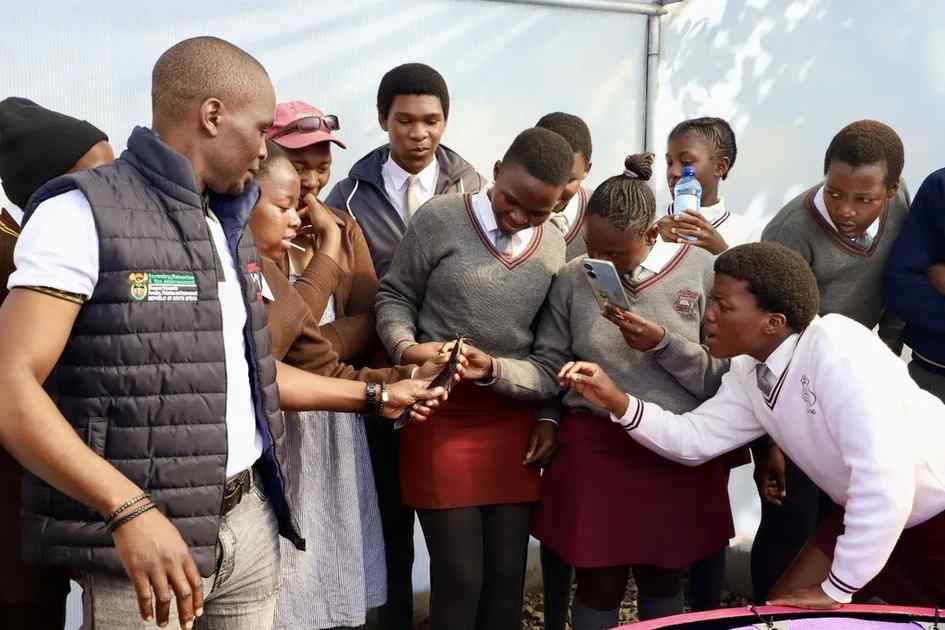

South African schools are teaching aquaponics to improve food security, conserve water and equip students with practical climate adaptation skills, turning classrooms into hubs of sustainable food production.
In a greenhouse at a primary school on the outskirts of Johannesburg, children carefully tend rows of vegetables growing in a water-based farming system that educators hope can help tackle food insecurity and prepare a new generation for a changing climate.
The students at Laerskool Kempton Park are learning aquaponics, a method of producing plants and fish together in a mutually beneficial water system. Although the technique dates back centuries, it is experiencing a revival in South Africa and has been taught to millions of schoolchildren since being introduced into the country’s education system seven years ago.
The school was among the first in South Africa to adopt the subject as part of efforts to improve food security in a country where an estimated 19.7 million people, or about 30 percent of the population, face moderate food insecurity and struggle to afford enough nutritious food for a healthy and balanced diet.
Aquaponics combines fish farming with crop production in a closed-loop system. Fish waste is converted into nutrients by bacteria in the water, allowing plants to absorb them as fertiliser. The cleaned water is then returned to the fish tanks.
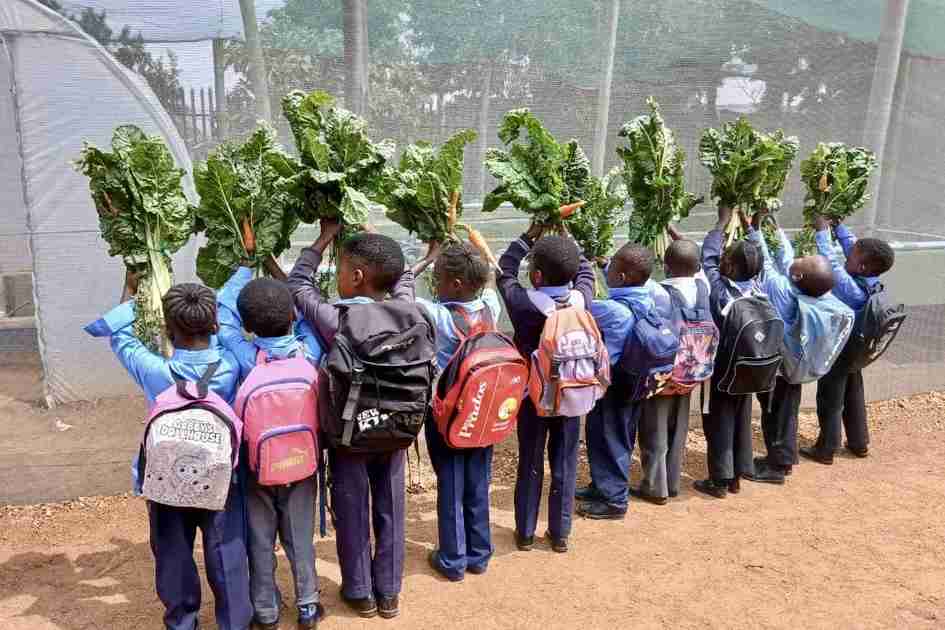
The approach offers several advantages. It does not require chemical fertilisers, soil or large areas of land. Water is continuously recirculated, making the system highly efficient and particularly valuable in parts of South Africa that face droughts and increasingly unpredictable weather patterns.
The technology is also suited to a variety of local challenges. In densely populated townships around cities such as Johannesburg, limited space often makes food production difficult. In other regions, including the Northern Cape, extreme weather conditions are making conventional farming increasingly challenging.
At Laerskool Kempton Park, students have benefited from programmes led by INMED, a non-profit organisation that works with vulnerable children and families across South Africa.
INMED has trained hundreds of teachers and more than 7,000 children in aquaponics. With funding from the Adaptation Fund through the UNDP-Adaptation Fund Climate Innovation Accelerator (AFCIA), the organisation developed its own aquaponics model for use in schools.
The prototype is described as a “plug and play” system designed to be modular, simple to install and easy to manage. It includes a 2,000-litre fish tank powered by a solar pump that circulates water throughout the system.
According to INMED, the design was intentionally kept simple so it could be replicated in schools across different regions.
“Aquaponics speaks to a number of challenges, including limited access to nutritious food, high youth unemployment, water scarcity and in many cases poor or no access to arable land,” said Unathi Sihlahla, director of INMED South Africa.
Because the system does not depend on soil and uses significantly less water than conventional agriculture, Sihlahla said it offers communities a practical way to overcome these obstacles.
“We’ve seen schools that previously had no food production now able to grow vegetables consistently while also producing fish. That food often goes straight into school meals or supports vulnerable households nearby,” he said.
The project estimates that more than 5,300 kilogrammes of food have been harvested during each quarter that the system has been operating.
As aquaponics has become part of the national school curriculum, education authorities across South Africa have been exploring effective ways to teach the subject. INMED’s model is now being introduced in schools across several provinces.
The organisation is also preparing a new collaboration with the Eastern Cape Provincial Department of Education and is expanding the plug-and-play model into Tanzania.
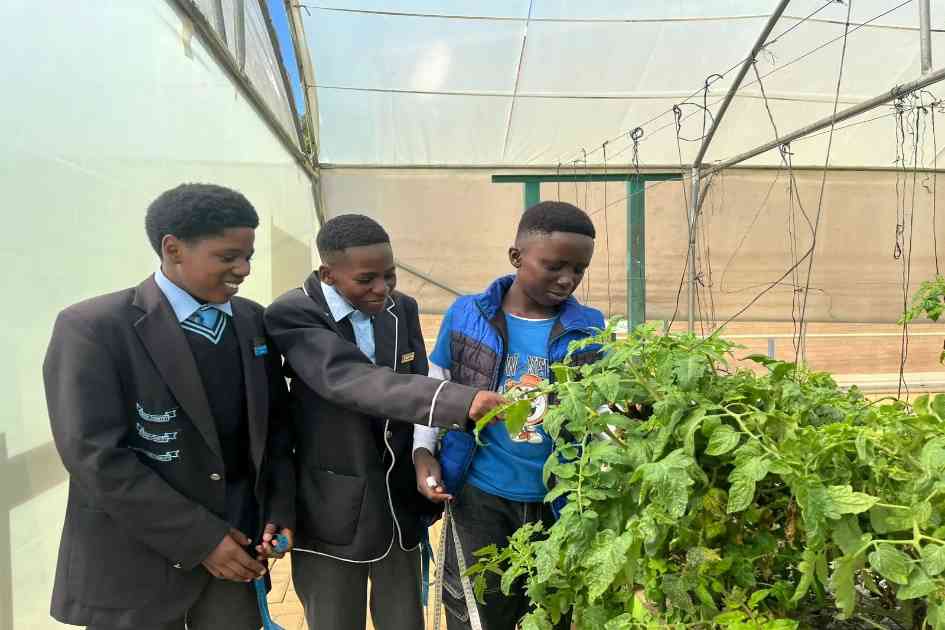
Educators say the benefits go beyond food production. They believe exposing students to modern agricultural technologies can help cultivate future farmers capable of responding to climate-related challenges and increasingly frequent extreme weather events.
“Agriculture is not seen as something young people want to go into, but when they are exposed to something like aquaponics, it feels modern and relevant,” Sihlahla said.
He added that some students have already started small aquaponics projects at home while others are considering further studies in the field.
“There’s also a sense of pride. Producing food that supports your school or community changes how young people see themselves and their role,” he said.
South Africa is not the only country where young people are being engaged in climate adaptation through education programmes supported by the Adaptation Fund.
In Costa Rica, a US$10 million project implemented by the private foundation Fundecooperación has launched several youth-focused initiatives in climate-vulnerable communities. The programme has trained young people in coral reef restoration and farming techniques, involved high school students in monitoring and managing community water resources, shared adaptation knowledge through a theatre tour in schools and organised an AI-based art mural competition.
In Lesotho, climate education is being incorporated into school curricula through climate-smart agriculture materials and teacher training programmes implemented in primary and secondary schools. The initiative aims to equip students with practical and locally relevant skills to strengthen resilience from an early age.
“Children and young people are among the most vulnerable to climate change,” said Mikko Ollikainen, head of the Adaptation Fund. “These programmes are not only training young people in adaptation but empowering them.”
This article is republished form The Climate Home News




