

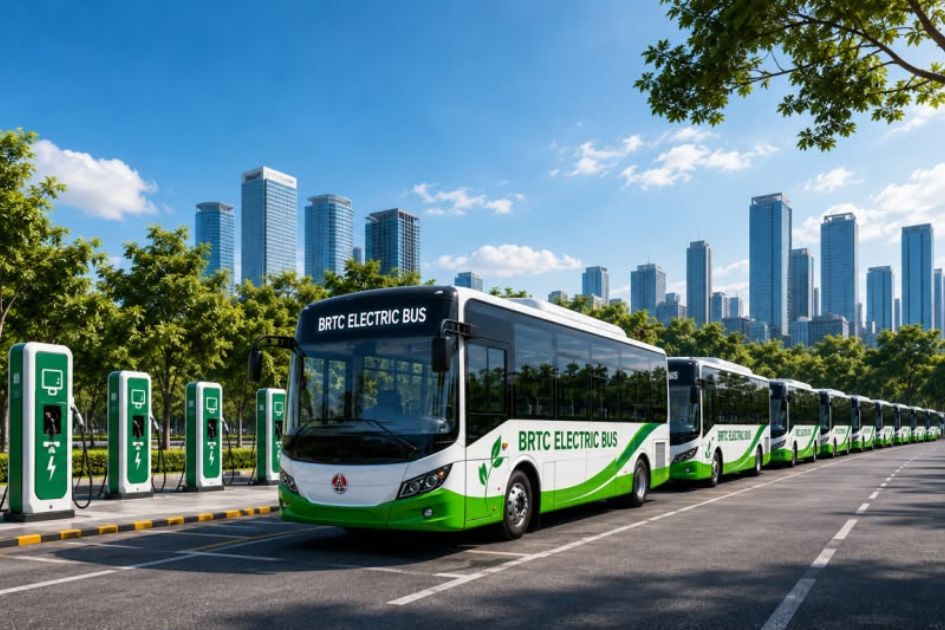



Bangladesh plans nationwide EV charging infrastructure, solar-powered charging stations and its first battery recycling facility as part of a UNDP-backed initiative supporting cleaner transport, renewable energy integration and sustainable urban development.
Facing rising urban air pollution, increasing transport demand and the need to reduce fossil fuel dependence, Bangladesh has launched a new initiative to accelerate the transition toward electric mobility by developing nationwide charging infrastructure and establishing its first electric vehicle (EV) battery recycling facility by 2030.
The initiative aims to support cleaner transportation by expanding charging facilities for electric buses, motorcycles and three-wheelers, integrating renewable energy solutions and building a skilled workforce through training programmes at home and abroad, officials said.
The project, titled “Bangladesh Enabling Electric Vehicles Adoption in the Framework of Sustainable Energy-Based Transportation,” is being formulated by Bangladesh’s Road Transport and Highways Division with financial support from the United Nations Development Programme (UNDP).
The proposed Tk25.35 crore (approximately $2.1 million) project will receive Tk23 crore in grants from UNDP. Following evaluation by the relevant authorities, the draft development project proposal is expected to be placed before the Executive Committee of the National Economic Council for approval.
As part of the initiative, four high-capacity charging stations for electric buses will be established at Bangladesh Road Transport Corporation (BRTC) depots. Each station will have superfast charging facilities with a capacity of 300 to 500 kilowatts and will be capable of charging up to 20 buses simultaneously.
Potential locations include BRTC depots in Jowar Sahara, Mirpur, Gabtoli, Narayanganj and Narsingdi.
Industry observers say Bangladesh has an opportunity to build a complete electric mobility ecosystem by combining clean transportation, renewable energy and responsible battery recycling. Such a transition could contribute to cleaner cities, green job creation and a more sustainable energy future for the country.
The government also plans to establish three solar-hybrid charging stations for electric motorcycles and three-wheelers at Uthali in Manikganj, Ekuria in Keraniganj and the BRTC depot in Chattogram. These facilities will operate using both grid electricity and solar power, with a capacity of 80 kilowatts, including 25 to 30 kilowatts generated from solar energy.
A major component of the initiative is the construction of Bangladesh’s first EV battery recycling and disposal plant at a BRTC depot in Gazipur. The facility will help address the growing challenge of battery waste management, recover valuable materials and reduce environmental risks associated with used batteries while supporting a circular economy approach.
The move comes as Bangladesh intensifies efforts to expand clean transportation and improve urban air quality. The government introduced electric vehicle-friendly tax incentives in the current fiscal year to encourage EV production and imports, creating new opportunities for domestic manufacturing and private investment.
The country’s transport sector is a major contributor to urban air pollution, and the shift toward electric mobility is expected to help reduce emissions while supporting Bangladesh’s climate commitments and long-term sustainable development goals.
State-owned Bangladesh Road Transport Corporation (BRTC) has already sought Tk400 crore from the government to purchase 100 electric buses and establish 25 charging stations. The transport operator is also planning to procure another 400 electric buses under the proposed Bangladesh Clean Air Project, for which the World Bank has offered a $300 million loan.
The government has set a target of establishing 1,200 commercial EV charging stations across Bangladesh by 2030. The Sustainable and Renewable Energy Development Authority (SREDA), the government’s renewable energy agency, has been tasked with preparing the regulatory framework and implementation guidelines for the charging network.
However, limited charging infrastructure remains a major challenge. Bangladesh currently has around 15 lakh electric two- and three-wheelers, along with thousands of plug-in hybrid vehicles, many of which are charged at homes and private garages.
The country currently has only 14 electric vehicle charging points with a combined capacity of 242 kilowatts, while the Bangladesh Rural Electrification Board has established eight solar-powered charging stations across the country to promote renewable energy-based transport.
The rapid growth of electric three-wheelers and locally manufactured electric vehicles has increased the urgency for proper charging systems, safety standards and sustainable battery management solutions.
Private sector interest in the EV sector is also increasing following recent policy support. Several companies from the automobile, manufacturing, energy and technology sectors are exploring opportunities in EV production, assembly, charging infrastructure and related services.




