




The proposed framework and policy brief aim to turn climate forecasts into practical plans for agriculture, water management, hydropower and disaster preparedness.
Experts and policymakers in Nepal have called for advance preparedness and cross-sectoral coordination to reduce potential risks to the country’s water resources, food security, energy sector and disaster resilience from a possible Super El Niño.
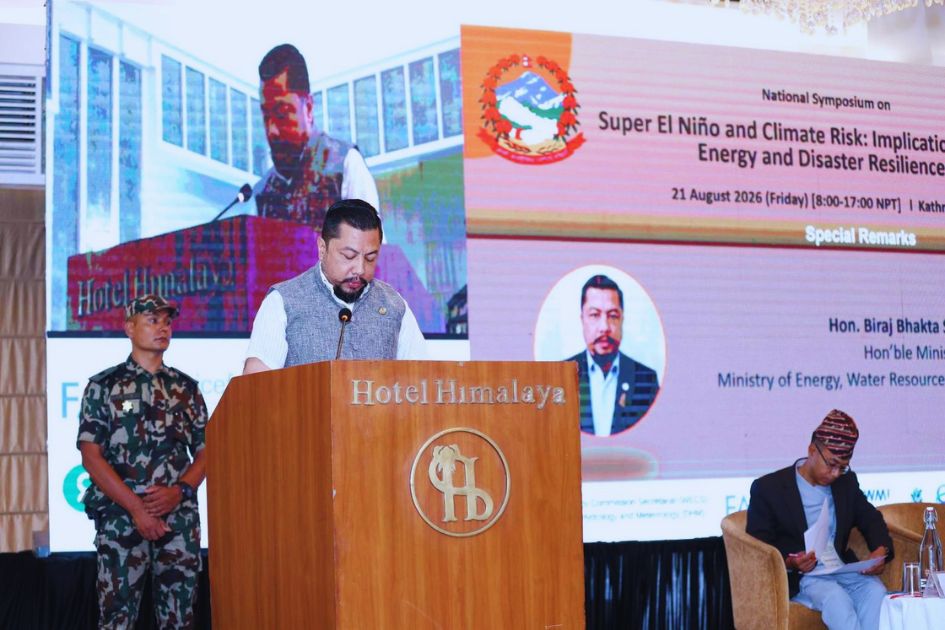
The call came at a national workshop titled “Super El Niño and Climate Risks: Impacts on Water, Food, Energy and Disaster Resilience in Nepal,” jointly organized by the Water and Energy Commission Secretariat and the Department of Hydrology and Meteorology.
El Niño occurs when sea surface temperatures in the central and eastern Pacific Ocean become unusually warm, influencing weather patterns around the world. A particularly strong El Niño event is commonly referred to as a “Super El Niño.”
A strong El Niño can potentially weaken or delay the monsoon, increase the likelihood of drought and raise temperatures. These conditions could reduce agricultural production, create pressure on drinking water and irrigation supplies, lower river flows and affect hydropower generation, while also increasing the risk of forest fires.
Officials said the government had begun preparations by identifying sectors that could be affected by the potential impacts of a Super El Niño.
Policymakers, researchers, technical experts, development partners, private-sector representatives and officials from various government agencies took part in the workshop.
Discussions focused on the potential impacts of Super El Niño, weather and climate forecasting, risk assessment, early warning systems and sector-specific preparedness.
Energy, Water Resources and Irrigation Minister Biraj Bhakta Shrestha stressed the need for preventive and anticipatory measures before risks materialize, rather than waiting to respond after an event occurs.
He said protecting the livelihoods and food security of vulnerable communities, particularly farmers, should remain a priority.
Shrestha said reduced river flows could directly affect run-of-river hydropower projects, while high mountain areas could face risks associated with glacial lake outburst floods, or GLOFs.
The workshop discussed the possibility that Super El Niño could contribute to delayed monsoon onset, reduced rainfall, prolonged drought, higher temperatures, lower river flows, increased forest-fire risks, drinking-water shortages and declines in agricultural production in Nepal.
Experts also warned that these impacts could affect hydropower generation and the country’s overall energy security.
Technical sessions examined the potential impacts of Super El Niño on water resources, glacier systems, irrigation, drinking water, hydropower, agriculture, food security and disaster risk management.
Participants stressed the need to connect weather and climate forecasts with practical decision-making.
They called for more effective use of scientific information in agricultural planning, water management, energy production, disaster preparedness and the dissemination of information to communities.
The workshop also highlighted Nepal’s heavy reliance on hydropower based on river flows. Any significant decline in river discharge could pose a direct threat to the country’s energy security.
Representatives of the National Disaster Risk Reduction and Management Authority emphasized the need to bridge the gap between climate information and action.
They said timely warnings must reach people at risk, while resources, communities and institutional mechanisms should be prepared before a crisis occurs.
Participants highlighted the need to strengthen preparedness in water resources, irrigation and drinking water; hydropower and energy security; agriculture and food security; and disaster risk reduction.
They said forecasts generated by global climate models must be translated into locally relevant and actionable plans using reliable local data and continuous research.
Based on recommendations from the workshop, the organizers said the discussions would provide a foundation for developing a “Sectoral Super El Niño Contingency Framework” and a “National Policy Brief on Super El Niño Preparedness.”




