

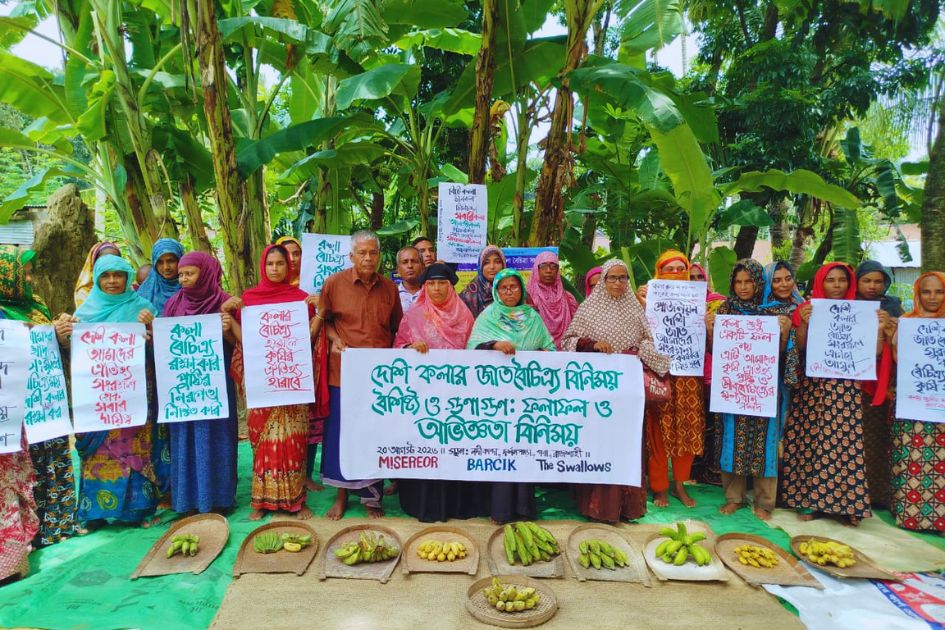



The BARCIK field findings highlight how village learning centres and household exchanges are keeping indigenous banana varieties alive while supporting food culture, local knowledge and climate-resilient farming.
Farmer-led exchanges of local banana varieties are helping conserve and expand crop diversity in Bangladesh’s drought-prone Barind region, according to a three-year field study by development research organisation BARCIK.
The study, based on information and experience from 901 households in 14 villages, documented the cultivation and spread of 17 indigenous and locally known banana varieties in parts of Paba, Tanore and Nachol upazilas.
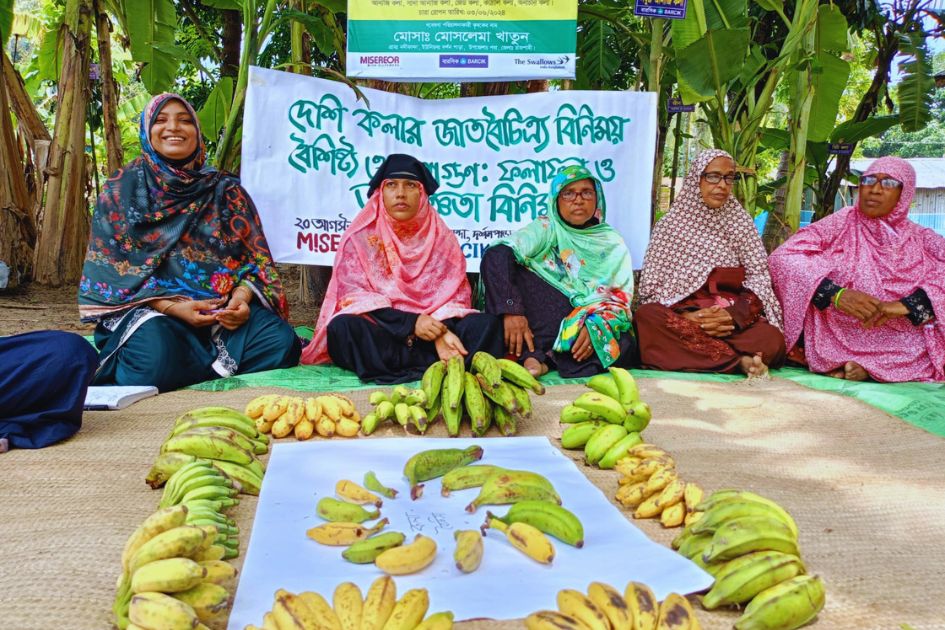
The findings were presented on Thursday, August 20, 2026, at a discussion on farmer-led research into indigenous banana diversity in Nodikhanda village of Darshanpara union in Paba upazila of Rajshahi district. The event was organised by BARCIK and the Green Coalition.
BARCIK anthropologist and regional coordinator Md Shahidul Islam presented the combined field report from the three upazilas, linking indigenous banana diversity with wider agrobiodiversity and agroecological farming systems.
The study identified local banana varieties known as Chini or Chini Champa, Bichi, Manik, Jin, Sabri or Shabri, Sabuj Anachi, Sada Anachi, Zed, Kathali, Anaji, Monohor, Sagor, Achin, Lal Kola or Agnishwar, Anupam, Ete and Modna.
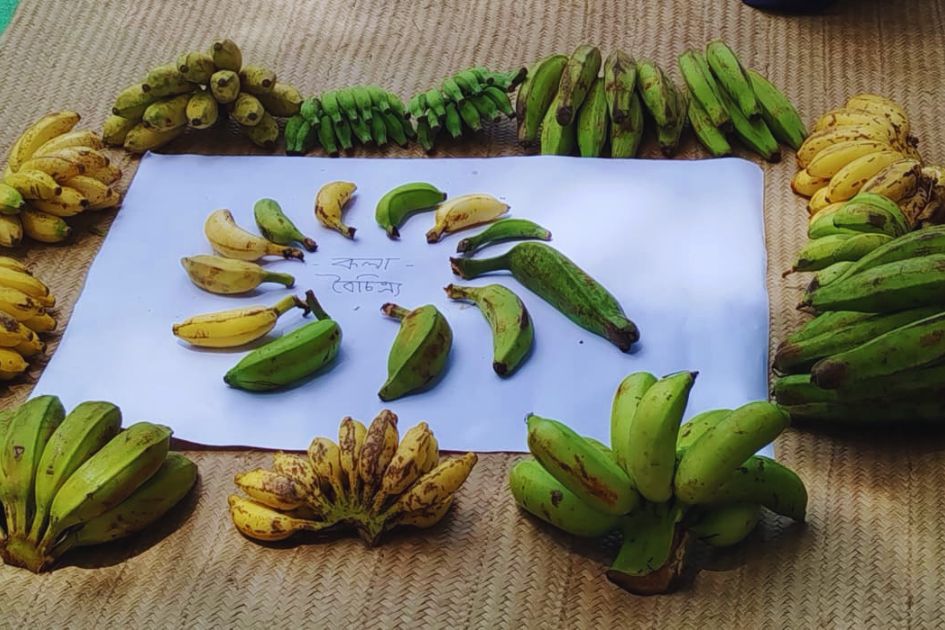
Field data showed that some varieties had long been confined to a few households, while others expanded into new areas through exchanges among farmers.
According to the study, Anaji, Anachi, Bichi, Manik, Sabri or Shabri and Chini Champa had spread relatively widely. Other varieties, including Jin, Sada Anachi, Zed, Sagor, Achin and Lal Kola or Agnishwar, were also found to have moved between farming households.
Some varieties are eaten ripe as fruit, some are used green as vegetables and others are linked to local food culture and traditional knowledge, the study found.
The research highlighted the role of Agroecology Learning Centres and “model hundred homes” in conserving and expanding local varieties. At the learning centres, farmers from different villages gathered to discuss crop varieties, cultivation practices, uses and local agricultural knowledge.
Through these discussions, farmers identified who had which variety and who needed planting materials. The model homes worked as practical spaces for household-based safe food production and conservation of agricultural diversity.
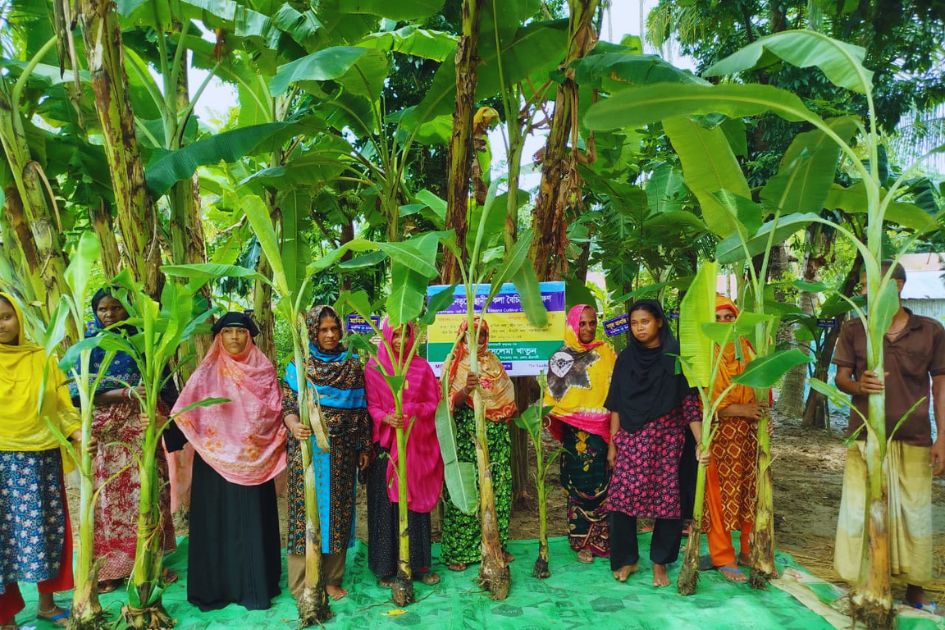
BARCIK said its role in the process was mainly to facilitate and connect farmers. It helped move saplings and planting materials from farmers in one village to interested farmers in another, allowing conservation to take place in living form on farms and homesteads rather than at a single central site.
Sultana Khatun, a woman farmer who runs the Bil Nepal Para Agroecology Learning Centre in Paba upazila, said 10 indigenous banana varieties were collected from different villages in 2024 and cultivated experimentally at one site in Nodikhanda village under the management of Mosammat Moslema Khatun.
“After that, the varieties were exchanged from here to villages in different unions and also to other upazilas,” she said.
Raihan Kabir Ranju, a farmer-researcher with BARCIK in Nachol upazila of Chapainawabganj district, said he brought three varieties, Agnishwar, Kathali and Chini, from Gaibandha.
“Now these have spread to more than 90 families through sapling exchanges,” he said, adding that the spread was continuing day by day.
Jitendranath, a farmer who runs the Gokul-Mathura Agroecology Learning Centre in Tanore upazila, said many villages once had a range of indigenous banana varieties.
“Because of modern farming and the temptation of higher yields, we are losing them. After losing them, we understand what treasures we have lost,” he said.
He said the varieties still existed in scattered form and that banana diversity could return to villages if they were identified and exchanged.
Mosammat Kobuljan, a woman farmer who runs the Haridebpur Agroecology Learning Centre in Tanore, said indigenous banana varieties were linked to local heritage.
“Our own tradition is hidden in indigenous bananas. Hindus have some pujas that are performed with Jin bananas,” she said. “If there is no Jin banana, how will they perform the puja? So we need to protect indigenous banana varieties for our own interest.”
Mosammat Mahmuda Begum, an elderly woman farmer from a model hundred-home family in Bil Dharmapur village of Paba upazila, said green Anaji banana was believed to help with diarrhoea, stomach problems and dysentery, while Anupam banana was considered beneficial for pregnant mothers and their children.
“Every indigenous banana has its own taste, smell, qualities and characteristics. Banana is useful to us not only as a fruit but also as a vegetable,” she said. “Bichi banana is believed to help men with semen-related diseases. These bananas are useful to us.”
Participants in the discussion described the qualities and characteristics of different banana varieties.
Speakers said indigenous banana diversity was not only about fruit diversity. It was also tied to farmers’ local knowledge, food culture, household food security, homestead-based production, social cooperation and agrobiodiversity.
“When a variety moves from one farmer to another, it is not only a sapling that is transferred,” speakers said. “Knowledge of identifying the variety, cultivation experience and local uses are also transferred.”
Based on the research findings, speakers called for recognition of farmer leadership in conserving indigenous and local varieties, inclusion of local agrobiodiversity and agroecology in union and upazila-level agricultural planning, strengthening farmer-based variety exchange systems and creating community registers of local varieties.
They said that amid climate change, drought and uniform production systems in agriculture, local varieties held by farmers were important resources for the future of farming.
Indigenous variety conservation should not be seen only as a way to protect past heritage, but also as a strategy for building safe, diverse and climate-resilient agriculture for the future, they said.
The study of 901 household-variety exchange records and 17 local banana varieties showed that diversity held by farmers is one of the foundations of agriculture’s future.
The discussion and presentation of field-based findings were attended by BARCIK programme officers Amrit Kumar Sarkar, Md Touhidul Islam and Md Shahidul Islam Shahid, Barendra Youth Forum President Atiqur Rahman Atiq and 65 farmers from 10 villages in three upazilas who have played roles in expanding indigenous banana varieties.




