

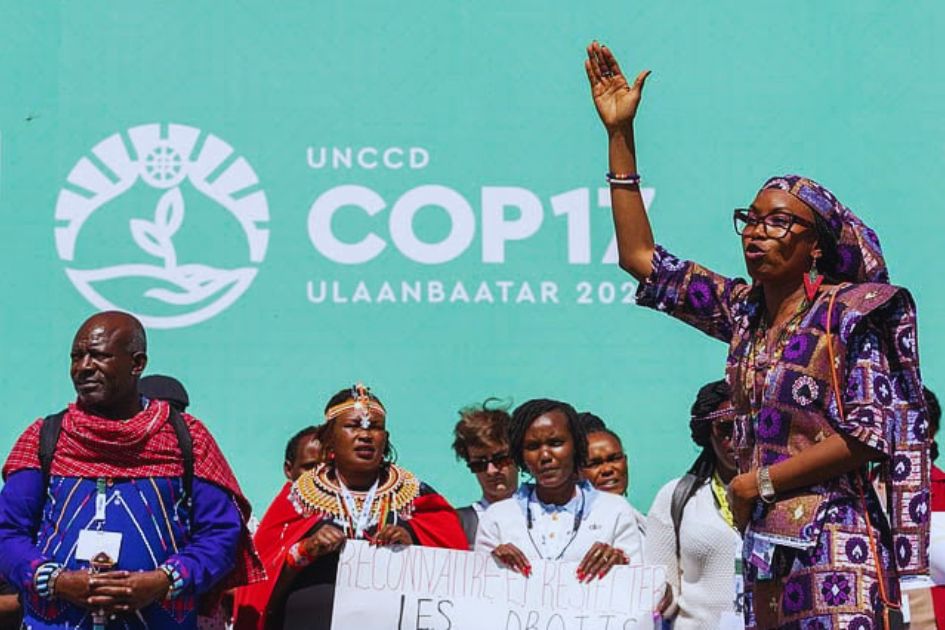



Indigenous leaders, youth observers and more than 340 organisations are urging governments to protect participation, gender equality and Rio Convention cooperation as land restoration negotiations continue in Ulaanbaatar.
A dispute over inclusion is overshadowing the 17th Conference of the Parties (COP17) to the United Nations Convention to Combat Desertification (UNCCD) after governments deferred discussions on gender equality, civil society engagement and other issues seen as critical by Indigenous Peoples, local communities and vulnerable groups.
COP17 opened on August 17 in Ulaanbaatar of Mongolia under the theme “Restoring Land, Restoring Hope”, with Mongolian Prime Minister Nyam-Osoryn Uchral calling on delegates to move beyond declarations and focus on implementation. UNCCD Executive Secretary Yasmine Fouad echoed that message, describing the summit as the “COP of implementation”.
At the opening plenary, delegates approved the provisional agenda but deferred examination of several contested items for further consultations. The postponed discussions include gender-responsive approaches, migration, drought, rangelands, civil society engagement and cooperation among the three Rio Conventions.
The decision followed objections from the United States and Russia, while Brazil and the European Union supported keeping the items on the formal agenda.
The official UNCCD report on the opening session confirmed that the conference adopted its provisional agenda with several items left for further consultations. The document recorded interventions from the United States and other delegations but did not officially attribute the postponement to any single country.
A report by Agência Brasil published on August 20, however, said discussions related to gender and social participation were set aside following a request from Washington. The adoption of the agenda requires consensus among the 197 Parties to the Convention.
Observers say agenda decisions at UN environmental summits shape which priorities receive attention in formal negotiations and influence how governments respond to the concerns of vulnerable populations.
For communities already facing drought, declining soil fertility and ecosystem loss, the debate is about more than procedure. It is about who helps shape solutions to environmental challenges affecting their livelihoods.
Civil society groups argue that successful action against desertification cannot happen without the involvement of communities living with the impacts of land degradation.
The UNCCD Civil Society Organizations (CSO) Panel, representing accredited observers from the Convention’s five regions, warned that sidelining these discussions could weaken the role of people most affected by land degradation in shaping global solutions.
“Deferral is not deletion,” the panel said, stressing that under UNCCD rules, postponed agenda items must continue through a formal process. It called on governments to announce the consultation format, responsible convenor and a clear timeline for reporting back to the plenary before COP17 concludes.
More than 340 civil society organisations, Indigenous Peoples’ organisations, local communities, women’s and youth organisations, networks and supporting institutions from around the world have signed an urgent joint letter addressed to the Presidencies of the three Rio Conventions: UNCCD, the Convention on Biological Diversity (CBD) and the UN Framework Convention on Climate Change (UNFCCC), along with their Executive Secretaries.
The signatories said the blocking of key agenda items, including those related to gender equality, civil society engagement, cooperation among the Rio Conventions and the UNCCD Future Strategic Framework, raised concerns about the future of inclusive multilateral decision-making.
The letter called on the Mongolian Presidency of UNCCD COP17 to support efforts by Parties to reinstate the agenda items and uphold previously agreed commitments and provisions under the Convention.
It also urged the presidencies of UNFCCC COP31 and CBD COP17 to strengthen cooperation among the three Rio Conventions, safeguard multilateral processes and protect commitments related to gender equality, Indigenous Peoples’ rights and the full and effective engagement of civil society.
The signatories warned that disruptions to established multilateral processes at COP17 could set a precedent beyond the desertification convention. They argued that, amid interconnected crises of land degradation, biodiversity loss and climate change, global action depends on protecting agreed commitments and ensuring Indigenous Peoples, women, youth and civil society have a meaningful role in decisions affecting their rights, lands, territories, resources and futures.
Indigenous Peoples Seek Influence Beyond Symbolic Participation
On August 20, Indigenous Peoples’ representatives staged a protest in Ulaanbaatar demanding a meaningful role in COP17 decision-making processes.
The protesters called for the reinstatement of discussions specifically on gender and the involvement of Indigenous Peoples and local communities. They argued that having a presence in consultation spaces does not guarantee real influence over decisions.
The demonstration was led by Hindou Oumarou Ibrahim, leader of the Association of Indigenous Peul Women of Chad (AFPAT), who called for Indigenous Peoples’ engagement to move beyond symbolic representation.
She stressed the importance of recognising Indigenous Peoples’ territorial rights, traditional knowledge and role in protecting ecosystems and restoring degraded lands.
The COP16 summit in Riyadh created dedicated caucuses for Indigenous Peoples and local communities as platforms for engagement with the Convention’s work. Representatives at COP17 argue that these mechanisms must now translate into stronger influence over decisions and policies.
Indigenous organisations highlight their experience managing pastures, water resources and drought-affected territories. They are calling for their land rights and consent to be considered in restoration programmes that may directly affect their communities.
Inclusion Debate Extends to Youth and Global South Communities
The protest also renewed calls for gender and civil society engagement issues to return to the formal agenda.
For communities across Africa, Asia and other climate-vulnerable regions, the debate has wider implications. Pastoralists, farmers, Indigenous communities and local organisations often experience the impacts of drought, soil degradation and changing weather patterns first, while also holding traditional knowledge that can support land restoration.
For many countries in the Global South, where rural livelihoods depend directly on land and natural resources, decisions made at COP17 could have immediate consequences for food security, climate adaptation and community resilience.
Youth observer groups and young climate representatives have also called for greater inclusion in decision-making, arguing that younger generations must have a role in shaping responses to land degradation, climate risks and sustainable development.
Linking Rio Conventions with Gender-Transformative Climate Action
Another key issue at COP17 is strengthening cooperation among the three Rio Conventions: the UN Framework Convention on Climate Change (UNFCCC), the Convention on Biological Diversity (CBD) and the UNCCD.
Environmental experts say climate change, biodiversity loss and land degradation are interconnected challenges that require coordinated responses. Stronger cooperation among the three agreements could improve financing and support ecosystem restoration, sustainable agriculture and other nature-based approaches.
Sohanur Rahman, Executive Coordinator of YouthNet Global, said addressing the interconnected crises covered by the Rio Conventions also requires examining the social systems and power structures that shape relationships between people and nature.
“The climate crisis is not only an environmental challenge; it is also a challenge of justice, equality and social transformation. If we want lasting solutions under the Rio Conventions, we must address the social norms, including harmful forms of masculinity, that influence decision-making, resource use and our relationship with ecosystems,” Rahman said.
He said engaging men and boys through a gender-transformative approach is essential for building more equitable climate action.
“Climate solutions must move beyond technology and investment alone. They must also transform the behaviours, attitudes and power relations that create inequality. Engaging men and boys in care, responsibility and environmental stewardship can help build communities that are more resilient and just,” Rahman said.
Rahman added that stronger coordination among the UNCCD, UNFCCC and CBD should place communities, women, youth and Indigenous Peoples at the centre of decision-making while recognising gender-transformative approaches as part of stronger ecosystem protection and restoration.
Restoring degraded land can help capture carbon, protect biodiversity and strengthen resilience for communities facing climate risks. Experts and advocates say these solutions must be developed with the involvement of the people who depend on these ecosystems.
The official COP17 programme includes a “Land and Peoples” day on August 26, featuring a caucus dedicated to women herders and pastoralists, along with a special event focusing on Indigenous Peoples and local communities.
For countries facing rising climate risks, the debate reflects a broader question of whether global environmental decisions can be effective without the voices of those most affected.
As COP17 negotiations continue in Ulaanbaatar, calls are growing on governments to resolve the outstanding agenda issues and ensure that Indigenous Peoples, civil society and local communities have a direct role in shaping global land restoration policies.
The outcome of the consultations will test whether COP17 can deliver implementation while preserving the inclusive multilateral approach needed to address land degradation, biodiversity loss and climate change.




