

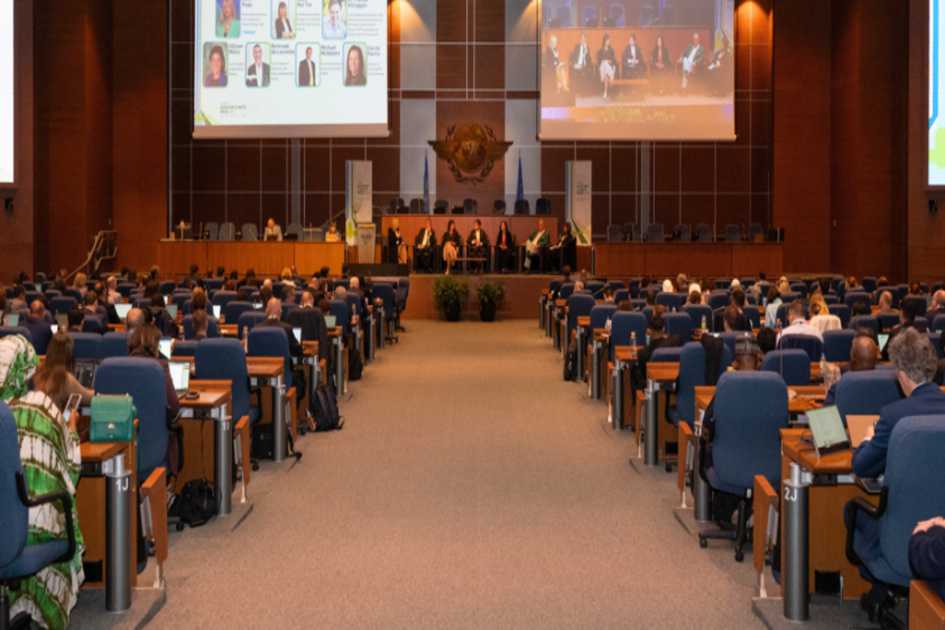



ICAO Climate Week highlighted sustainable fuels, operational innovation, non-CO₂ emissions reductions and urgent adaptation measures to strengthen airport resilience against escalating climate risks worldwide.
Aviation leaders at ICAO Aviation Climate Week, which officially opened today, focused on how the sector can meet its goal of reaching net-zero emissions by 2050 and what must change to make that happen.
Speakers stressed that stronger cross-sector collaboration will be critical to speeding up climate mitigation and resilience efforts while also helping advance the UN Sustainable Development Goals.
As evidence of growing momentum, participants pointed to rising production of Sustainable Aviation Fuels, supported by ICAO’s globally harmonized framework. They also cited new data-sharing platforms, scenario analysis and multi-partner research initiatives as signs that the aviation sector is capable of coordinated action.
The discussions also highlighted the major impact of non-CO₂ emissions, which participants said could account for as much as half of aviation’s total net warming effect. New operational trials showed that rerouting flights to avoid areas where persistent contrails form can significantly reduce warming, offering what participants described as a practical and data-driven step forward.
Speakers said technological innovation and operational change will both be needed if aviation is to stay on course for net-zero carbon emissions by mid-century. Operational improvements were identified as one of the most immediate and practical options, including modernization of air traffic management, real-time trajectory planning and upgraded ground handling protocols.
Participants also noted the potential of new aircraft technologies such as hydrogen propulsion, while emphasizing that an aggressive rollout of advanced designs will be necessary to deliver the scale of emissions cuts required.
Panelists said regulatory and certification processes must keep pace with rapid technological and operational changes, including the development of new standards. ICAO was recognized for its leadership role in bringing stakeholders together and harmonizing standards, while several participants called for stronger international frameworks to reduce fragmentation and support coordinated action.
The session also made clear that aviation’s climate challenge extends beyond mitigation to adaptation, with discussions showing that major barriers still stand in the way of a stronger response.
Participants said recent extreme weather events have already exceeded earlier projections and are now directly affecting airport operations and business continuity in ways once considered unlikely at this stage. Even airports built to high engineering standards are facing new levels of stress from climate hazards.
Survey findings presented at the session showed that while most aviation stakeholders recognize the growing threat posed by changing weather patterns, more frequent storms and damage to aviation infrastructure, only a small share are moving beyond risk assessment to implement adaptation strategies.
Access to financing, especially in developing regions, was identified as a major concern. Many airports are struggling with limited resources and rising costs just as climate risks become more complex. Participants also said adaptation efforts are being weakened by poor integration between national and local planning and by limited stakeholder engagement.
Many speakers pointed to a continuing shortage of location-specific climate data and modelling, leaving some airports unable to carry out meaningful risk assessments. Within the sector, only a small number of locations have established a regular cycle of review and improvement to keep adaptation measures aligned with evolving climate science.
At the same time, rising awareness and growing exposure to climate risks are creating momentum for investment and innovation. Participants said interest is increasing in tailored solutions and that lessons are emerging from a range of adaptation efforts. Collaborative partnerships, particularly with weather agencies and research organizations, are helping narrow data gaps and strengthen scenario planning.
The session also underscored the importance of embedding adaptation measures into wider development and investment frameworks. Participants said treating climate resilience as part of a long-term business strategy can help airports protect operations, improve safety and preserve economic value.
Source: ICAO




