

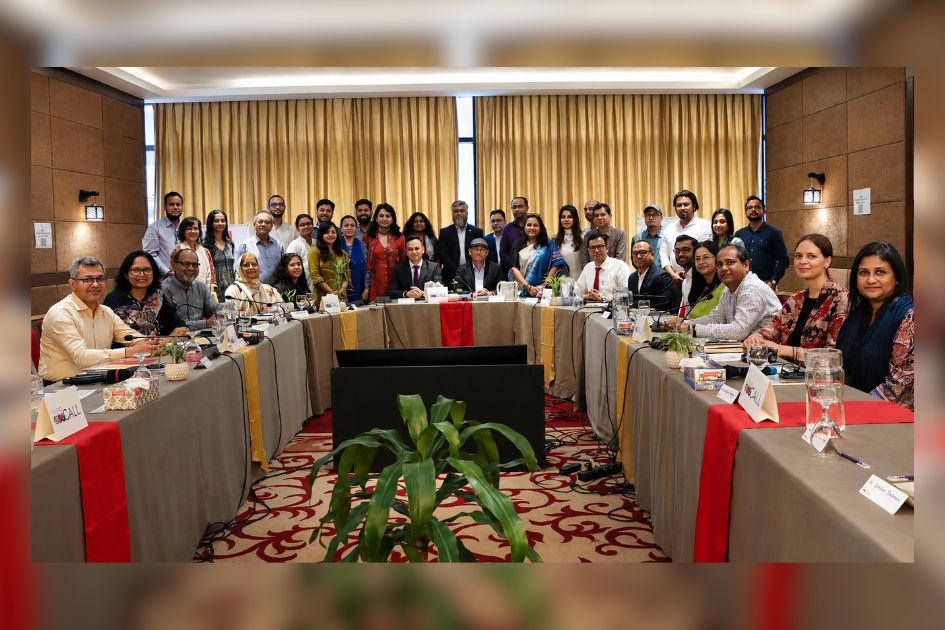

Speakers from government, development partners and civil society urged reforms to improve transparency, accountability and local access to climate funding, outlining policy priorities to strengthen Bangladesh’s adaptation and resilience efforts.
Climate experts and policymakers on Wednesday called for a more equitable, transparent and locally responsive climate finance system in Bangladesh to enable the country’s most climate-vulnerable communities to lead adaptation and resilience efforts.
Speaking at a national policy dialogue in Dhaka, the participants agreed on the urgent need to address climate challenges and called for a comprehensive Climate Finance Implementation Plan based on a 360-degree approach that brings together all relevant stakeholders. They also stressed the need to strengthen green finance mechanisms, including greater use of the Green Climate Fund (GCF) and other international climate financing sources.
Dr. Saimum Parvez, Special Assistant to the Prime Minister on Environment, Forest and Climate Change Affairs, attended the event as chief guest and said, “it is our duty to protect the environment,” emphasising collective responsibility across government, civil society and citizens.
He said Prime Minister is a “Green Prime Minister” and noted that the Government of Bangladesh recognises the importance of developing a comprehensive environmental strategy through collaboration among government institutions and relevant stakeholders, including civil society.
Parvez said the government has identified three key environmental priorities in its political commitments: expanding renewable energy to accelerate the transition towards clean and sustainable energy sources; large-scale tree plantation and afforestation to enhance carbon sequestration, restore ecosystems and strengthen climate resilience; and canal excavation and restoration to improve water management, enhance flood resilience and revive natural drainage systems.
Mr. Diepak Elmer, Chargé d’Affaires of the Embassy of Switzerland in Bangladesh, attended the dialogue as guest of honour and reaffirmed Switzerland’s continued support for locally led climate action.
In his remarks, Elmer said climate finance continues to face significant implementation and coordination challenges, particularly in ensuring that resources reach those most vulnerable.
“While climate change is a global challenge, effective adaptation requires strong national and local action. Solutions must be locally driven and tailored to community needs,” he said.
During the dialogue, Adv. M. Hafijul Islam Khan, climate negotiator and founder director of the Centre for Climate Justice Bangladesh (CCJB), presented a set of policy recommendations.
The findings highlighted the need to strengthen the equity, transparency and effectiveness of Bangladesh’s climate finance architecture by improving access to climate finance for local actors, enhancing accountability in climate budget allocations and institutionalising mechanisms and monitoring that support locally led climate action.
A high-level expert discussion moderated by Dr. Rudaba Khandakar, Country Director of GAIN, brought together Mr. Md. Abujafar Ripon, Director (Deputy Secretary) at the Bangladesh Climate Change Trust, a government agency; Mr. Md. Shamsuddoha, Chief Executive of the Centre for Participatory Research and Development (CPRD); Mr. Zakir Hossain Khan, Chief Executive Officer of Change Initiative; Ms. Dilruba Haider, Programme Specialist at UN Women; Dr. Golam Rabbani, Director of the Centre for Climate Change and Environmental Research (C3ER) at BRAC University; and Prof. Sharmind Neelormi of the Department of Economics at Jahangirnagar University.
The discussion examined existing climate finance practices, institutional challenges and opportunities to strengthen locally led climate action through more inclusive financing mechanisms.
The closing session included remarks by Mr. AKM Sohel, Additional Secretary of the Economic Relations Division under the Government of Bangladesh and Ms. Nurun Nahar, Additional Secretary at the Ministry of Environment, Forest and Climate Change.
The session was facilitated by Ms. Farhana Afroz, Programme Director of the Climate Action at Local Level (CALL) Programme.
Participants said equitable climate finance is not only about increasing financial resources but also about ensuring that climate finance reaches local governments and frontline communities through transparent, accountable and vulnerability-responsive systems. The dialogue concluded with a shared commitment to advancing policy reforms and institutional mechanisms that strengthen locally led climate action across Bangladesh.
The National Policy Dialogue on Equitable Climate Finance for Locally Led Climate Action in Bangladesh was organised by HEKS/EPER Bangladesh in collaboration with the Centre for Climate Justice Bangladesh under the Climate Action at Local Level (CALL) programme with support from the Embassy of Switzerland in Bangladesh.




