




Officials say stronger finance, coordination, research and community participation are needed to turn Bangladesh’s updated biodiversity strategy into measurable action by 2030.
From the fish that sustain millions of families to the forests, wetlands and rivers that protect communities from climate risks, biodiversity is deeply connected to everyday life in Bangladesh. But pollution, habitat loss, climate change and unsustainable development are putting the country’s natural systems under increasing pressure.
Against this backdrop, Bangladesh is strengthening efforts to implement its updated National Biodiversity Strategy and Action Plan (NBSAP) 2026-2030 in line with the Kunming-Montreal Global Biodiversity Framework (KMGBF), while addressing major challenges including financing gaps, institutional coordination and ecosystem degradation.
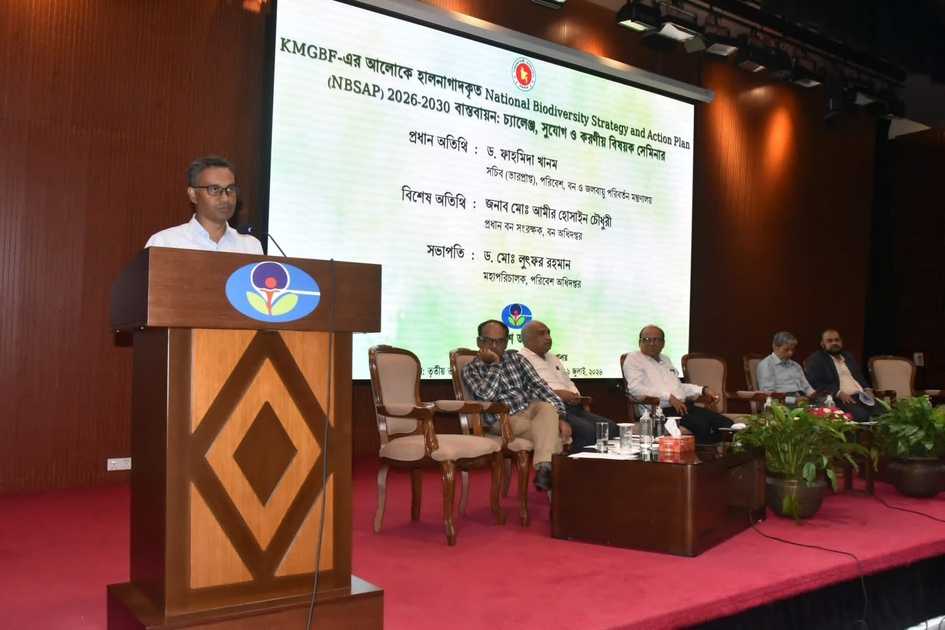
A special seminar titled “Implementation of Updated National Biodiversity Strategy and Action Plan (NBSAP) 2026-2030 in Light of KMGBF: Challenges, Opportunities and Way Forward” was held on July 19, 2026, at the Department of Environment auditorium in Dhaka as part of the observance of World Environment Day 2026.
Organized by the Department of Environment, the event brought together senior officials from the Ministry of Environment, Forest and Climate Change, Department of Environment, Forest Department and other relevant government institutions to discuss strategies for protecting biodiversity and meeting global conservation commitments.
Chief Conservator of Forests of the Forest Department Md Amir Hossain Chowdhury attended the seminar as the chief guest, while Director General of the Department of Environment Dr Md Lutfor Rahman chaired the session.
Bangladesh, a delta country rich in ecological diversity, is home to globally important ecosystems including the Sundarbans mangrove forest, river networks, wetlands, haors, coastal zones and marine habitats. These ecosystems support biodiversity, provide livelihoods and strengthen resilience against climate-related disasters.
However, experts warned that these natural assets are facing growing threats. Shrinking habitats, polluted rivers, changing land use, unplanned urbanization, industrial expansion and climate impacts are contributing to biodiversity decline across the country.
Biodiversity is not only about forests and wildlife. It is reflected in the clean air people breathe, the fish that support millions of livelihoods and the plants traditionally used as medicine in village homes. From degraded rivers to shrinking elephant habitats, biodiversity loss is increasingly affecting communities across Bangladesh.
Bangladesh is a signatory to the Convention on Biological Diversity (CBD), adopted in 1992, and has been working to align national biodiversity policies with international commitments. In 2022, Bangladesh and other countries adopted the Kunming-Montreal Global Biodiversity Framework, which sets global targets to halt and reverse biodiversity loss by 2030.
The KMGBF includes 23 targets focusing on ecosystem restoration, protection of biodiversity-rich areas, sustainable use of natural resources, improved financing and inclusive participation. Bangladesh’s updated NBSAP 2026-2030 aims to translate these global commitments into national actions.
During the seminar, participants identified financial limitations as one of the biggest barriers to achieving biodiversity targets. They noted that conservation, ecosystem restoration and biodiversity monitoring require significant investment and called for stronger access to international biodiversity funds, climate finance, the Global Environment Facility (GEF) and private sector green financing.
Officials and experts also highlighted the need for stronger coordination among government agencies. They said biodiversity conservation cannot be addressed by the environment sector alone and requires integration across policies related to agriculture, fisheries, water resources, land management, industry and infrastructure development.
“Biodiversity conservation must become part of mainstream development planning. Protecting nature means protecting our economy, communities and future generations,” Chief Conservator of Forests of the Forest Department Md Amir Hossain Chowdhury said during the discussion.
The seminar also highlighted institutional challenges, including limited technical capacity, insufficient manpower and gaps in biodiversity monitoring systems. Participants stressed the need for stronger scientific research, updated species databases and improved spatial data to support evidence-based conservation decisions.
Stakeholders recommended expanding protected areas and recognizing Other Effective Area-Based Conservation Measures (OECMs), including community-managed forests, wetlands and other conservation areas that contribute to biodiversity protection beyond traditional protected zones.
They also called for stronger environmental assessments, improved enforcement of biodiversity-related laws and technology-based monitoring systems to track progress under the NBSAP.
Experts emphasized that biodiversity protection must involve communities, Indigenous Peoples, women, youth and other marginalized groups. Bangladesh’s updated strategy aims to ensure that women and girls, children and youth, and persons with disabilities participate meaningfully in biodiversity-related programmes and projects by 2030.
The plan also seeks to ensure that all areas are covered by participatory, integrated and biodiversity-inclusive spatial planning and effective management processes to address land and sea-use changes and prevent the loss of areas of high biodiversity importance.
Experts noted that protecting biodiversity is closely linked with climate action. Mangroves, forests and wetlands provide natural protection against floods, cyclones and rising climate risks while supporting food security and local livelihoods.
Bangladesh’s experience reflects a wider challenge faced by biodiversity-rich developing countries: balancing economic growth with ecosystem protection while ensuring adequate financial and technical support.
The seminar concluded with a call for stronger collaboration among government agencies, communities, researchers, civil society organizations, development partners and the private sector to turn biodiversity commitments into measurable action and safeguard Bangladesh’s natural heritage for future generations.




