

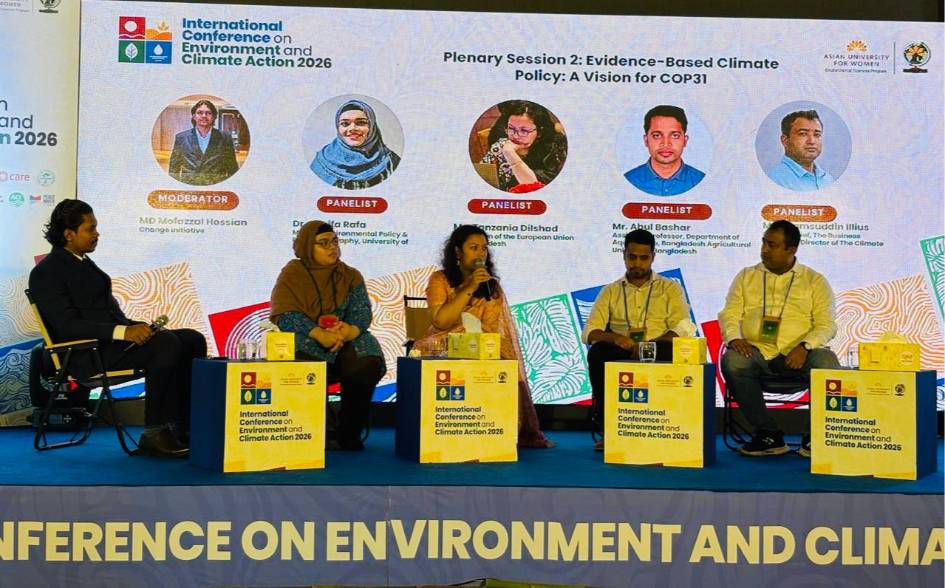



Academics, researchers and environmental professionals gathered at Sonapahar Farmhouse Resort for the opening day of ICECA 2026, featuring keynote addresses, climate science discussions, research presentations
Bangladesh should shift from donor-driven climate responses towards science-backed, evidence-based policies that connect research with the realities of vulnerable communities and strengthen the country’s position in global climate negotiations, experts said at the first day of the two-day International Conference on Environment and Climate Action or ICECA 2026 in Chattogram, Bangladesh on Friday.
Researchers, climate finance specialists, journalists and academics made the call during a plenary session titled “Evidence-Based Climate Policy: A Vision for COP31” at the second ICECA 2026, organised by the Asian University for Women at Sonapahar in Chattogram.
The discussion centred on weaknesses in climate governance, access to finance, climate-related displacement, the risk of sovereign debt, accountability in climate reporting and the need to turn scientific research into policies and projects that produce measurable benefits for communities.
Speakers said Bangladesh, one of the countries highly exposed to climate impacts, needed to move beyond policies and projects shaped largely by donor priorities and instead build its climate agenda around credible evidence, locally identified needs and solutions that can be implemented and financed.
The debate comes three months before the COP31 UN climate summit in Antalya, Türkiye, from November 9 to 20, where governments will again negotiate over mitigation, adaptation, climate finance and implementation of international climate commitments.
Shamsuddin Illius, Chittagong bureau chief of The Business Standard and founder and editor of The Climate Watch, said scientific research should not remain isolated within universities, laboratories or academic journals but should be translated into information that policymakers and communities can use.
“We need science-backed, evidence-based and solution-oriented stories that can connect policymakers, researchers and scientists,” Illius told.
Such communication, he said, could help Bangladesh build a stronger position in international climate negotiations, particularly on climate finance, while also supporting the formulation of domestic climate policies grounded in evidence rather than assumptions.
Research findings are often produced by scientists and academics but do not always reach policymakers, he said, while journalists may report the consequences of climate change without having sufficient access to the scientific evidence that explains why those changes are happening or which solutions are likely to work.
Bringing those groups together could narrow that gap.
Illius said The Climate Watch was seeking to practise a form of climate journalism focused on evidence, science and solutions, connecting policymakers and researchers with people experiencing climate impacts in vulnerable communities.
That approach, he said, was particularly important for Bangladesh because international climate negotiations increasingly require countries not only to demonstrate vulnerability but also to present credible data, documented impacts and implementable proposals when seeking finance and support.
Journalism as part of climate evidence chain
Illius said journalists could play a much larger role in that process than simply reporting disasters after they occur.
Climate journalism, he argued, can become part of the evidence chain by documenting impacts on communities, interrogating policies, examining scientific findings and testing whether climate interventions actually deliver their promised outcomes.
The task required stronger cooperation among journalists, universities, research institutions, policymakers and affected communities, he said.
Scientific research could help journalists move beyond anecdotal reporting, while field-based journalism could give researchers and decision-makers evidence of how policies work in practice.

That relationship would also help scientists communicate research findings in language accessible to policymakers and the public.
For Bangladesh ahead of COP31, Illius said, such collaboration could help establish clearer evidence on issues including adaptation, loss and damage, displacement and climate finance.
The country should be able to demonstrate both the scale of the climate risks it faces and the effectiveness of the solutions for which it seeks support, he added.
Carbon auditing proposed to raise domestic finance
Illius also called for Bangladesh to explore domestic sources of climate finance instead of depending overwhelmingly on international funding.
One option, he said, would be to introduce systematic carbon auditing for major corporate emitters, using verified emissions information to establish greater responsibility for financing sustainability measures.
Companies with substantial emissions should be required to measure and report their carbon footprint regularly, he said.
Bangladesh could consider making annual carbon audits similar in principle to financial audits and require companies to produce sustainability reports, creating a clearer picture of corporate emissions and environmental performance.
That information could then help policymakers design mechanisms through which major emitters contribute more directly to climate and sustainability financing.
Illius said corporate social responsibility should not be treated simply as philanthropy.
“CSR is not philanthropic work. They should pay for sustainability,” he said.
A mandatory reporting framework, he argued, could also improve transparency by allowing regulators, investors, communities and journalists to compare corporate climate commitments with actual emissions and environmental performance.
Such a system could eventually help Bangladesh mobilise more climate resources domestically, reducing some of the pressure created by dependence on external climate finance, he added.
Debt risks and need for bankable projects
Tanzina Dilshad of the Delegation of the European Union to Bangladesh and also Programme Manager for Energy and Environment said climate financiers were interested in supporting projects backed by strong evidence and structured in ways that made them financially and technically credible.
Evidence-based and bankable projects, she said, were important for translating climate ambitions into investments.
Dilshad said the European Union remained committed to supporting climate action in Bangladesh as part of efforts towards sustainable development and a sustainable future.
She also acknowledged concerns surrounding the debt implications of climate finance.
“The risk of debt burden is true,” she said, calling for innovative financing modalities that could reduce dependence on international finance.
The issue is particularly significant for developing economies seeking large investments in renewable energy, adaptation, resilient infrastructure and other climate programmes while also trying to avoid increasing debt vulnerability.
Dilshad currently works on energy and environment for the EU Delegation to Bangladesh, including renewable-energy investment and climate mitigation. Public information on her role identifies her as Programme Manager for Energy and Environment.
Climate migration needs greater policy recognition
Nazifa Rafa, a senior instructor at the Asian University for Women who holds an MPhil in Environmental Policy from the University of Cambridge and has pursued doctoral research in geography there, raised the issue of climate-related human mobility.
She said clearer categorisation and understanding of climate migration could benefit affected communities by allowing their circumstances to be better recognised in policy and support systems.
Her intervention highlighted the difficulty of treating all climate-related movement as a single phenomenon.
People may move permanently or temporarily, voluntarily or under severe pressure, while others may remain trapped in highly vulnerable locations because they lack the resources or legal opportunities to relocate.
For governments, the way those different forms of mobility are classified can shape who receives assistance, what policies are applied and how displacement is reflected in planning.
Shift climate action towards communities
M Mofazzal Hossain of Dhaka-based think tank Change Initiative, who moderated the plenary, said climate action and finance should increasingly be designed around communities rather than relying primarily on state-centred approaches.
“It is high time that the development partners, governments and think-tanks shift their priorities from state-based modalities to a community-owned approach for both climate finance and climate actions,” Hossain said.
The panel examined how conventional systems of climate finance and public financial management can make it difficult for funding to reach communities facing climate risks directly.
Hossain argued for climate governance that gives greater weight to local stewardship of natural ecosystems and community ownership.
Change Initiative describes its work as using evidence and data-backed research to advance policy solutions. Its current public team listing identifies M Mofazzal Hossain as a research associate.
The session also examined whether international climate architecture needs to evolve further to ensure that resources reach locally led projects with stronger transparency and accountability.
Participants discussed approaches that would put communities closer to the centre of decisions over how climate resources are allocated and how interventions are designed.
The discussions included the concept of natural rights-led governance, under which ecosystems and communities become central elements of decision-making instead of climate action being treated only as a conventional infrastructure or public expenditure issue.
Speakers also explored ways to reduce reliance on debt-bearing international assistance, including locally mobilised resources and innovative financing.
Question of who controls climate finance
The debate reflected a broader problem facing climate-vulnerable developing countries: even where international finance is available, the architecture through which it is delivered can determine who ultimately benefits.
Large national projects can absorb substantial amounts of funding while locally led interventions may struggle to meet technical requirements or secure direct access to finance.
The panel argued that evidence could help address that problem.
Local data can identify which communities face the greatest risks. Scientific evidence can determine which interventions are likely to work. Financial analysis can test whether proposed projects are viable. Independent reporting can examine whether money reaches its intended beneficiaries.
Combining those elements, speakers said, could help shift climate finance from a system driven by the availability of funding towards one driven by demonstrated needs and measurable results. The discussion also raised questions about accountability.
Climate projects require transparent reporting not simply on how much money has been spent but on what the expenditure has achieved, panelists said.
That means governments, development partners, researchers and the media all have roles in evaluating whether interventions reduce vulnerability, strengthen resilience or merely produce short-term outputs.
Abul Bashar of Bangladesh Agricultural University also joined the discussion, adding an academic perspective to a panel that brought together research, finance, policy and journalism.
Broader conference connects science with climate justice
The evidence-based policy discussion formed part of the second International Conference on Environment and Climate Action, being held in Chattogram on August 7 and 8 under the theme “Commoning Our Futures with Climate Justice.”
Conference organisers said ICECA 2026 was designed to bring together researchers, students, activists and practitioners and to examine issues ranging from ecological resilience and gender justice to sustainable economies and regenerative ecosystems. The event was co-organised with the Green Bangle Movement, Young Power in Social Action, KFL and Sonapahar Farmhouse Resort. The Climate Watch was media partner.
The programme began with registration, an opening ceremony, a flag walk and a cultural performance. Dr Nancy Mock of Tulane University delivered the first keynote address, “Two Deltas, One Commons: Women’s Leadership and the Future We Build Together.”
The first plenary session, “Natural Science for Climate Action: Charting Ways Forward,” featured experts from Purdue University, Erzurum Technical University, Karunya University, Maejo University and the Bangladesh Forest Research Institute. A second keynote address by M Zakir Hossain Khan of Change Initiative focused on natural rights-led governance, energy sovereignty and community stewardship.
Afternoon oral presentation sessions showcased research on climate risks, renewable energy, water insecurity, women’s vulnerability, locally led adaptation, coastal resilience, environmental inequality, mangrove health and climate-related displacement.
A poster presentation was also held in Hall 2, where Shamsuddin Illius served as a judge, evaluating research presentations alongside the conference activities.
The day concluded with a Women in Environmental Sciences alumnae panel, followed by a prize-giving ceremony and dinner.




