

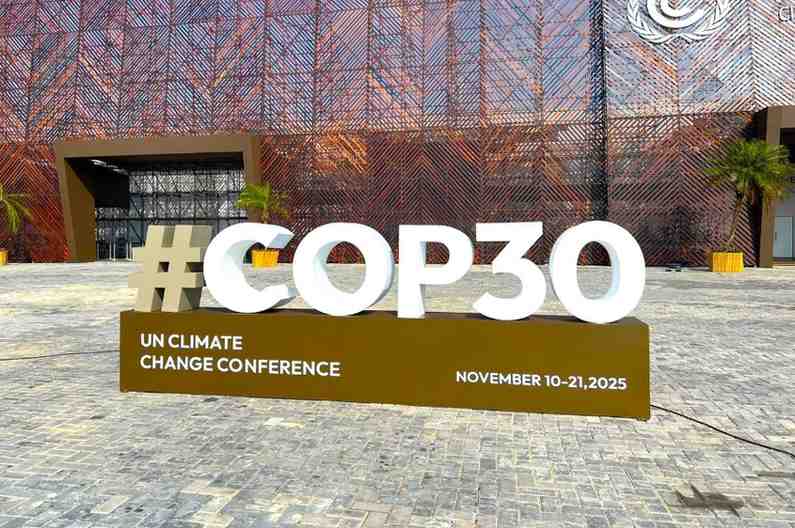



The first week of the 30th UN Climate Change Conference (COP30) closed on November 15 with wide political fractures still exposed across all major negotiation tracks, despite a notably smooth start to the talks. Promoted as the “Implementation COP,” “Forest COP,” and even the “COP of Truth,” the Belém conference entered its halfway mark with sharply differing interpretations of climate ambition, finance obligations and adaptation metrics, setting the stage for tense ministerial negotiations in week two.
Week one negotiation at COP
The opening session surprised observers by avoiding the procedural clashes that have become routine at recent COPs. COP30 President André Corrêa secured adoption of the agenda without debate and immediately asked Parties to break into parallel consultations to accelerate work on contentious files. For a brief moment, the atmosphere suggested a shared commitment to advance technical progress before ministers arrive.
But that harmony dissolved quickly as Parties confronted the hard questions of how to align national commitments with scientific warnings, how to track adaptation equitably, and how to define the financial responsibilities of developed nations.
Science demands urgency, politics slows progress
The mitigation discussions unfolded under an alarming scientific backdrop. A UNFCCC synthesis report showed that the latest round of NDC submissions would cut emissions by only 12% below 2019 levels by 2035, while the Global Carbon Project warned that atmospheric CO₂ levels have hit 425.7 ppm, leaving the world with a drastically shrinking carbon budget. The urgency of these findings echoed throughout plenary halls, yet consensus remained elusive on how forcefully COP30 should steer countries toward 1.5°C alignment.
Developed countries pushed for strengthened tracking of NDC implementation through Biennial Transparency Reports and clearer links to the Mitigation Work Programme and Global Stocktake. However, developing blocs insisted NDC guidance must remain flexible and rooted in national circumstances, resisting attempts to embed what they see as prescriptive language that could later translate into conditionalities. Small island states and LDCs, meanwhile, urged stronger accountability mechanisms, arguing that without them the 1.5°C goal becomes “politically declared but practically abandoned.”
Trade spark one of COP30’s most contentious debates
Unilateral trade-restrictive measures, especially the EU’s Carbon Border Adjustment Mechanism (CBAM), dominated conversations on the sidelines and inside negotiating rooms. Developing countries denounced such measures as disguised forms of protectionism that violate the equity principles of the Convention and impose unfair burdens on countries struggling to decarbonize their export sectors.
Delegations from South Asia and Africa warned that if CBAM-style tariffs enter full effect in 2026, industries such as Bangladesh’s ready-made garments could face severe economic disruption. They warned of factory closures, unemployment and the erosion of competitive advantages that least developed countries have historically relied upon.
At the heart of the disagreement lies Article 2.1(c) of the Paris Agreement, which developed countries cite as a mandate to align financial flows with low-carbon development. Developing nations argue that a narrow interpretation of this article risks overriding national policy sovereignty and weaponizing trade rules under the guise of climate ambition. Week one ended with no resolution, but growing support for establishing a dedicated dialogue on UTMs in the months ahead.
Adaptation Metrics Stuck Between Technical Complexity and Political Disputes
Negotiations on the Global Goal on Adaptation (GGA) were expected to make decisive progress under the UAE–Belém Work Programme. Instead, they became one of the most complicated files of the week. Parties disagreed not only on the substance of the indicators, ranging from data disaggregation to the treatment of transboundary risks but also on the timeline for adoption and the institutional framework responsible for refining them.
Developing countries expressed concern that overly prescriptive indicators could become tools of donor conditionality or be used to judge governance capacity, further shifting burdens onto vulnerable countries. They insisted that any meaningful adaptation tracking system must be tied to a dedicated adaptation finance goal that supports National Adaptation Plans. Developed countries rejected this linkage outright, arguing that financial commitments belong under separate agenda items. As a result, most of the text remains heavily bracketed, and ministers will now have to reconcile divergent expectations.
Article 9.1 finance obligations prove a major sticking point
Climate finance witnessed some of the sharpest exchanges of the week. The New Collective Quantified Goal (NCQG), fixed at USD 300 billion annually by 2035, was widely condemned by developing countries as insufficient. Many referenced the Baku-to-Belém Roadmap and argued for scaling it toward USD 1.3 trillion, reflecting actual needs for mitigation, adaptation and loss and damage.
The central dispute, however, revolved around Article 9.1 of the Paris Agreement, which states that developed countries “shall provide” financial resources to developing nations. Developing blocs maintained that the word “shall” constitutes a legal obligation and that delivery must remain anchored in equity principles under the Convention. Developed countries pushed back, describing Article 9.1 obligations as flexible and warning against attempts to formalize new reporting requirements under Articles 9.5 and 9.7.
The debate left almost every paragraph of the finance text bracketed, signaling a difficult and politically charged negotiation ahead.
Just transition talks complicated by fossil fuel politics
The Just Transition Work Programme became another arena of sharp disagreement. Countries differed on whether the framework should explicitly reference the 1.5°C pathway or acknowledge fossil fuel phase-out. Several developing countries rejected language linking just transition to fossil fuel decline, arguing that their economic futures still depend heavily on fossil fuel production.
Attempts to integrate labor rights and human rights into the just transition framework also stalled, with some governments arguing that such concepts are not uniformly defined within the UN system and should not be operationalized through the UNFCCC. When the G77+China proposed establishing a new “Belém Action Mechanism” to replace the current programme after 2026, the EU objected, warning against duplication.
Loss and Damage: Progress shadowed by scale of needs
The launch of the first call for proposals by the Fund for Responding to Loss and Damage (FRLD), with an initial allocation of USD 250 million, was welcomed as a tangible step. Yet developing countries emphasized that the amount falls far short of their needs. They pressed for direct access, faster disbursement mechanisms and clearer alignment with the Barbados Implementation Modalities.
Negotiations also grappled with governance questions—most notably whether the Warsaw International Mechanism should continue to be jointly governed by the COP and CMA, as developing countries prefer, or moved exclusively under the CMA, as some developed countries advocated.
Gender action plan negotiations slow down over equality language
The process of developing a new Gender Action Plan became protracted as Parties disagreed over references to “equal participation,” the wording used to describe African women, and how to incorporate intersectionality into the new framework. Several delegations argued that their concerns were not adequately reflected in draft texts forwarded by the Subsidiary Bodies, demanding more time and deeper discussions. The resulting text remains heavily bracketed and politically sensitive.
Week two: Ministers step in to search for common ground
Following a stocktake session on November 15, COP30 enters week two with a three-track negotiation structure: continued technical discussions, ministerial consultations, and Presidency-led “Mutirão” dialogues aimed at bridging the divides on NDC ambition, transparency, finance obligations under Article 9.1 and the politically charged issue of unilateral trade measures.
The success of COP30 now hinges on whether ministers can reconcile these long-standing tensions and deliver a balanced outcome that addresses ambition, equity and implementation. As week one made clear, the stakes could not be higher.




