

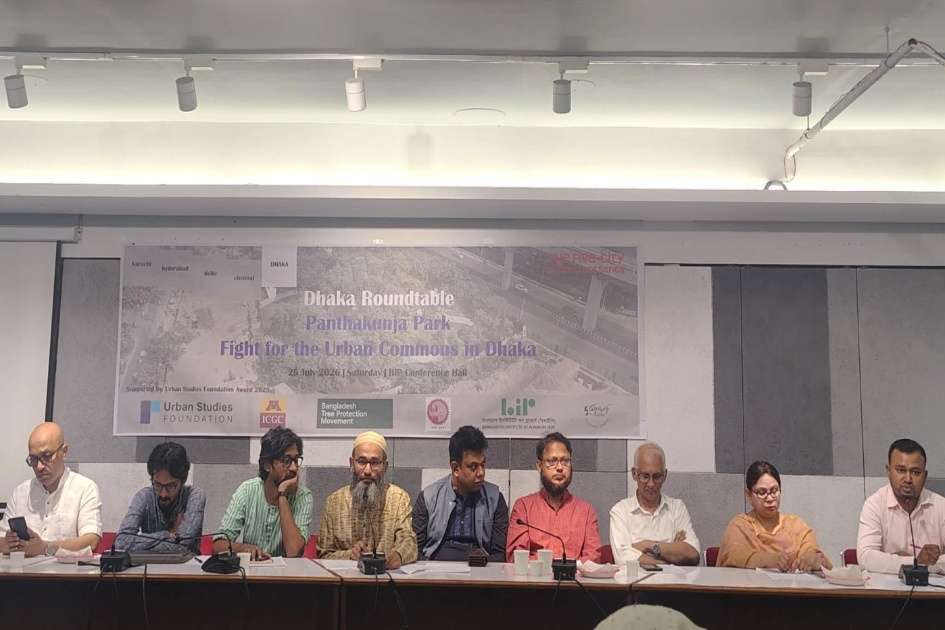

Speakers at a Dhaka roundtable said the ramp would shrink scarce open space, undermine court directives and mainly benefit private car users, urging authorities to prioritise public interest.
Urban planners and environmental experts on Saturday called for the cancellation of a proposed Elevated Expressway ramp through Panthakunja Park, warning that it would damage the Hatirjheel environment and worsen traffic congestion and public suffering across several key areas of Bangladesh’s capital.
The proposed ramp, part of the FDC-Palashi section of the Elevated Expressway, could harm Panthakunja Park and the Hatirjheel waterbody while creating major environmental and traffic management problems in Kathalbagan, Katabon, Nilkhet, Palashi, Dhaka University and the Bangladesh University of Engineering and Technology, they said.
The concerns were raised at a roundtable discussion held at the Bangladesh Institute of Planners auditorium in Dhaka’s Banglamotor area on 25 July.
The event was jointly organised by the Urban Studies Foundation, the Interdisciplinary Center for the Study of Global Change, Buet’s Department of Urban and Regional Planning, the Bangladesh Tree Protection Movement, the Bangladesh Institute of Planners and Duniadari Archive.
Speakers said development could not be considered meaningful when it focused solely on human convenience because human survival was inseparable from nature. They stressed that environmental impacts must be given equal importance when development projects are implemented.
Bangladesh Tree Protection Movement coordinators Amirul Rajib and Naeem Ul Hasan presented the keynote paper.
They said court directives prohibited the construction of any structure around Panthakunja Park, but the previous Awami League government had failed to comply with those orders. They added that the interim government did not stop the work and the current Bangladesh Nationalist Party government had also taken no effective initiative.
Continued tree felling in the Panthakunja and Hatirjheel areas for the project would eventually make Dhaka uninhabitable, they said.
Urban planner Professor Adil Muhammad Khan called for the Elevated Expressway ramp at the Panthakunja Park section to be cancelled.
He said the ramp would severely affect the environment and traffic movement around Panthakunja Park, the Hatirjheel waterbody, Dhaka University, Buet and nearby areas, while its benefits would mainly go to private car users.
Khan also questioned why the government had failed to respond effectively despite a long-running campaign demanding the ramp’s cancellation.
Urging the authorities to respect public opinion, he called on the government to scrap the ramp. He also said an investigation was needed to determine whether any irregularities or corruption had occurred in the project during the previous government’s tenure.
Kathalbagan resident Sadman Sakib said the densely populated neighbourhood lacked open spaces or playgrounds where people could seek shelter during disasters such as earthquakes.
Panthakunja Park was the area’s only remaining refuge, he said, but it now risked shrinking because of the Elevated Expressway and unplanned development projects. He urged the government to reconsider the project in the public interest.
Urban planner Professor Akhtar Mahmud said Dhaka was heading towards severe public suffering because of a lack of planned urban management.
He said several meetings had been held with advisers and officials of the interim government over the campaign to protect Panthakunja Park, but no solution had been reached.
Mahmud also proposed establishing a separate “Park and Recreation Authority” to protect parks and wetlands in Dhaka.
Bangladesh Institute of Planners Vice-President Sheikh Muhammad Mehdi Ahsan said it was time to question how realistic the goal of building a clean and green Dhaka was without structural reforms to the Capital Development Authority, known as Rajuk, and the city corporations, under whose supervision the capital had become one of the world’s least liveable cities.
Writer and thinker Firoz Ahmed said administrative decisions and management, rather than the public, were primarily responsible for the destruction of parks and waterbodies.
He called for public participation in the planning process and urged experts and citizens to speak out more strongly on the issue.
Buet Professor Dr Abdul Hasib Chowdhury said preserving urban open spaces had become increasingly difficult because of limitations in the existing legal and institutional framework.
Reforms to laws and policies based on the public interest were essential, he said.
The discussion was moderated by Bangladesh Institute of Planners General Secretary Professor Musleh Uddin Hasan. It was also addressed by Buet Professor Abdul Hasib Chowdhury, urban and regional planner Khandaker Niaz Rahman, writer and political organiser Firoz Ahmed, Bengal Stream chief curator Niklaus Graber, Urban Development Journalists Forum President Motin Abdullah and others.




