


As the Ganges treaty nears expiry, the unresolved Teesta dispute exposes how climate stress, upstream politics and gendered water burdens are reshaping river diplomacy for millions downstream.
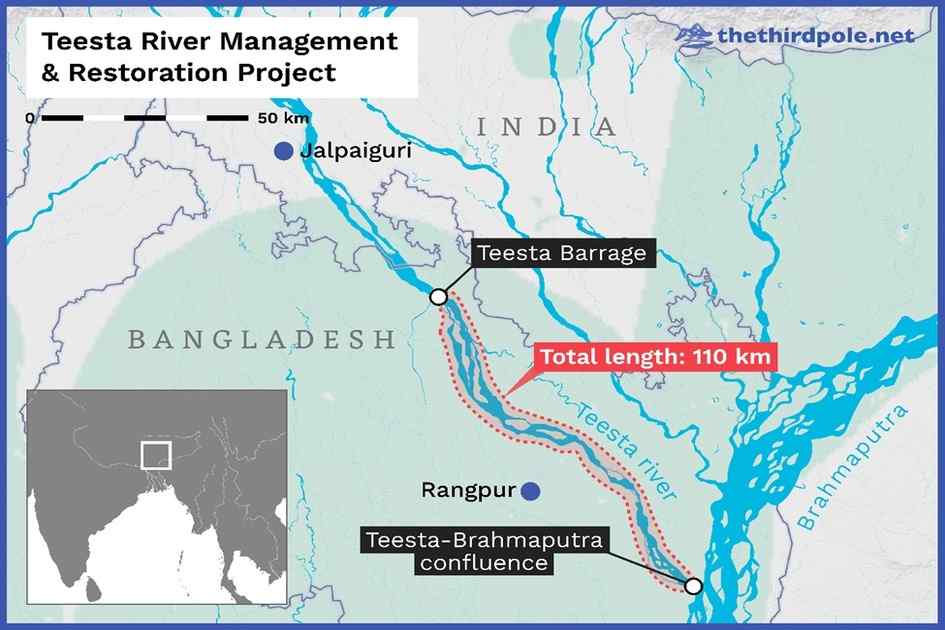
The Teesta is a relatively modest transboundary river by South Asian standards, flowing approximately 414 kilometers from its glacial source in North Sikkim, India, to its confluence with the Jamuna River, the main channel of the Brahmaputra in Bangladesh, yet for more than four decades it has held two nations hostage to a negotiation neither side has dared to finish. What is sold to the public as a technical dispute over percentages is, in truth, a failure of political imagination on both sides of the border, and it is long past time to say so plainly.
According to the documented record of the dispute, an interim 1983 arrangement gave India 39 percent of dry-season flow and Bangladesh 36 percent, leaving the rest unresolved, as if ambiguity itself were a policy. A more serious 2011 draft treaty offered Bangladesh 37.5 percent against India’s 42.5, with the remaining 20 percent left unallocated for the river’s own ecological flow, and collapsed at the eleventh hour when West Bengal’s chief minister, Mamata Banerjee, withheld her endorsement. Water is a state subject under India’s constitution, and successive Indian officials have themselves invoked this, citing Article 253, to argue that no transboundary treaty can be concluded without the consenting state’s cooperation. That constitutional structure does not hand a chief minister a formal legal veto over foreign policy, which constitutionally sits with the Union government; it hands her something more durable in practice the power to withhold the political and administrative cooperation any agreement needs to actually function on the ground. For fifteen years, that practical leverage has been enough to stall the food security of an entire neighboring country. That is not federalism functioning as intended; it is federalism used as an alibi.
The landscape shifted in 2026, when the Bharatiya Janata Party won West Bengal’s state assembly and removed the figure most associated with blocking a deal, though anyone who believes the obstacle was ever a single person, rather than the entrenched farmer politics of northern West Bengal that any successor government must still answer to, is not paying close enough attention. Banerjee’s veto was never the disease; it was the symptom of a genuine, unresolved constituency of north Bengal farmers who fear losing water they depend on a constituency that outlasts any one politician and that Delhi will have to reckon with regardless of who sits in Kolkata. The stakes have only grown sharper: the 1996 Ganges Water Treaty, long held up as South Asia’s rare success story in river diplomacy, was signed for a fixed thirty-year term with no automatic renewal clause, and that term lapses in December 2026. As of this writing, formal renewal negotiations between Delhi and Dhaka have only just begun, leaving the treaty’s future genuinely unresolved rather than a foregone conclusion in either direction. India’s appetite for renegotiating its terms has convinced Dhaka that even its hard-won agreements are provisional at Delhi’s convenience. Into this volatile mix has stepped a great-power rivalry that neither river nor region asked for: Bangladesh’s outreach to China for financing of Teesta management, in proximity to India’s sensitive Siliguri Corridor, has hardened New Delhi’s security instincts rather than accelerating the cooperation Dhaka hoped it would provoke. Using a river as leverage in a geopolitical chess match is a dangerous game to play with the water millions of people drink.
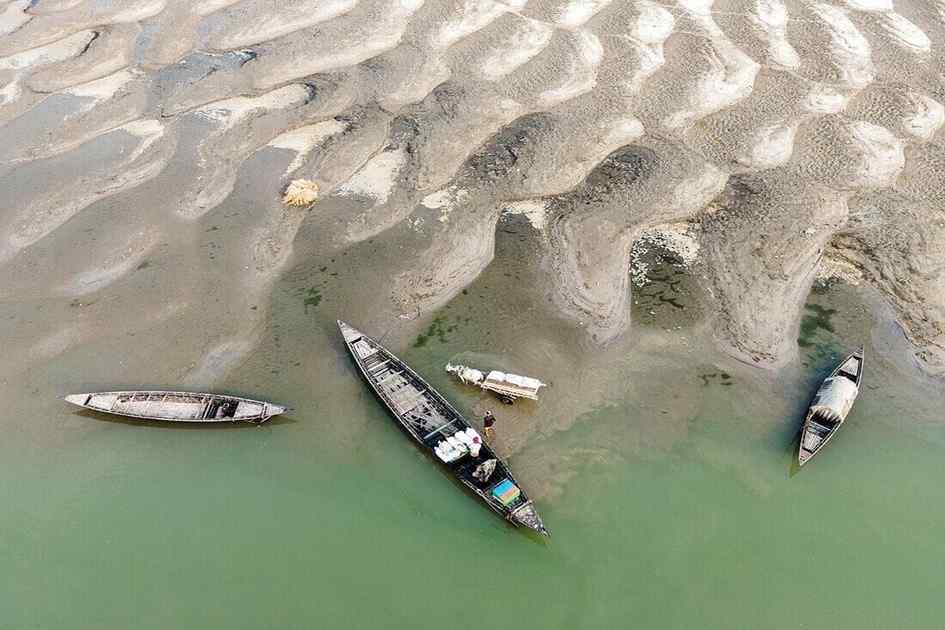
None of this brinkmanship would matter as much if the hydrology beneath it were stable, but it is not, and pretending otherwise is its own form of denial. According to a landmark 2023 assessment by the International Centre for Integrated Mountain Development (ICIMOD), up to 80 percent of the Hindu Kush Himalaya’s glacier volume could be lost by 2100 under high-emissions scenarios, threatening the long-term flow of the ice-fed rivers that feed the Teesta system. And, as documented in reporting on the October 2023 South Lhonak glacial lake outburst flood, the disaster that destroyed the Teesta-3 dam in Sikkim was not a freak accident; it was a preview. The basin now lurches between extremes with no middle left: Bangladeshi flood-management officials and disaster reports have repeatedly linked monsoon flooding in Nilphamari, Lalmonirhat, and Rangpur to India opening the gates of the Gazoldoba Barrage though these same reports are consistent that the barrage releases compound, rather than single-handedly cause, flooding that also depends on heavy upstream and local rainfall, riverbed siltation, and the condition of Bangladesh’s own embankments. The dry season, meanwhile, leaves the same river reduced to sandbars. A 2015 assessment of irrigation shortfall in the Teesta Barrage Irrigation Project’s command area, covering roughly one hundred thousand hectares across five Bangladeshi districts and drawing on data from 2006 to 2015, found the shortfall recurring year after year; that figure describes the actively irrigation-dependent command area studied, not the river’s much larger total floodplain or catchment population. Compounding this, a widely cited International Food Policy Research Institute (IFPRI) analysis conducted with Bangladesh’s Centre for Agri-research and Sustainable Environment & Entrepreneurship Development (CASEED) estimates that Bangladesh’s Teesta-dependent districts forgo about 1.5 million tons of Boro rice production a year, some 8.9 percent of national output, because of the water shortage. This is a modeled estimate of unrealized production based on irrigation shortfalls, not a directly measured harvest loss, and researchers project the shortfall will deepen, reaching an estimated 8 percent of national rice production by 2030 and 14 percent by 2050 under current trends. Climate change does not invent new conflicts out of nothing; it strips away the slack that once let old, unresolved disputes limp along without collapsing, and the Teesta has now run out of slack.
What almost never makes it into diplomatic communiqués is who bears the everyday cost of the Teesta’s uncertain flow: overwhelmingly women and girls. Across Bangladesh’s Teesta basin, fetching and managing household water remains a gendered responsibility rather than a matter of choice. During the dry season, declining river flow and falling groundwater levels often force women and girls to travel longer distances or spend additional hours collecting water, time taken directly from education, paid work, rest, and community participation. This is not a peripheral consequence of transboundary water politics; it is one of its most immediate human impacts.
A 2019 study conducted in four upazilas of the lower Teesta basin in Rangpur division areas repeatedly hit by seasonal floods, flash floods, riverbank erosion, and drought found that women absorb a disproportionate share of the resulting burden precisely because they are the primary managers of household water, food, and fuel. The same research found that flooding intensifies women’s workload while men more often leave affected villages in search of alternative income, leaving women to shoulder the caregiving and resource strain at home, compounded by social norms that already restrict their mobility and their voice in public decision-making. A separate household survey of farmers across the same basin found that perceived and actual drought risk diverge significantly by gender, income, and education meaning the basin’s driest years are not felt uniformly even within a single village. This evidence is drawn directly from Teesta-basin communities and from the stressors flow variability, flooding, erosion that actually define the river’s transboundary politics.
Yet the institutions responsible for negotiating and governing the Teesta’s waters remain largely disconnected from these lived realities. Women’s participation in local water governance continues to be constrained by unequal social norms, unpaid care responsibilities, and limited access to decision-making spaces. This exclusion extends beyond the community level to bilateral river governance, where negotiations over the Teesta are dominated by technical and political actors, while the voices of those who experience water insecurity most directly remain largely absent.
A durable peace on the Teesta demands more courage than another round of percentage haggling. It demands adaptive, jointly monitored agreements built on real-time flow data, not historical averages, and not data collected unilaterally by the upstream state and handed downstream on faith, which is precisely the arrangement that has bred Bangladesh’s justified mistrust for decades. It demands that West Bengal’s interests be built into any settlement from the start, rather than treated as an inconvenience to be steamrolled after the fact, a courtesy that must extend equally to the farmers, fisherfolk, and indigenous communities of Bangladesh’s own Teesta floodplain, whose voices are as absent from Dhaka’s negotiating position as West Bengal’s ever were from Delhi’s. It demands gender-responsive governance as a matter of principle, not decoration: gender-disaggregated impact assessments before infrastructure decisions are made, real participation targets for women in river commissions, and adaptation financing aimed squarely at the water and health burdens women disproportionately carry, because a negotiation that excludes half the basin’s population from the table is not a complete negotiation, whatever percentage it eventually settles on. And it demands treating the Teesta not as an isolated bargaining chip but as one river within the wider roster of fifty-four transboundary rivers India and Bangladesh share separate basins, but a shared diplomatic architecture where cooperation on one can unlock trust on all the others, rather than as fifty-four separate opportunities for leverage and delay.
The Teesta is often called a river of diplomatic storms, and the metaphor holds because storms build precisely where pressure outpaces the mechanisms meant to release it. That pressure is not abstract. It is glacial, it is political, and it is gendered, carried daily, quite literally, on the shoulders of women who had no seat at any table where these decisions were made. A settlement that resolves the politics while ignoring who bears the human cost of failure will not be peace. It will simply move the storm into the household, where it has been raging all along.
The author is a development worker working in the field of climate justice and gender justice.




