

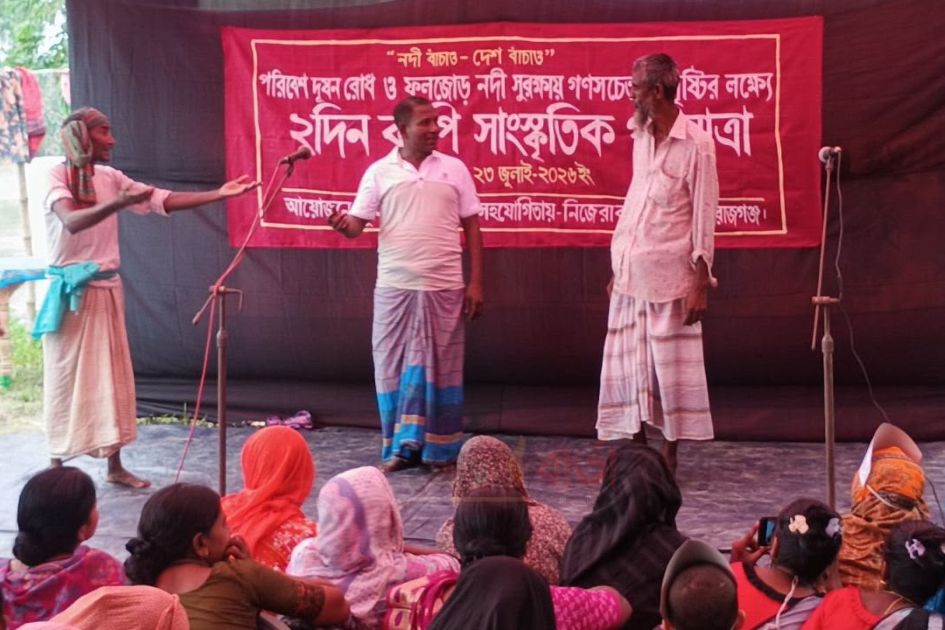

A community-led campaign in Sirajganj combined cultural performances with public engagement to highlight river conservation, as pollution allegations, legal action and environmental governance remain under increasing public scrutiny.
Along the banks of the Phuljhor and Karatoa rivers in northern Bangladesh, communities are turning to cultural activism, public mobilisation and legal advocacy to protect two vital waterways facing growing environmental pressure from pollution, encroachment, declining river flow and climate-related challenges.
Through songs, street theatre, public discussions and cultural performances, residents of Raiganj Upazila in Sirajganj district joined a two-day cultural march calling for urgent measures to restore the ecological health of the rivers that have supported local agriculture, fisheries, biodiversity and livelihoods for generations.
The campaign was organised by local landless community groups with support from the development organisation Nijera Kori, bringing together grassroots leaders, environmental activists, women, children and local residents.
The programme began on Wednesday (July 22) at Kutirchar village on the bank of the Phuljhor River in Dhangara Union. The march later travelled through Dhangara East Para and Gramsonai, where participants held community discussions, performed awareness songs and staged environmental street plays highlighting the importance of river conservation.
On the second day, Thursday, the campaign reached Royhati village in Ghurcha Union before concluding at Ghurcha Old Market with discussions, cultural performances, awareness songs and environmental theatre.
Speakers said the Phuljhor and Karatoa rivers are more than water channels; they are essential parts of local ecosystems, supporting farming, fisheries, biodiversity and rural livelihoods.
However, they warned that the rivers are under increasing pressure from pollution, illegal occupation of river areas, industrial waste concerns, unplanned development and changes in natural river flow.
Phuljhor River at the centre of pollution dispute
The Phuljhor River has become a major environmental concern in northern Bangladesh amid public protests and demands for greater transparency over alleged industrial pollution linked to SR Chemical Industries Ltd.
Local residents and environmental activists have alleged that untreated industrial effluents from the company entered the river system, affecting aquatic ecosystems, agricultural activities and community health.
The company is linked to businessman and politician Golam Mohammad Siraj, widely known as G.M. Siraj, founder of SR Group. He previously served as a lawmaker for Bogura-6 and was elected as a Member of Parliament from the Bogura-5 constituency under the Bangladesh Nationalist Party.
The company’s association with a politically influential figure has increased public calls for independent investigations, accountability and effective regulatory oversight.
Environmental campaigners argue that allegations involving industrial facilities connected to influential individuals require transparent review and strict enforcement of environmental laws to maintain public trust.
However, SR Chemical Industries Ltd has denied the allegations, saying its Effluent Treatment Plant is operational and that the company complies with Bangladesh’s environmental regulations. The company has maintained that it does not release untreated waste into the river and follows required environmental standards.
Karatoa River faces pollution and encroachment concerns
Alongside concerns over the Phuljhor River, activists and local communities have raised alarm over the declining condition of the Karatoa River, one of northern Bangladesh’s historically important waterways.
Campaigners have blamed years of inadequate monitoring, delayed action and weak enforcement for allowing pollution and alleged encroachment, which they say have contributed to reduced river flow and ecological decline.
The NGO Thengamara Mohila Sabuj Sangha has faced allegations from the Bogura District Administration, the local government authority, and environmental activists over alleged encroachment and pollution-related concerns involving the Karatoa River.
According to findings cited by authorities and activists, TMSS was identified as having occupied 16.97 acres of river land. The organisation has faced calls for accountability and restoration of areas identified as illegally occupied.
Environmental activists say restoring the Karatoa River requires transparent investigations into all allegations of encroachment, regardless of the identity or influence of those involved, alongside effective implementation of river protection laws.
Legal action raises questions over environmental enforcement
The dispute over river pollution has also moved into the legal arena.
The Bangladesh Environmental Lawyers Association, a public interest environmental law organisation, has filed a writ petition concerning alleged pollution linked to SR Chemical Industries and Majumdar Products, which activists say has affected the Phuljhor, Karatoa and Bangali rivers.
Following an initial hearing, the High Court issued a rule seeking explanations from relevant government agencies and the companies over alleged failures to prevent environmentally harmful activities.
The court also sought clarification on why necessary measures should not be taken under Bangladesh’s Environment Conservation Act to prevent further pollution and protect the rivers.
The case has renewed debate over environmental governance in Bangladesh, including industrial compliance with effluent treatment requirements, monitoring systems and the capacity of regulatory institutions to protect rivers.
Speaking virtually during the public hearing in Bogura, BELA Chief Executive Syeda Rizwana Hasan said government initiatives to restore the Karatoa River were welcome but stronger action was needed against illegal occupation and pollution.
She also said authorities should consider removing the Khulshi sluice gate if investigations find that it is affecting the river’s natural flow.
Local voices drive river protection movement
Residents say the river crisis is directly affecting everyday life.
Farmers, fishers and river-dependent communities have expressed concerns over declining water quality, reduced biodiversity and threats to traditional livelihoods.
Participants at the cultural march said protecting rivers is not only an environmental issue but also a question of food security, community resilience and the future of rural economies.
“The survival of rivers is directly linked with the survival of communities. When rivers lose their natural flow or become polluted, people, agriculture and biodiversity all suffer,” youth activist Faysal Biswas said.
Among those addressing the gatherings were Nijera Kori’s Rajshahi divisional coordinator Pavitra Sarkar, central cultural activist Idris Ali, divisional organiser Saifun Nahar Ratna, Bangladesh Poribesh Andolon Sirajganj district convener Dipak Kumar Kar, Nijera Kori’s Raiganj coordinator Asabur Rahman and local climate activist Faisal Biswas.
Local landless association leaders and members from Dhangara and Ghurcha unions, along with hundreds of residents including women, men and children, participated in the two-day initiative.
A wider freshwater challenge for Bangladesh
Environmental experts say the challenges facing the Phuljhor and Karatoa rivers reflect a broader freshwater crisis across Bangladesh, where rivers are increasingly affected by pollution, sedimentation, encroachment, declining natural flows and climate change impacts.
Community groups argue that river restoration requires cooperation between residents, government agencies, environmental organisations and responsible industries.
Under the slogan “Save rivers, save the country,” participants called for stronger monitoring, greater public awareness and effective enforcement of environmental laws to ensure that the Phuljhor and Karatoa rivers remain protected for future generations.




