

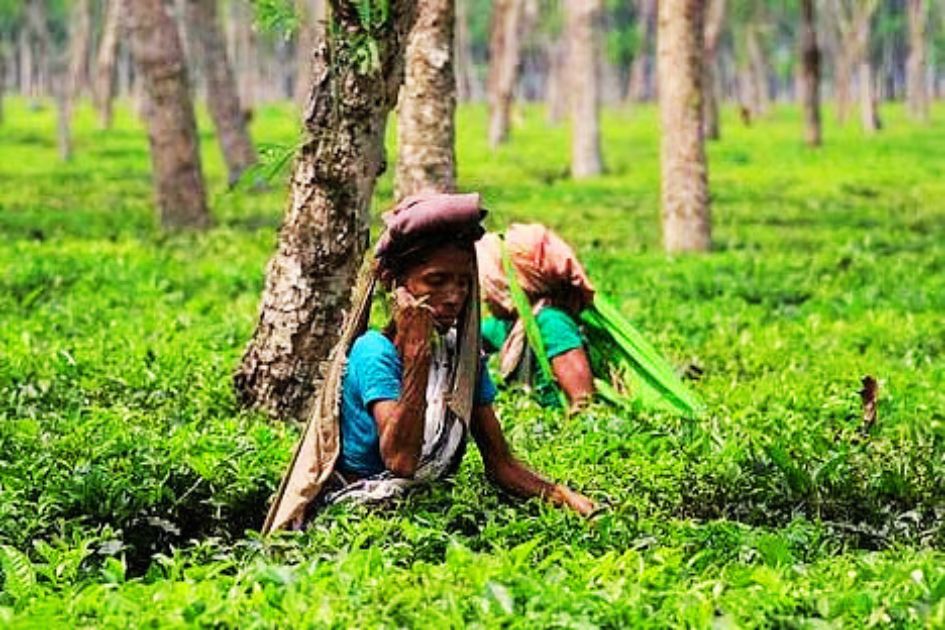



From Amu tea estate to memories of Gorée Island, inherited labour, landlessness and cultural resistance frame renewed calls for reform across Bangladesh’s tea gardens today.
Nearly two centuries after British colonial rule established tea estates in what is now Bangladesh, generations of workers remain landless, poorly paid and tied to a labour system whose roots lie in coercion, displacement and inherited servitude.
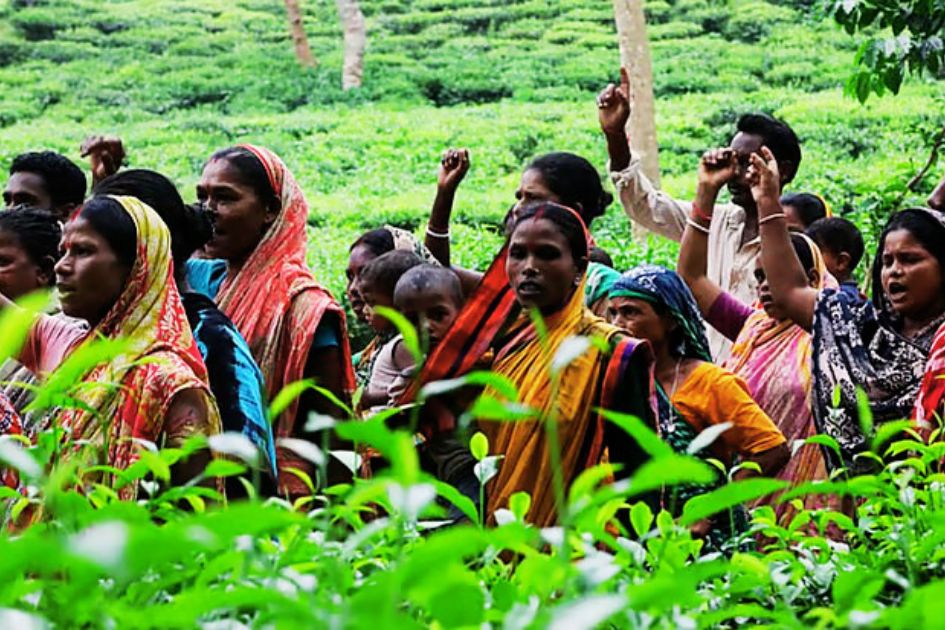
The conditions facing tea workers have again drawn attention around August 23, observed as the International Day for the Remembrance of the Slave Trade and its Abolition, as workers press demands for a daily wage of Tk 500, cancellation of the Minimum Wage Board’s 2023 gazette, elections to the Bangladesh Tea Workers Union, or B-77, and permanent settlement of land used by tea garden communities.
The history of the Amu tea estate in Chunarughat, in Bangladesh’s northeastern Habiganj district, reflects the origins of that system.
The estate, owned by National Tea Company and located in Ahmedabad Union near the Tripura border, was established in 1870 after ancient sal forests, farmland and settlements of Manipuri, Tripura, Santal and Munda communities disappeared.
British rulers brought Indigenous people by force from places stretching from Mayurbhanj to the Nilgiris and from Ranchi to Bihar. Under the guise of “girmit”, or lifetime bondage contracts, one member of each family was given work in the tea estate.
Matan Burha of Amu tea estate was among them.
When Matan retired at the age of 60, his job passed to his eldest son, Largo Kharia. Largo’s position later went to Budhni Kharia, wife of his son Bandul. Budhni’s job passed to her son Manbadhua, whose son Swapan subsequently inherited his father’s position and now works as a permanent labourer at Amu.
In this way, permanent tea estate jobs have moved from one generation of a family to another.
Swapan and his wife Rupa Kharia have two children, Tanmoy and Ankit, who attend school. They do not want their children to become tea workers.
Swapan’s father earned eight annas a day. Swapan now receives Tk 187 daily, raising a broader question over how a family can survive on that amount amid rising living costs.
From the beginning, tea estates functioned as places of confinement under a system of servitude.
Workers were once paid with copper “tea-token” currency carrying the name of individual estates. Money issued by one estate could not be used in another.
Labourers had to put shoes on estate managers. They were not given glasses for drinking water while working. Workers entering officials’ bungalows had to use the back door.
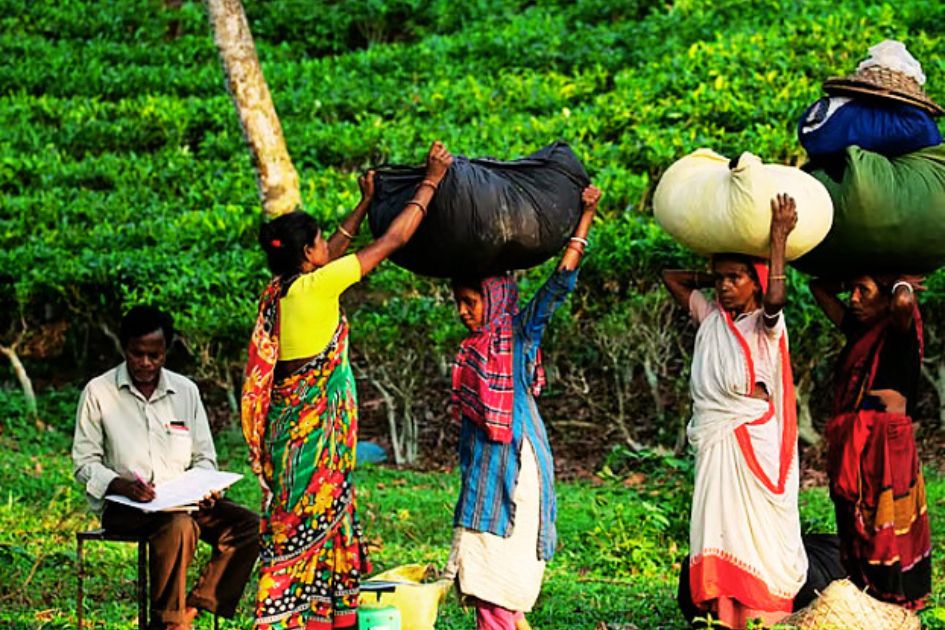
The daily requirement for plucking 24 kilograms of tea leaves became known as the “nirikh”. Workers who failed to meet the target did not receive full wages.
Estate owners manipulated the quota and withheld pay. Children of workers were prevented from studying and the authorities remained active in ensuring they did not gain access to higher education.
At Amu, Ghanshyampur Primary School was established in 1888, 18 years after the estate itself was created.
People died year after year from hunger and disease.
Many forms of such harsh rule have changed, but tea workers are still treated as “slaves”. Although families have been given small homestead plots and “khetland” for cultivation, they have no permanent settlement rights over the land.
Despite sustaining the country through almost 200 years of labour and sweat, tea estate workers remain effectively landless.
Tea communities have staged repeated movements, from the historic “Muluk Chalo” campaign to struggles against bonded labour and for higher wages, but freedom has remained elusive.
The wider history of August 23 is rooted in the revolt against the trans-Atlantic slave trade.
An uprising that began in 1791 in Saint-Domingue, now Haiti, against the organised slave trade linking Africa, Europe, the Americas and the Caribbean eventually led to Haiti’s independence.
In memory of the historic Haitian slave revolt, UNESCO declared August 23 the International Day for the Remembrance of the Slave Trade and its Abolition.
The decision was taken at UNESCO’s 29th General Conference on July 29, 1998. The day was first observed in Haiti in 1998 and in Senegal in 1999.
Neither the abolition of the slave trade nor the killing of tea workers is officially commemorated in Bangladesh’s tea estates by the state or estate owners.
The colonial legacy that has concealed coercion and oppression in tea gardens requires fundamental reform.
Tea workers are again raising four demands: a daily wage of Tk 500, cancellation of the Minimum Wage Board’s 2023 gazette, an election to the Bangladesh Tea Workers Union, or B-77, and permanent settlement of land for tea garden communities.
In 2011, writer and researcher Pavel Partha visited Senegal to attend the World Social Forum.
Renowned economist Samir Amin was there and said that another kind of world was possible through social struggle.
From the Senegalese capital Dakar, Partha crossed the sea to Gorée Island, once the largest slave-trading centre on the African coast.
Portuguese, Dutch, English and French powers controlled the trade.
Seeing cell-like barred rooms and the brutal platforms where enslaved people were auctioned left him with a deep sense of guilt.
As the island disappeared into the distance across the Atlantic on his return journey, Gorée no longer seemed unfamiliar to him. It recalled the “labour lines”, the settlements of workers inside Bangladesh’s tea estates.
UNESCO has designated Gorée as a heritage site.
The continuing question is whether tea estates carrying the living memory of colonial servitude could ever receive similar recognition.
While Dhaka University was being established, tea workers were challenging bondage and oppression through the “Muluk Chalo” movement.
Conversations with elderly tea workers recalled severe abuse by British managers.
Labourers were forced to work for more than 16 hours. Unable to endure the conditions, some left aboard freight trains while others began their journey on foot.
Workers were shot dead on May 20, 1921.
The history of the tea workers’ killing has remained concealed by the state and successive regimes.
The absence extends beyond tea estates. Narratives of organised struggles by lower-class communities against unjust slavery and labour exploitation have largely remained outside dominant historical structures.
The brutality of slavery has often been preserved through literature and memory.
Alex Haley’s “Roots” evokes the story of Kunta Kinte, captured in a net from a Mandinka Indigenous village in Gambia and sold into slavery.
Harriet Beecher Stowe’s “Uncle Tom’s Cabin” from 1852, William Wells Brown’s “Clotel” from 1853, Herman Melville’s “Benito Cereno” from 1855, Toni Morrison’s “Beloved” from 1987, Andrea Levy’s “The Long Song” from 2010 and Yaa Gyasi’s “Homegoing” from 2016 also bring forward memories of the slave trade, colonial oppression, slavery and slave resistance.
The forms and boundaries of slave trading and servitude have changed with geography, time and structures of power.
Historical records also point to the buying and selling of people in Bangladesh beyond tea estates.
Some such documents remain in the record room of the Sylhet Sadar Sub-Registry Office.
Slave-sale deeds dated 1801, 1806 and 1807 show that Ganai Bhandari was sold for Tk 25, Sheikh Biania for 10 rupees and Nab Dasi and her daughter Amra Dasi were sold together.
At one time, landowners and influential families forced poor and indebted people into servitude in return for labour.
Domestic work and agricultural production became foundations for lives of confinement.
Powerful groups exploited epidemics, disasters, wars, famine, poverty, debt and social marginalisation to sustain systems of slavery.
During the Sultanate period, Bengal’s sultans imported enslaved people, including Africans known as “Habshi” slaves.
European colonisation later linked slavery in Bengal to the wider global slave trade.
Researcher Rila Mukherjee in 2009 identified the coast of southeastern Bengal as an important “slave-collection” region in the 17th century.
One factor behind conflicts between the Mughals and Portuguese-Arakanese raiders was an effort to stop the slave trade.
Amal Kumar Chattopadhyay’s 1977 work, “Slavery in the Bengal Presidency under East India Company Rule 1772-1843”, remains an important academic account of slavery in colonial Bengal.
Institutionalised slave trading was abolished through the Indian Slavery Act of 1843, but different forms of slavery continued socially under discriminatory rule and structures of power.
Public discussion of slave trading in tea estates, colonial domination and tea workers’ struggles remains limited.
Dominant systems have instead presented tea estates through a stereotypical image of scenic natural beauty.
Rizia Rahman’s “Surjo Sobuj Rokto” from 1981, Samaresh Majumdar’s “Buker Ghore Bondi Agun” from 2019, Badrun Nahar’s “Muluk Jatra” from 2024 and Mulk Raj Anand’s “Two Leaves and a Bud” from 1937, though the last was not written in Bangla, have sought to portray experiences of confinement, coercion and suffering in tea estates.
Songs and oral narratives recalling slavery and oppression also survive through tea garden festivals including Karam, Sohrai, Baha, Phagua and Danda.
These are not merely cultural records of particular communities. They also represent accounts of claims for justice against colonial wrongdoing.
Such community records from tea estates require preservation by the state.
Herbicide is known among tea workers as “dawaimara”, or poison.
Workers have to spray it without safety preparations.
Many people have lost limbs or suffered chronic illnesses and other health problems as a result.
Repeated closures at one tea estate in Moulvibazar also left many workers suffering from hunger and illness.
For 200 years, tea estates have not been able to provide jobs for everyone.
About 500,000 people depend on the earnings of more than 100,000 permanent workers and nearly 40,000 temporary labourers.
Some daily work is available in the gardens for six months from Baishakh to Ashwin in the Bengali calendar.
From Kartik to Chaitra, hardship becomes acute. Work is also scarce in nearby villages outside the estates during that period.
People outside the gardens socially treat tea communities as “untouchable” and marginalised.
Tea workers have crossed generations wearing old, used clothes.
Shibnath Munda, a young permanent worker at a tea estate in Barlekha, Moulvibazar, was denied his mother’s job after her death.
Estate authorities cited financial difficulties in refusing to transfer the position previously held by his mother, Mohini Munda.
Poverty and the discriminatory environment of the estate forced Shibnath to leave school after the ninth grade.
Asked whether he would make his own children work in the estate, Shibnath smiled broadly and replied: “Given the condition of the garden, I will not make them work here.”
Despite the deep scars of colonialism, children from tea garden communities are increasingly pursuing education and entering professions outside the estates.
Dulli Munda, 77, of Amu tea estate said he had financed his son’s education by selling firewood.
“I educated my son by selling firewood. My son now earns 13,000. But we still eat leftover rice,” he said, ending with the phrase, “Ale naao basi mandi jajmale.”
The descendants of people displaced and oppressed through slavery and colonial domination have also created new cultural expressions of resistance around the world.
“Tango” emerged in poor urban areas of Argentina among descendants of enslaved Africans, European immigrants and local Creollos.
The Garifuna language and culture of Honduras, Guatemala, Nicaragua and Belize, and Brazil’s “Samba de Roda”, created through the mixing of Portuguese and African cultures, preserve memories of and resistance to slavery and colonialism through song and poetry.
Colombia’s marimba music, the Cocolo musical theatre tradition of the Dominican Republic, the Festival of Saint Francis of Assisi in Quibdó, Colombia, Cuba’s Tumba drums and the Maloya songs of Malagasy slaves continue to carry accounts of the suffering and rebellion of enslaved people.
Bangladesh’s tea estates are home to 85 Indigenous ethnic communities.
Only 18 ethnic groups, however, are listed in the schedule of the Small Ethnic Groups Cultural Institutions Act.
Although each community has its own language, food traditions and cultural heritage, the concentration of many groups within the same geographical space has also produced a new common language of communication inside tea estates.
Some festivals, dance forms and songs have collectively developed into a broader cultural identity associated with the tea gardens.
Tea communities have also challenged structural hunger through foods they created from young tea leaves, including “pattichkha” and “pattidlar”.
From the wounds of confinement, the drumbeat of awakening and liberation is sounding across the tea estates.
The question is whether companies, estate owners and the state can hear it.
The article is republished from the Daily Prothom Alo.




