

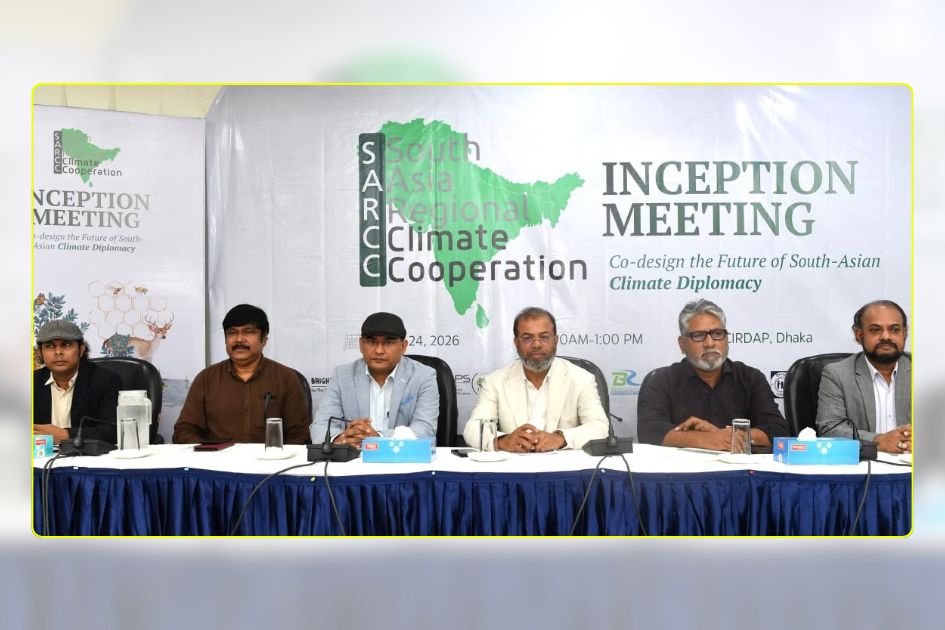



Officials, experts and civil society representatives highlighted cross-border threats including floods, cyclones, drought, heatwaves, glacier changes and sea-level rise at the Dhaka meeting.
South Asian countries need stronger regional cooperation to confront shared climate risks, Bangladesh’s State Minister for Environment, Forest and Climate Change Sheikh Faridul Islam, said on Today.
Speaking at a meeting of South Asia Regional Climate Cooperation or SARCC, at the CIRDAP auditorium in Dhaka, he said the region faced common climate threats that required coordinated action.
Sheikh Faridul Islam said Bangladesh was implementing a range of programmes under the leadership of the Prime Minister to address climate risks.
He said the government was working on several initiatives, including the planting of 250 million trees and measures to control pollution.
A master plan has been taken to free rivers around Dhaka from pollution, he said, adding that initiatives were being taken to close pollution outlets falling into the Buriganga, Shitalakshya, Turag and Balu rivers.
Speaking as a special guest, Dr Md Saimum Parvez, Special Assistant to the Prime Minister on Environment, Forest and Climate Change, said SAARC and BIMSTEC needed to be activated to address climate risks.
Climate change risks were no longer a problem for any single country, he said.
Political will was the most urgent requirement for dealing with cross-border problems, he added, calling on all to work together to build a safer and risk-free world for future generations.
The keynote paper was presented by Dr A K M Saiful Islam, a professor at the Institute of Water and Flood Management at Bangladesh University of Engineering and Technology.
“Climate change is no longer a future threat; it is the current development reality of South Asia,” he said.
He said the impacts of heatwaves, floods, cyclones, drought, irregular rainfall, glacier changes and sea-level rise were crossing national borders.
Addressing those risks required integrated, regional and future-oriented initiatives, he said.
Other special guests included Jamail Bashir JB, member and technical expert of the National Tree Plantation Cell at the Prime Minister’s Office, Sharif Jamil, member secretary of Dharitri Rokkhay Amra, Ziaul Haque, coordinator of the Least Developed Countries negotiating group, and climate negotiator M Hafizul Islam Khan.
Senior journalist Habib Rahman spoke at the beginning of the event.
Thematic discussions were joined by Advocate M A Mukit, chairman of the Human Safety Foundation, and Mir Mohammad Ali, assistant professor at Sher-e-Bangla Agricultural University.
Other discussants included Md Ashrafuzzaman Khan, coordinator of the climate change programme at CCDB, Sarwar Alam Dipu, programme manager of IUCN Bangladesh, Mahmudul Hasan Tareq, head of the Water, Food and Climate programme at HELVETAS Bangladesh, Sharmin Nahar Nipa, assistant director of the Centre for Climate Change and Environmental Research at BRAC University, and Professor Dr Kamruzzaman Majumder, chairman of the Center for Atmospheric Pollution Studies.
Mohammad Ali Shahin, head of advocacy at Young Power in Social Action, environmental and climate expert Dr Hasib Md Irfanullah, and S M Monzur Rashid, director of Unnayan Onneshan, also took part in the discussion.
Climate experts, policymakers, researchers, development workers, media professionals and young representatives joined the meeting, held under the theme “Co-design the Future of South-Asian Climate Diplomacy.”




