

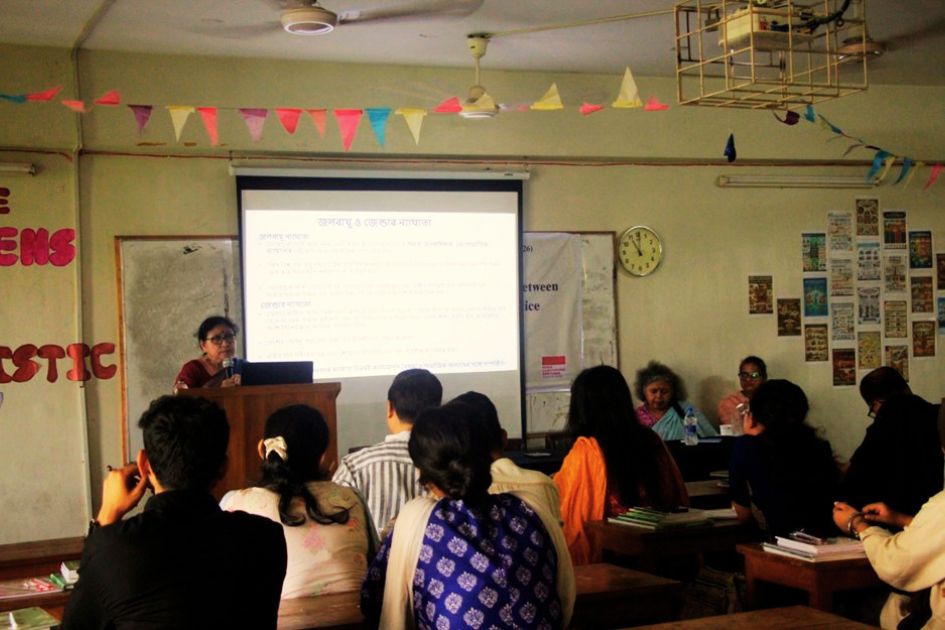



Speakers at the Jagannath University event urged climate policies to confront structural exclusion, bringing academic, community and youth perspectives into Bangladesh’s gender-responsive climate dialogue.
Academics, researchers, development practitioners and students gathered in Bangladesh’s capital on 23 August for a programme focused on the links between gender inequality and climate vulnerability.
Research Initiatives Bangladesh, a research organisation, organised the programme titled “Sensitization on the Interconnection between Gender Justice and Climate Justice” in collaboration with the Department of Anthropology at Jagannath University in Dhaka and with support from Rosa-Luxemburg-Stiftung South Asia.
The event aimed to deepen understanding of the interconnected nature of gender inequality and climate vulnerability while exploring the importance of inclusive and equitable approaches to climate action.
Suraiya Begum, Director of Research Initiatives Bangladesh, delivered the keynote presentation on “Intersectionality Between Gender Justice and Climate Justice.”
In her presentation, Begum highlighted that climate change does not affect all people equally and emphasised the need to address structural and gender-based inequalities in climate policies and actions.
Dr. Meghna Guhathakurta, Writer and Researcher, attended the programme as the Special Guest. Drawing on her research and experience, she shared insights on gender justice, climate change, social inequality and the importance of centering marginalized communities in discussions on climate justice.
Dr. Habiba Sultana, Chair of the Department of Anthropology at Jagannath University, also spoke on the relationship between gender, society and climate change, contributing to the academic and policy-oriented discussion.
The session was chaired by Dr. Fatama Sultana Suvra, Associate Professor in the Department of Anthropology at Jagannath University. She facilitated the discussion and encouraged participants to critically engage with the social and gender dimensions of climate change.
Students from the Department of Anthropology at Jagannath University actively participated in the programme. Their questions, reflections and discussions contributed to the session and reflected growing interest among young people in gender justice, climate justice and social transformation.
The programme emphasised that climate justice cannot be achieved without addressing existing gender inequalities and other forms of structural exclusion.
The discussion also highlighted the importance of creating spaces where academic knowledge, community experiences and youth perspectives can come together to inform more inclusive climate action.
Research Initiatives Bangladesh thanked the speakers, the Department of Anthropology at Jagannath University, participating students and Rosa-Luxemburg-Stiftung South Asia for their contributions and support.
RIB said it remained committed to strengthening dialogue, research and collective action toward a more just, inclusive, gender-responsive and climate-resilient Bangladesh.




