

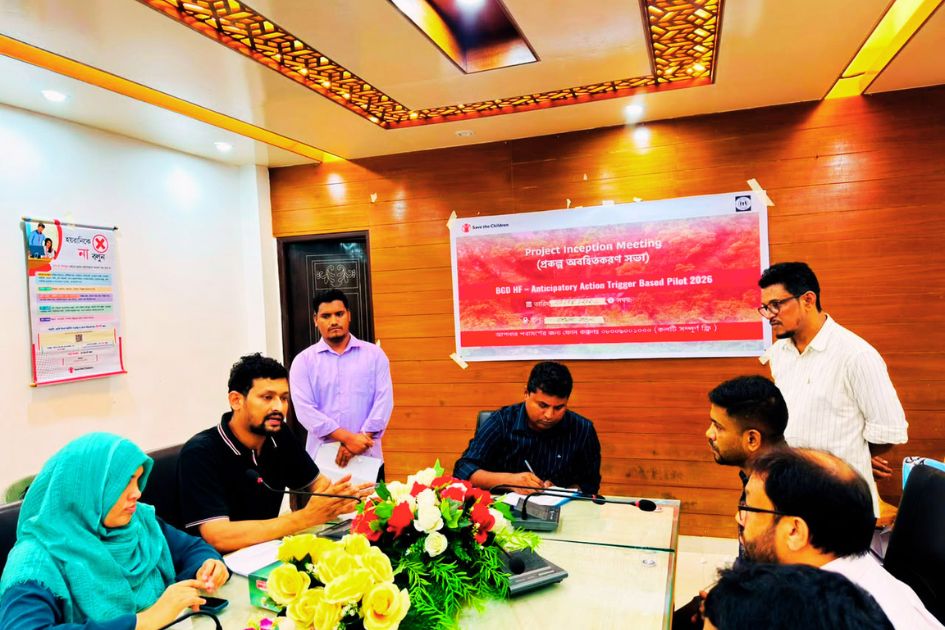



The forecast-based initiative used pre-arranged funds and risk triggers to help vulnerable Banshkhali households move, buy essentials and protect assets before potential damage.
Cash assistance has been provided to 420 highly vulnerable families in Bangladesh’s southeastern Chattogram district to help them prepare before a possible landslide disaster, organisers said.
The support was distributed in Banshkhali upazila, where families exposed to landslide risks received Tk 6,000 each under the “Anticipatory Action Trigger-Based Pilot-2026” project.
Of the families, 390 received the money through the mobile financial service bKash, while 30 received direct cash assistance.
The project is being implemented under Save the Children Bangladesh’s Humanitarian Fund initiative with support from Young Power in Social Action or YPSA, a non-governmental development organisation.
Organisers said the families were selected after landslide risks increased based on forecasts from the Bangladesh Meteorological Department and monitoring of pre-determined triggers.
The support targeted highly vulnerable households in four project-covered unions of Banshkhali upazila: Pukuria, Sadhanpur, Kalipur and Bailchhari.
Beneficiaries were selected using information from the Start Network’s Common Beneficiary Database, along with field-level verification. Organisers said the selection also followed set criteria based on the risk level of each household.
An orientation meeting on the project was held atCash aid reaches Officers’ Club. Banshkhali Upazila Nirbahi Officer Md Ruhul Amin attended as chief guest.
Local union parishad chairmen and members, representatives of government offices, journalists, civil society representatives and volunteers were also present.
“When support reaches vulnerable families before a disaster, they can prepare in advance according to their own needs,” Ruhul Amin said. “Especially in disasters such as landslides and heavy rainfall, preparedness plays an important role in reducing damage to lives and property.”
He said the relevant union parishads and the administration had provided necessary support in beneficiary selection, verification and assistance distribution at the field level.
YPSA disaster management focal point Sanjida Akter said anticipatory action aims to deliver support to vulnerable people before a disaster, alongside conventional post-disaster assistance.
“Through quick decision-making and early action based on forecasts, it is possible to reduce the potential negative impacts of disasters on people’s lives, assets and livelihoods,” she said.
Mohammad Arafat Hossain, manager of YPSA’s Anticipatory Action Trigger-Based Pilot-2026 project, said the initiative includes coordination with local administration, city corporation authorities, union parishads and other stakeholders.
He said the project also includes verification of information on at-risk households, monitoring of forecasts and awareness activities on what should be done before disasters.
“The effectiveness and experience of the initiative will be evaluated later through post-distribution monitoring and lesson-learned activities,” he said.
Under conventional disaster management, assistance is usually provided after a disaster has occurred and damage has already been done.
Anticipatory action works differently. It is a forecast-based early measure in which action is taken before a disaster strikes, once a potential hazard is forecast and pre-determined risk indicators or triggers are activated.
The approach uses pre-arranged funds and activities to strengthen the preparedness and capacity of vulnerable people before possible damage occurs.
Organisers said timely cash assistance can help a family move to a safer place, collect food and essential supplies, or protect homes and livelihood assets before a disaster.




