

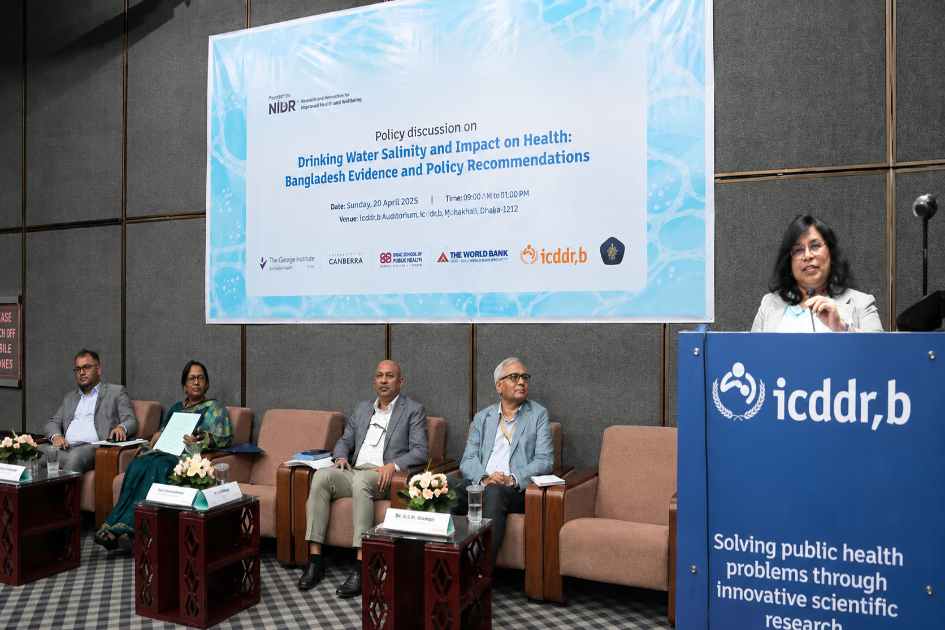



Saline drinking water is emerging as a major health threat in coastal Bangladesh, with new icddr,b research linking high sodium exposure to elevated cardiovascular and kidney disease risks among residents of Koyra and Assasuni, where salinity increasingly shapes public health.
In the tide-locked villages of Koyra and Assasuni, the water people drink to survive may be quietly damaging their hearts. A new study has found that one in five residents over 40 in these two salinity-hit coastal upazilas now face a moderate-to-high risk of cardiovascular disease, a stark marker of how climate change is reshaping public health on the frontlines of the crisis.
The preliminary findings, unveiled Monday at a seminar in Dhaka jointly organised by icddr,b and Imperial College London, show that more than half of drinking water sources tested in Koyra, Khulna, were saline, compared with nearly a quarter in Assasuni, Satkhira. Researchers surveyed over 27,000 water sources and screened more than 15,000 adults across 172 villages as part of the multi-year study, run under the NIHR Global Health Research Centre for Non-Communicable Diseases and Environmental Change.
A Warning From the Water
Sodium exposure from saline drinking water is being linked to rising blood pressure, and by extension, to heart and kidney disease,with pregnant women facing added risk. Aliya Naheed, senior scientist at icddr,b, who presented the findings, said the crisis is no longer confined to the environment. “Drinking water salinity is no longer only an environmental challenge,” she told the seminar, warning that it is now driving up cardiovascular and kidney disease risk across coastal communities.
The numbers put the threat in sharp relief: while a national WHO survey had earlier put cardiovascular risk at roughly 9 percent among adults aged 40–69, this study found risk levels near 11 percent in the same age bracket in Koyra and Assasuni — climbing to 21.6 percent when the full 40-plus population was counted.
Climate Change as a Health Multiplier
Scientists at the seminar connected the dots between extreme weather and long-term health damage. Imperial College London’s Professor Adrian Butler presented evidence that cyclone-driven storm surges can leave drinking water ponds and shallow groundwater salinised for years afterward, and called for stronger embankments and faster post-storm restoration of water sources. Professor Paolo Vineis, also of Imperial, noted that science has yet to establish a clear health-based safety threshold for salinity in drinking water, a gap he urged national and international bodies to close.
Tahmeed Ahmed, executive director of icddr,b, said research linking climate change to health outcomes in Bangladesh remains scarce, and evidence on adaptation strategies scarcer still — a gap his institution is now working to fill by testing solutions that combine safe water access, primary healthcare and community participation.
Turning Evidence Into Action
Rather than stopping at diagnosis, the research team has designed an integrated intervention package: expanding access to low-salinity water through rainwater harvesting, pond sand filters and tube wells, paired with stronger primary healthcare including digital screening and follow-up for hypertension, diabetes and chronic kidney disease.
Government officials at the seminar framed the findings as more than a domestic health issue. Fahmida Khanom, secretary in-charge of the Ministry of Environment, Forest and Climate Change, said the evidence strengthens Bangladesh’s hand in global climate negotiations, giving the country sharper, science-backed arguments for adaptation and mitigation support.
As sea levels rise and cyclones intensify across the Bay of Bengal, researchers say Koyra and Assasuni offer an early, urgent signal of what climate-driven salinity could mean for coastal populations worldwide — a slow-moving health emergency hiding in plain sight, one glass of water at a time.




