

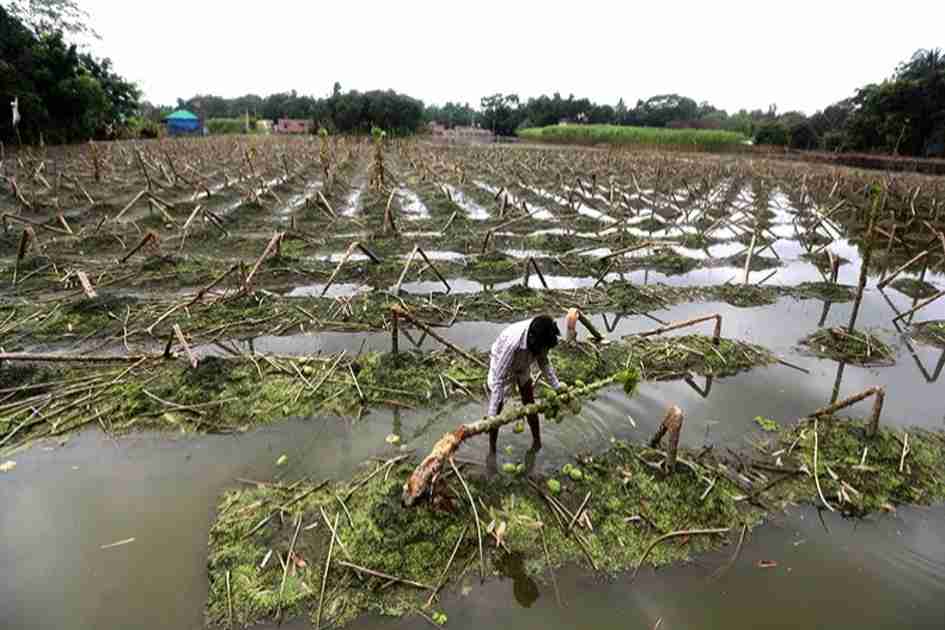

As floodwaters recede, officials are racing to assess farm losses and rebuild seedbeds, ponds and livestock farms before the damage ripples through rural economies and food markets.
Heavy rain and flooding have damaged crops on 114,723 hectares of land across 43 districts of Bangladesh, affecting more than 500,000 farmers and causing nearly Tk 4 billion in losses to the fisheries and livestock sectors, according to government figures.
Although floodwaters have begun to recede gradually, the scale of losses across agriculture, fisheries and livestock is now becoming clearer in large parts of the country. Aus paddy and Aman seedbeds have been submerged in some areas, while fish from ponds and enclosures have been washed away elsewhere. Large numbers of poultry, ducks and livestock have also died.
The losses have deepened financial pressure on farmers and raised fresh uncertainty over food production and markets.
In West Baghmara village of Katharia union in Chattogram’s Banshkhali upazila, farmer Faruk Mia’s home was damaged by floodwaters. Crops stored for his family’s year-round food supply, as well as paddy kept for sale, were destroyed during eight days of flooding.
“I have not seen water rise this high in the area in the past 30 years,” he said, his voice breaking. “Fish worth about Tk 100,000 from my pond were washed away by the floodwaters. Crops worth Tk 800,000 to Tk 900,000 stored in my house were also destroyed. Even my last shelter, my home, has collapsed.”
According to data released by Bangladesh’s Ministry of Agriculture on Tuesday, crops on 114,723 hectares of land in 43 districts had been damaged as of Monday, affecting more than 500,000 farmers.
A report by the Department of Agricultural Extension said Chattogram, Cox’s Bazar, Rangamati, Khagrachhari, Noakhali, Cumilla, Habiganj, Naogaon, Jashore, Meherpur, Bagerhat, Barguna, Bhola, Barishal, Jhalakathi and Patuakhali were the worst-hit districts.
In these 16 districts alone, 107,425 hectares of cropland were damaged, accounting for more than 90 percent of the total affected area nationwide. A total of 456,076 farmers were affected in these districts.
Of the total damaged land, 79,500 hectares were planted with Aus paddy, 10,504 hectares with Aman seedbeds and 17,800 hectares with summer vegetables. High-value crops including ginger, turmeric and papaya were also widely damaged.
Md Obaidur Rahman Mondal, director of the field services wing of the Department of Agricultural Extension, said officials were collecting actual damage data from the field as floodwaters receded.
“Preparing lists of affected farmers, determining the extent of damage and taking up rapid rehabilitation plans are now our priorities,” he said.
Agriculture, Fisheries and Livestock Minister Mohammad Amin Ur Rashid said Aman seedbeds had suffered the greatest damage. However, he said there was still scope to prepare new seedbeds until August 15.
He said new seedbeds would be prepared on government land and the seedlings produced there would be distributed among affected farmers.
A report by the Ministry of Fisheries and Livestock said total losses in the fisheries and livestock sectors had reached Tk 399.12 crore. The worst damage was recorded in Chattogram, Cox’s Bazar, Bandarban, Rangamati and Khagrachhari districts.
In those areas, 157,300 cattle, 4,148 buffaloes, 112,655 goats, 24,795 sheep, 1,191,020 chickens and 24,028 ducks were affected by the floods.
Among them, 45 cattle, 123 goats, 40 sheep, 101,198 chickens and 1,521 ducks died.
The floods damaged 65 livestock farms and 63 poultry farms, while 118 tonnes of cattle feed were also destroyed.
In the fisheries sector, 12,043 tonnes of white fish, nearly 14,000 tonnes of shrimp, 1.8 million fish fry and 25.9 million hatchlings were washed away by floodwaters across 602 unions of the country.
Fishing nets, boats, ponds, enclosures, sluice gates and other fisheries infrastructure were also badly damaged.
Mohammad Mozammel Haque, an assistant professor in the Department of Botany at the University of Chittagong, said accurate assessment of the losses must be accompanied by technology-driven adaptation in agriculture.
“Floating seedbeds, improved early warning systems and timely delivery of necessary information to farmers can significantly reduce agricultural losses from floods in the future,” he said.
Experts said that unless affected farmers and farm owners quickly receive financial assistance, free seeds and seedlings, loans on easy terms and support to rebuild the fisheries and livestock sectors, the floods could have a long-term impact on rural economies and food markets.




