

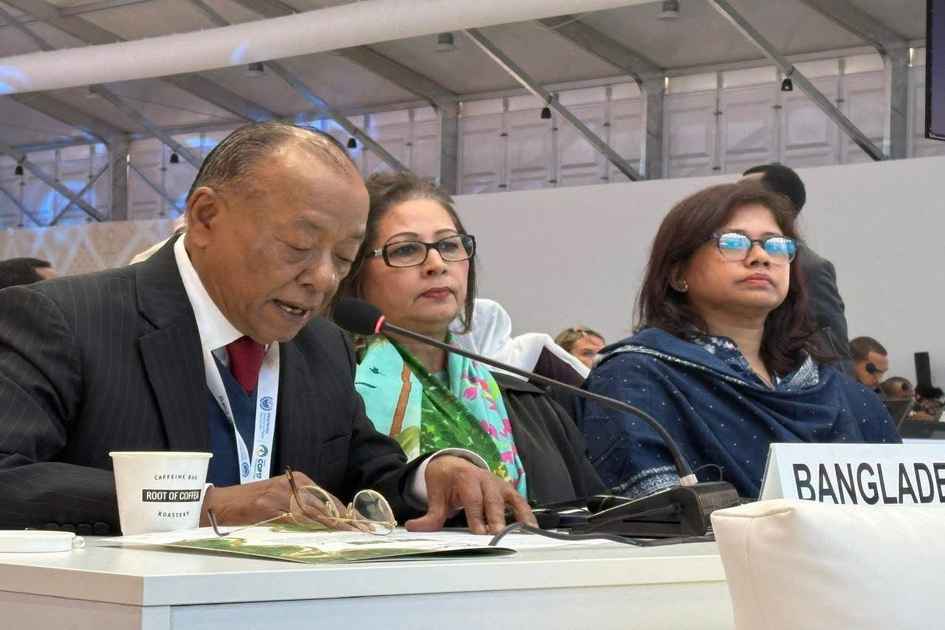



Bangladesh urged world leaders at UNCCD COP17 in Mongolia to put science, youth and women at the heart of land restoration, while calling for stronger financing, regional water cooperation and time-bound commitments to protect livelihoods, food security and climate resilience.
Bangladesh has called on world leaders to put science, youth leadership and women’s empowerment at the centre of the global fight against land degradation, as negotiations intensify at the 17th Conference of the Parties (COP17) to the UN Convention to Combat Desertification (UNCCD).
The summit, running from August 17 to 28, 2026, in the Mongolian capital under the theme “Restoring Land. Restoring Hope,” has brought together governments, scientists, civil society groups, Indigenous Peoples and local communities to tackle one of the world’s most pressing environmental crises: the degradation of the land that sustains food security and livelihoods worldwide.
A Climate-Vulnerable Nation’s Stake
For Bangladesh, one of the countries most exposed to climate change, the stakes are especially high. Millions of people across its coastal, riverine and drought-prone regions are already grappling with salinity intrusion, water scarcity, river erosion and land loss — pressures that are steadily eroding livelihoods and displacing communities.
At COP17, Dhaka’s delegation has pressed for localising scientific knowledge, strengthening outreach and communication systems, and folding these efforts into regular government budgets to ensure they last beyond the conference itself. Above all, Bangladesh has argued that young people and women should be treated not merely as victims of environmental crisis but as decision-makers and innovators driving solutions.
Finance Takes Centre Stage
That message carried into the summit’s Finance Day, where Bangladesh’s Environment, Forest and Climate Change Minister, Abdul Awal Mintoo, told a ministerial dialogue on innovative financing that land can no longer be treated as an environmental afterthought.
“Land protection is fundamental to ensuring climate resilience and food security,” Mintoo said, pointing to national efforts on soil fertility, forest conservation, and coastal and riverbank erosion. He urged multilateral development banks to explore guarantees, first-loss capital and blended finance to help smallholder farmers and speed up land restoration.
Mintoo highlighted Bangladesh’s own track record, noting that the Bangladesh Climate Change Trust Fund — one of the earliest domestic climate financing mechanisms set up by a developing country, launched in 2009 — has mobilised more than $495 million for climate resilience work. That funding has helped develop a dozen stress-tolerant crop varieties and distribute over 19,400 metric tonnes of drought- and salinity-tolerant seeds to farmers.
Still, he cautioned that demand for climate and land resilience funding has already outstripped annual budgets, and called for tools such as debt-for-nature swaps, debt-for-climate swaps and green bonds to unlock further resources — money he said should complement, not replace, national spending.
Mintoo also flagged a regional concern: shifting upstream water flows are raising the risk of drought and salinity intrusion in delta nations like Bangladesh, and he called for closer cooperation among countries sharing river basins on water data and management.
Where the Talks Stand
Beyond Bangladesh’s interventions, COP17’s first week saw negotiations shift from plenary speeches to detailed contact-group discussions on land restoration, drought resilience, migration, capacity-building and science-policy cooperation.
Delegates worked to strengthen the UNCCD’s communication strategy and improve coordination with parallel climate and biodiversity talks during the current “triple-COP” period. Civil society groups pushed for communities most affected by land degradation — including Indigenous Peoples — to have a real seat at the table, with information made available in local languages.
Migration linked to drought and land degradation also featured prominently, with countries calling for better evidence on the links between environmental stress and displacement, alongside more predictable financing and technology support for developing nations. Talks also touched on how private investment can support sustainable land management without crowding out public funding.
On the scientific front, parties reached a tentative agreement to have the procedures of the UNCCD’s Science-Policy Interface reviewed at a future meeting, though negotiators acknowledged that disagreements over financing, participation and drought strategy have slowed progress on some fronts.
The Bigger Picture
The summit’s high-level segment was opened by Mongolian President Khurelsukh Ukhnaa, with UN Deputy Secretary-General Amina J. Mohammed, UNCCD Executive Secretary Yasmine Fouad and COP17 President Battsetseg Batmunkh among those in attendance.
For Bangladesh, the message from Ulaanbaatar has been consistent: restoring land is inseparable from restoring livelihoods and dignity for the millions already living with the consequences of a warming, drying planet. “We seek commitments that are specific, adequately financed and time-bound,” Mintoo said, “so that land financing moves from the margins of decision-making to the centre.”




