




Women farmers in coastal Bangladesh sustain food production and climate adaptation, yet remain excluded from land ownership, agricultural support and decision-making, highlighting the urgent need for recognition, rights and investment.
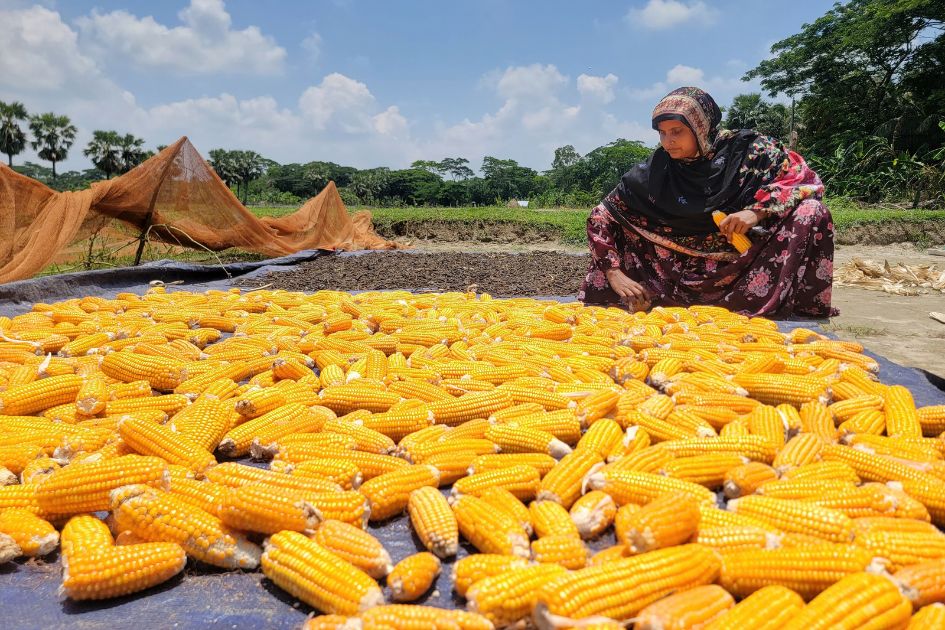
In the remote coastal upazila of Rangabali in Patuakhali, where farmland gradually gives way to the Bay of Bengal, Asma Begum spreads harvested corn under the scorching sun of Baishakh.
The 40-year-old farmer pauses, wipes sweat from her face, and asks a question shaped by years of unpaid work and quiet sacrifice.
“I have worked so hard for my family and the land for so many years,” she says. “What appreciation have I received?”
For decades, Asma has carried a double burden familiar to thousands of women across Bangladesh’s climate-vulnerable coastal belt. She cooks, cleans, washes clothes, raises children, and manages household responsibilities while also working long hours in the field.
Male farm labourers in her area can earn around Tk 600 a day. Women like Asma often receive little or nothing when their agricultural work is treated as part of household duty.
“This is justice?” she asks with quiet sarcasm.
Her story reflects a deeper governance failure in rural Bangladesh: women are central to agriculture and climate adaptation, but their labour remains largely invisible in official records, land ownership, agricultural support systems and resource distribution.
Women on the climate frontline
Rangabali is one of Bangladesh’s southernmost upazilas. Beyond its coastal land lies only the sea. The area faces frequent cyclones, tidal surges, salinity intrusion, river erosion, and increasingly erratic rainfall, threats that are being intensified by climate change.
For the past 25 to 30 years, agriculture has shaped Asma’s life. She first worked alongside her father. Now she farms with her husband, a retired Ansar member.
Sitting beneath a tree beside her field, she speaks about a lifetime of sacrifice.
“Women work extremely hard for their families and for agriculture, but nobody values that work properly,” she says. “If a husband understands a woman’s struggle, that is one thing. But society never does.”
Even when husbands acknowledge women’s labour, ownership and recognition rarely follow.
Asma owns no land. She cultivates under a local sharecropping and lease arrangement. This season, she paid Tk 3,000 to cultivate mung beans, locally known as mug dal. But poor yields linked to changing weather left her with only eight kilograms of harvest, which she sold for Tk 1,000.
“I am a poor woman farmer,” she says. “I cultivate on credit. Because of climate change, production is falling.”
Government agricultural support also remains mostly beyond her reach.
“When farming cards or benefits come, everything is issued in my husband’s name,” she says. “As a woman, I lose everywhere.”
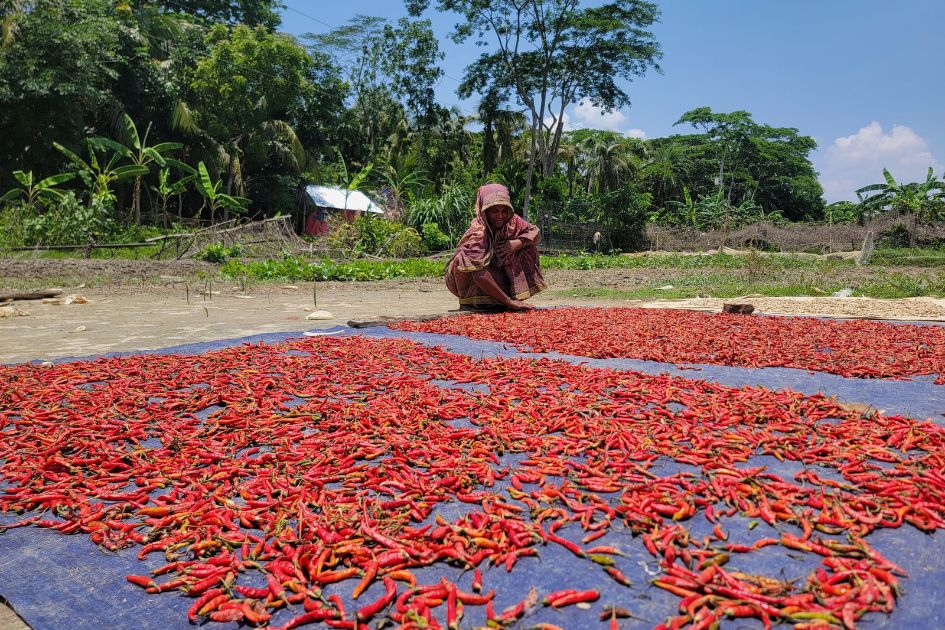
Nearby, 45-year-old Nurbanu joins the conversation. She has spent years cultivating corn, vegetables, chilies, and pulses while managing a household with four sons.
Through years of savings and hard labour, she helped buy additional land. But the property was registered in her husband’s name. Even her savings are kept in his bank account.
Asked why she never opened one in her own name, she hesitates.
“I will buy land in my own name in the future,” she says softly.
Asma responds with visible regret.
“We spend our whole lives caring for husbands and children without keeping anything in our own names,” she says. “That is why women suffer in old age.”
Their experiences expose structural inequalities deeply embedded in Bangladesh’s rural economy, where land ownership, financial control, extension services, and official farmer identities remain overwhelmingly male-dominated.
Bangladesh marks International Year of the Woman Farmer
Bangladesh has launched national activities marking the UN-declared International Year of the Woman Farmer 2026, creating a timely opportunity to formally recognise women’s contribution to agriculture and climate resilience.
Md Abdur Rahim, Director General of the Department of Agricultural Extension, said the government has begun taking steps to acknowledge women farmers and increase their access to support.
He said women are being given priority in the issuance of Farmer Cards, through which their identity as farmers and the value of their labour can be recognised.
Rahim said the Department of Agricultural Extension is also implementing projects to create women entrepreneurs and ensure their participation in agricultural development activities.
“We are working to ensure at least 30 percent participation of women farmers in different activities, including training under these projects,” he said.
But he acknowledged that many women, particularly in remote and digitally disconnected areas, still cannot access modern agricultural information services.
According to Rahim, coastal women farmers are being reached through mobile apps, radio and training materials from agricultural information services. Educated women farmers are also receiving information through apps such as Krishaker Janala and Krishaker Digital Thikana.
He said a separate digital database for women farmers could be created in the future to strengthen recognition and participation.
“Women are half of the population of this country. Development in agriculture and the economic sector is not possible by leaving half of the population behind,” he said.
The invisible economic engine
Women’s contribution to Bangladesh’s agriculture is enormous, though much of it remains economically invisible and institutionally unrecognised.
Across rural Bangladesh, women preserve seeds, prepare seedlings, transplant crops, process harvests, raise livestock, maintain homestead gardens, collect water and fuel, store food, and manage household survival during cyclones and floods.
Yet much of this work is still classified as household assistance rather than productive economic activity.
Globally, the same invisibility sustains the wider care economy. According to a 2026 article published in Defending Peasants’ Rights, citing International Labour Organization data, the world relies on 16.4 billion hours of unpaid care work every day. If valued at minimum wage, that labour would equal nearly 9 percent of global GDP, or about $11 trillion, with women and girls performing 76.2 percent of it.
Closer to home, the Unpaid Household Production Satellite Account 2023 report by the Bangladesh Bureau of Statistics and UN Women estimates that unpaid household production generates value equivalent to 21 percent to 30 percent of Bangladesh’s GDP. The BBS Time Use Survey 2022 shows that women spend five to seven times more hours on unpaid domestic chores than men.
A 2024 case study by America’s Test Kitchen on electric cooking echoed this gender gap, showing Bangladeshi women spend an average of 5.9 hours a day on domestic care, compared with just 0.8 hours for men.
Climate change further intensifies this unpaid workload. In coastal villages, water scarcity, fuel shortages, and family illnesses caused or worsened by climate stresses can add hours to women’s daily responsibilities. Salinity intrusion and freshwater scarcity often force women to travel long distances to collect drinking water, while many also gather fuelwood, care for livestock, prepare food, and support agricultural production at the same time.
Despite this contribution, women remain significantly excluded from formal economic participation, ownership, and decision-making.
A policy brief by Manusher Jonno Foundation on women’s role in agriculture notes that rural women carry an intense “triple burden”: unpaid domestic work, caregiving responsibilities, and agricultural labour.
Wage discrimination remains another major challenge. In many rural areas, women agricultural workers receive lower wages than men for similar work, while women working on family farms often receive no direct payment at all.
Climate change deepens inequality
Climate change has made women’s burdens significantly heavier across coastal Bangladesh.
Rising sea levels, cyclones, salinity intrusion, and irregular rainfall are damaging farmland, reducing crop yields, contaminating freshwater sources, and increasing food insecurity.
Women often absorb the impacts first and longest.
International climate activist Harjeet Singh said salinity and freshwater scarcity are among the greatest challenges facing coastal women farmers.
“Rising sea levels and frequent cyclones are turning agricultural land and drinking water salty,” he said. “For women farmers, this creates a devastating double burden.”
Women are increasingly forced to walk farther to collect water, manage shrinking food supplies, care for sick family members during climate-related disease outbreaks and maintain household survival during disasters.
At the same time, they continue to preserve traditional salt-tolerant seeds, maintain homestead gardens, and protect livestock during emergencies.
“This invisible labour keeps families fed and alive during and immediately after climate disasters,” Singh said. “Without this unpaid safety net, local food systems would collapse.”
Despite their central role in climate adaptation, women are rarely recognised as farmers because they usually lack land ownership documents. As a result, many are excluded from Farmer Cards, agricultural subsidies, climate finance opportunities, formal loans, crop insurance, climate-smart agriculture training and access to improved seeds and technology.
Most agricultural resources and local decision-making structures continue to favour men.
Policy recognition has not reached the field
Roufa Khanum, Assistant Director–Operations at the Centre for Climate Change and Environmental Research of BRAC University, said Bangladesh’s National Adaptation Plan recognises women as key contributors to agriculture and climate resilience, particularly in coastal areas affected by salinity intrusion, cyclones, and waterlogging.
She said the plan promotes gender-sensitive vulnerability assessments, women-friendly farm tools, salt-tolerant crop varieties, improved irrigation, women’s farming groups, and early warning systems that can reach women directly.
But Khanum warned that policy recognition has not yet fully changed field-level realities.
“Strong gender traditions and powerful local leaders can still keep women out of decision-making and away from resources,” she said.
She said women need formal recognition as farmers to access loans, subsidies, training, and government support.
Building resilience despite limited support
Despite these barriers, some women are gradually transforming their lives through training and community-based support programmes.
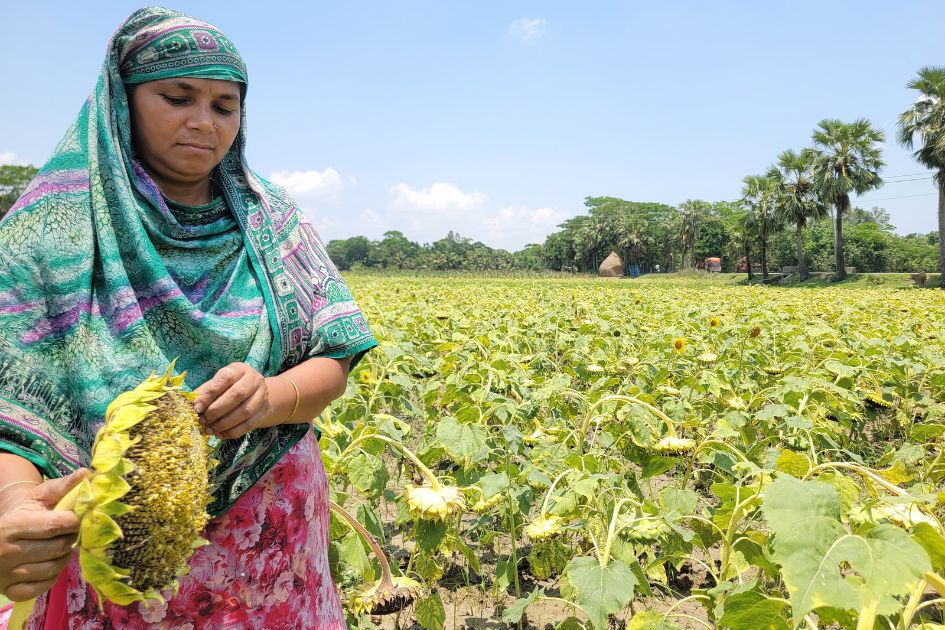
Shakuri Begum, who studied up to the SSC level, faced severe uncertainty after separating from her husband while raising her daughter alone.
With support from a local NGO, she received advanced agricultural training, an interest-free loan, and practical lessons in mulching, sack gardening, and pot cultivation. She also received sewing training and chickens from the Department of Livestock Services.
Today, she is financially independent and grows sunflowers and vegetables.
“People in the village now invite us to local arbitration meetings,” she says proudly. “They value our opinions.”
Her daughter Hena is preparing for this year’s HSC examinations, and Shakuri is determined to ensure her education continues.
Another farmer, Mosammat Asma from Rangabali village, earned around Tk 70,000 last year by growing cucumber, bitter gourd, and ridge gourd using mulching techniques learned through NGO training.
But challenges remain severe.
In winter, saline water contaminates local wells. Farmers struggle to access irrigation pumps and often cannot obtain quality seeds from government offices.
Khanum said practical steps are needed to overcome discrimination at the field level. These include reserved places for women in training programmes, women-only training where necessary, instruction in local languages, access to mobile banking and special loans, support for women’s group-based marketing, and help in obtaining legal documents and formal recognition as farmers.
“These steps are crucial because without formal recognition, women cannot properly access loans, subsidies, or government support,” she said.
Women-led adaptation offers a path forward
Experts say Bangladesh cannot build effective climate resilience while ignoring women farmers.
Khanum said climate adaptation in Bangladesh will not be sustainable unless women are fully included.
“Women are key to food production, nutrition, and managing family resources,” she said. “If women are left out, solutions are incomplete, and communities stay vulnerable.”
She cited women-led salt-tolerant rice cultivation in Satkhira and Khulna as one example of successful adaptation, where women’s groups have received training on saline-resilient rice and vegetable varieties and shared seeds and knowledge within their communities.
She also pointed to women’s participation in cyclone preparedness committees, fish and crab farming cooperatives, and homestead gardening as examples of how women are already leading adaptation in coastal areas.
In several coastal villages, women’s cooperatives have helped families earn income from small-scale fish and crab farming, while homestead gardens have provided nutrition and acted as a safety net when main crops fail due to floods, droughts or salinity.
“These examples show that women are not only victims of climate change,” Khanum said. “They are also innovators and leaders in adaptation.”
Harjeet Singh said women must move from being treated as passive beneficiaries to becoming leaders in climate adaptation.
“Women-led solutions already exist,” he said. “Floating agriculture, community seed banks and mulching systems have proven effective. These initiatives now need direct funding and institutional support.”
Local organisations fill gaps
Bangladesh has several progressive policies supporting women’s rights in agriculture.
The National Women Development Policy 2011 calls for equal wages and recognition of women’s labour. The National Agricultural Extension Policy 2012 also stresses the need to integrate women into agricultural services and training.
International commitments under CEDAW, the Beijing Platform for Action and the Sustainable Development Goals further reinforce women’s rights to land, training and economic participation.
But implementation remains weak.
Agricultural training, subsidies, climate adaptation resources and extension services continue to reach men far more often than women. Many women also face mobility restrictions, limited financial control and overwhelming domestic workloads that prevent them from participating in training or decision-making forums.
In many cases, women’s names are absent from land documents, farmer databases, irrigation groups and local agricultural committees, leaving them excluded from official support.
Local organisations have stepped in where government support remains limited.
The Village Education Resource Center, which has worked in Rangabali since 2017, provides group-based training, interest-free loans, and health awareness programmes for women.
Mohsin Talukder, who works with the organisation, said women in the area once had very limited access to agricultural knowledge and healthcare.
“Things have improved slowly through training and group support,” he said. “But government services are still inadequate.”
Climate resilience and women’s rights
Banasree Mitra Neogi, Director of Rights and Governance Programmes at Manusher Jonno Foundation, said, “We are witnessing growing awareness among rural women. When women receive accessible information, they turn knowledge into action. As a result, many are now participating in local government elections, serving on Union Parishad standing committees, and taking active roles in local arbitration processes. These are visible signs of empowerment and leadership.”
The Manusher Jonno Foundation is implementing the Community-based Resilience, Women’s Empowerment and Action project, known as CREA, in climate-vulnerable regions, including Rangabali Upazila of Patuakhali.
The project, supported by the Embassy of Sweden, works in the hilly, char, coastal, and hill areas across 13 districts. It aims to build women’s leadership, increase community resilience, strengthen public accountability, and address the social impacts of climate change.
The Village Education Resource Center (VERC) is implementing the project in Patukhali, partnering with Manusher Jonno Foundation.
But women are still facing new and difficult challenges in their rights. Banasree Mitra Neogi said, “However, significant challenges remain. Unequal unpaid care responsibilities continue to limit women’s opportunities and increase their vulnerability, including exposure to domestic violence”.
In the coastal area, these challenges are more complicated. “In climate-vulnerable coastal areas, these burdens are compounded by food insecurity, disasters, and safety risks. Women contribute substantially to agriculture alongside household work, yet their labour remains largely invisible and unrecognized,” Banasree Mitra Neogi mentioned.
The Manusher Jonno Foundation project supports training on climate-adaptive livelihoods, income-generating activities, fund management, human rights, social accountability, gender-based violence prevention, and child marriage prevention.
For women farmers in places like Rangabali, this approach is important because climate resilience cannot be separated from safety, dignity, recognition, and access to public services.
Banasree Mitra Neogi specially mentioned the Bangladesh government’s recent initiatives for farmers, “Farmer Card”. She said, “One critical issue is the lack of official recognition of women as farmers. Without farmer cards, women are often excluded from government services, subsidies, and support mechanisms”.
Women are half of this population. Without the contribution of women, the economy cannot run. Banasree Mitra Neogi also said, “Achieving sustainable social and economic progress requires collective action to recognize women’s contributions and ensure a fairer distribution of unpaid care work.”
Her remarks show that women’s climate resilience is not only about seeds, crops, or irrigation. It is also about governance, accountability, protection from violence, control over resources, and recognition of women as decision-makers.
Why recognition matters
As climate pressures increase and more men migrate for work, women are increasingly becoming the primary managers of farms across vulnerable coastal regions.
Yet many still lack land rights, financial access, official farmer recognition, climate finance opportunities, training access, and representation in local decision-making.
Policy experts argue that women’s unpaid agricultural and care labour must be formally recognised in national economic statistics and climate policy frameworks.
They also stress the need for gender-responsive agricultural governance, including issuing Farmer Cards in women’s names, ensuring direct access to subsidies and climate finance, expanding childcare and healthcare services, improving water access, and strengthening women’s land and tenancy rights.
Md Abdur Rahim said the government is determined to increase women’s participation and recognition in agriculture.
“The government is determined to meet the challenge of women’s participation and recognition in agriculture,” he said. “All possible cooperation is being provided to increase women’s participation in agricultural development activities and in the creation of agricultural entrepreneurs.”
But for women like Asma Begum, recognition must reach the field, not remain only in policy documents.
Back in Rangabali, as evening light fades across the fields, women farmers continue their work quietly and without recognition.
They grow food under worsening climate conditions, preserve seeds, protect families during disasters and hold fragile rural economies together.
Yet many remain invisible in the systems meant to support them.
Bangladesh’s climate resilience depends heavily on these women. Without recognising them as farmers, economic contributors, decision-makers and leaders in adaptation, the country’s response to the climate crisis will remain incomplete.




