

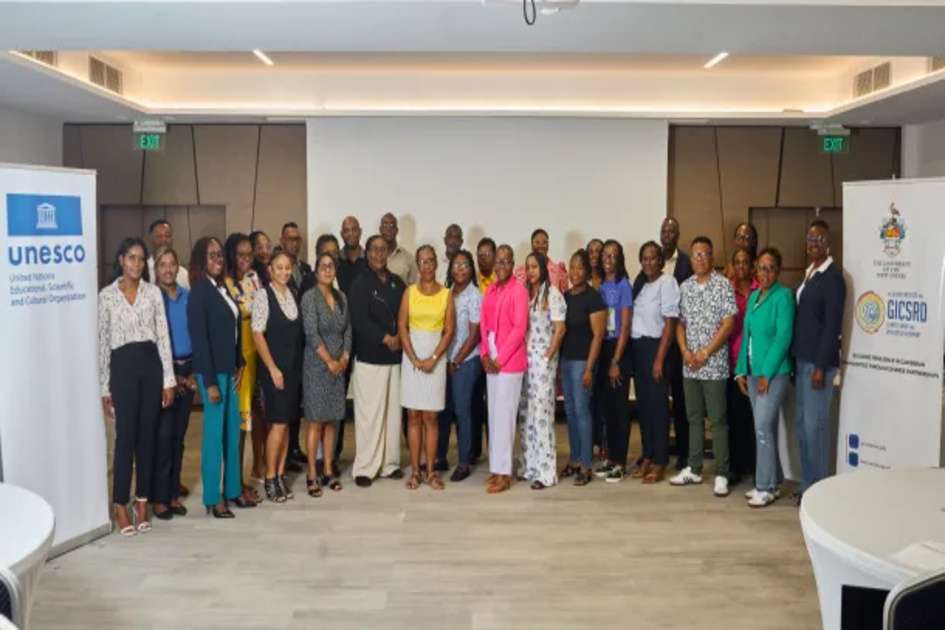



The Grenada workshop helped 34 participants develop country-level action projects, with UNESCO planning guidance and technical support to sustain climate-smart education across ministries and institutions.
UNESCO has brought together educators and education officials from five Caribbean countries in Grenada for a regional workshop aimed at strengthening the integration of sustainable development, climate change and disaster risk reduction into education systems.
Organised in collaboration with the University of the West Indies and with support from the Grenada National Commission for UNESCO, the workshop focused on Education for Sustainable Development, Climate Change Education and Disaster Risk Reduction.
The programme, held from June 30 to July 2, 2026 under the Climate Smart Education Systems Initiative, brought together 34 participants from Dominica, Grenada, Guyana, St. Lucia and St. Vincent and the Grenadines.
It aimed to strengthen participants’ understanding and capacity to integrate the three interconnected areas at school, classroom and education-system levels through practical approaches that can be adapted to Caribbean contexts.
The workshop examined strategies for incorporating sustainability, climate change and disaster risk reduction into teaching and learning, teacher education and professional development.
The focus is particularly relevant to Caribbean countries, which regularly face significant environmental and climate-related challenges and require education systems capable of supporting resilience and adaptation more effectively.
Participants worked with stimulus materials, expert presentations and practical activities designed to encourage transformative and inclusive learning environments.
They identified challenges and opportunities for curriculum integration, developed strategies to accelerate progress and began designing practical projects for implementation in their respective countries and contexts.
The programme combined theoretical foundations with hands-on learning, including creative group activities, reflection exercises, action research planning and a field visit to the Mirabeau Agriculture Station, a key facility in Grenada.
The activities were designed to help educators develop and implement locally relevant solutions while supporting the sustainability of initiatives beyond the workshop.
As a follow-up, UNESCO will consolidate the workshop outcomes into a regional guidance note and provide further technical support to participating ministries and institutions.
The outcomes will also inform upcoming regional resilience programmes to support continuity and scalability.
An online convening will take place later this year to allow participating countries to collect data and review progress on their action plans.
Through the continued collaboration, UNESCO and its partners aim to strengthen the capacity of Caribbean education systems to turn climate and environmental challenges into opportunities for more resilient, sustainable and inclusive education.




