

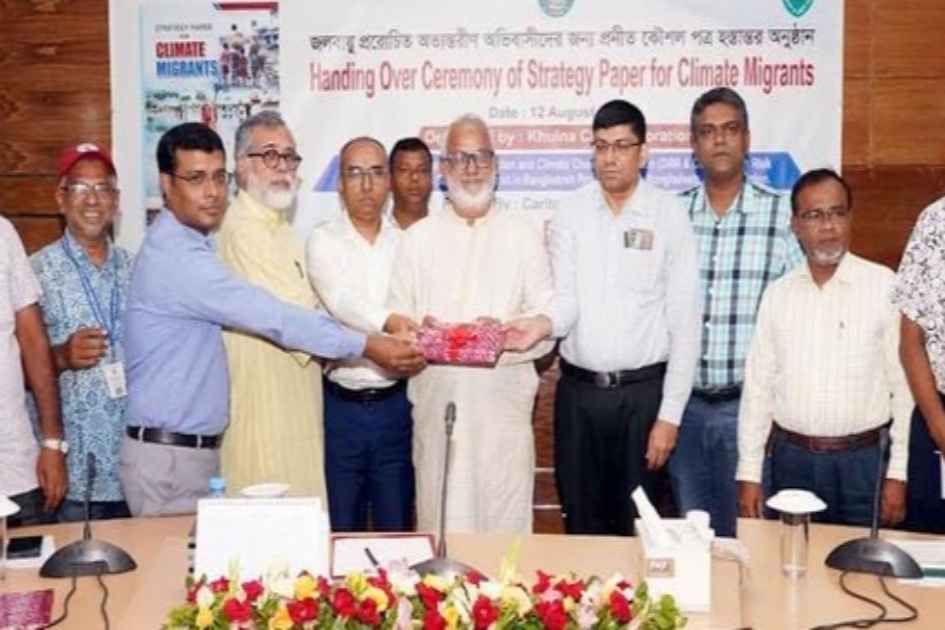



Prepared by KUET’s IDM and Caritas Bangladesh, the strategy sets out coordinated, inclusive steps to guide urban planning, services and support for climate-displaced communities in Khulna.
Khulna City Corporation Administrator Nazrul Islam Manju has welcomed the preparation of a strategy to address climate-induced internal displacement, saying the number of people forced from their homes by climate change is rising rapidly.
Many displaced people are living in extremely difficult conditions in different parts of Khulna city and surrounding areas as they search for livelihoods, Manju said while speaking as chief guest at a ceremony to hand over a comprehensive strategy titled “Strategy for Managing Climate-Induced Internal Displacement in Khulna Metropolitan City.”
He said the strategy would play an important role in the future planning of Khulna City Corporation to improve the socio-economic conditions of displaced people.
Manju also stressed the need for coordinated initiatives by government and private organisations to develop adequate and appropriate housing facilities for people displaced by climate change.
He called for an integrated and reliable database of climate-displaced communities to support better future planning, service delivery and allocation of resources.
Caritas Khulna Regional Director Albino Nath handed over the strategy document to Manju during the programme at the Shaheed Altaf Auditorium of the Nagar Bhaban, Khulna City Corporation’s headquarters.
Caritas Khulna Region organised the event under its Disaster Risk Reduction and Climate Change Adaptation, or DRR & CCA, project in collaboration with KCC.
The strategy was formulated to address the growing challenges facing climate-displaced and migrant communities in Khulna city through coordinated, inclusive and sustainable initiatives.
The Institute of Disaster Management at Khulna University of Engineering and Technology and Caritas Bangladesh jointly prepared the strategy.
Government agencies, educational institutions, development partners, NGOs, civil society, media and community-based networks actively participated in the formulation process and provided their views and inputs.
Speakers at the programme said the strategy would serve as an important guideline for KCC’s future urban planning, service delivery, coordination and policy and programme formulation concerning climate-displaced communities.
KCC Chief Executive Officer Rajib Ahmed highlighted the city corporation’s role in integrating climate-displaced communities into urban services and development activities.
KUET IDM Assistant Professor Dr Mohammad Ismail Hossain outlined the process of preparing the climate migration strategy, including its different stages and the collection of stakeholder consultations, information and evidence.
KCC Chief Planning Officer Abir-ul-Jabbar discussed the objectives and relevance of the strategy in relation to the corporation’s planning framework, while Caritas Khulna Regional Director Albino Nath highlighted Caritas Bangladesh’s commitment to supporting climate-vulnerable and displaced communities.
Representatives from UNICEF, ADAMS, ADB, World Vision, Nabolok, JJS, BRAC, Rupantar, Bangladesh Red Crescent Society, Uttaran and Shushilan, among other government and non-government organisations, as well as KCC ward officials, attended the programme.




