

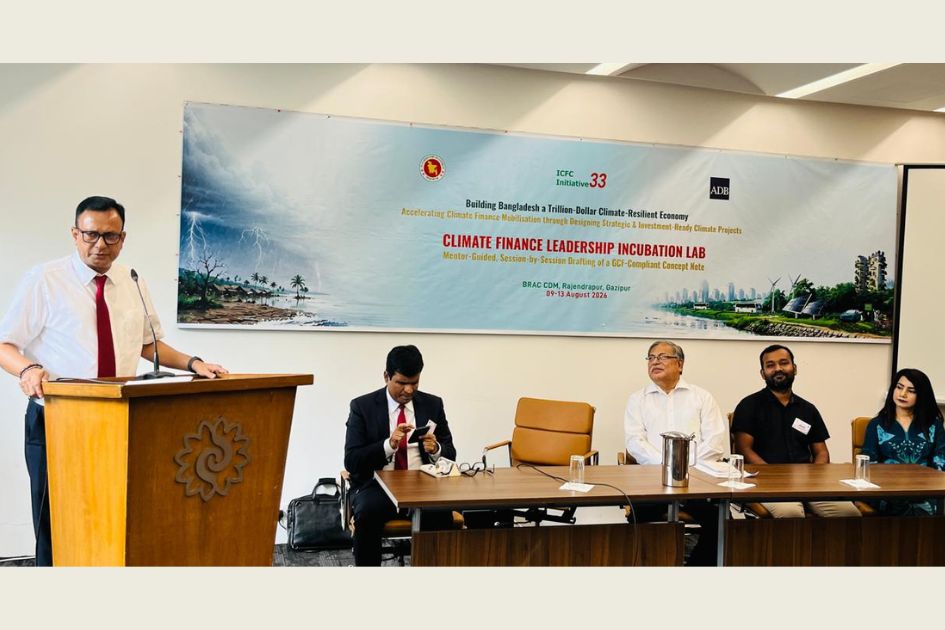



A five-day climate finance leadership lab in Gazipur has trained around 35 participants from 23 organisations to turn climate ideas into investment-ready Green Climate Fund concept notes, producing 35 proposals spanning mitigation, adaptation, resilience and climate insurance for Bangladesh’s vulnerable communities.
Bangladesh has expanded its pool of climate finance professionals after a five-day intensive lab helped around 35 participants from 23 organisations develop 35 project concepts aimed at attracting Green Climate Fund financing.
The Climate Finance Leadership Incubation Lab, held at BRAC CDM in Rajendrapur, Gazipur, from August 9 to 13, brought together government officials, development practitioners, bankers, researchers, civil society representatives and journalists for mentor-guided, section-by-section preparation of GCF concept notes.
The concepts developed by participants covered areas ranging from climate mitigation and adaptation to resilience-building and climate insurance for vulnerable communities, according to the organisers. Participants were required to convert initial climate ideas into structured proposals capable of responding to the GCF’s investment requirements.
The International Climate Finance Cell, or ICFC, of the Economic Relations Division under the Ministry of Finance organised the programme with financial and technical support from the Asian Development Bank.
Unlike conventional classroom-based climate finance training, the programme centred on hands-on proposal development, one-to-one mentoring, evaluation and project pitching. Participants worked through the GCF concept note template, tested their climate rationale, developed financing structures and assessed risks, country ownership, safeguards and potential for transformational impact.
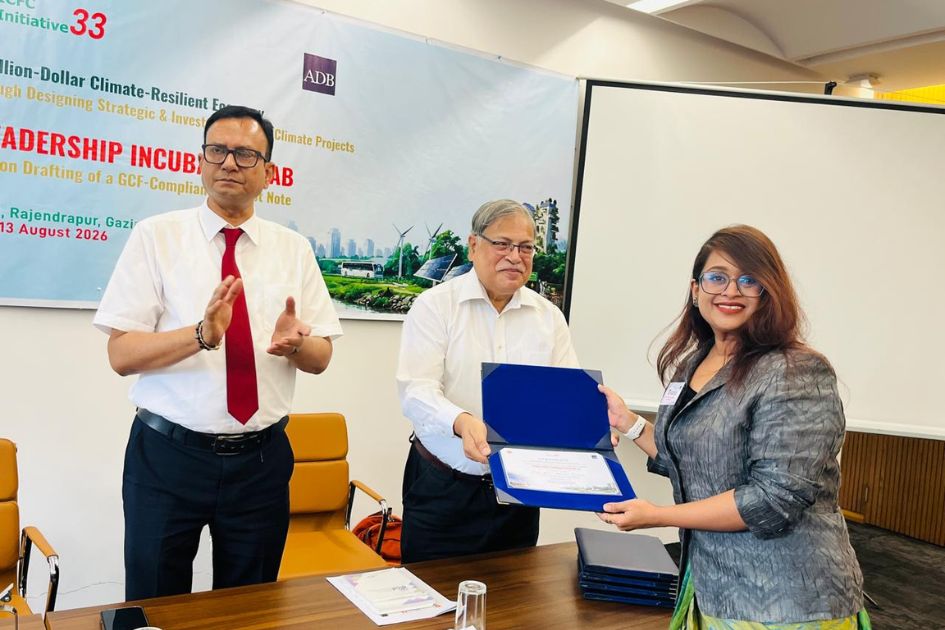
Ten of the final concept notes received awards, with three recognised as Diamond, three as Gold and four as Silver GCF Concept Notes.
But organisers said the awards marked only the beginning of a longer process, with selected participants expected to receive further mentoring aimed at turning promising concepts into stronger proposals that could eventually enter a financing pipeline.
‘Talk in the GCF language’
AKM Sohel, Additional Secretary and UN Wing Chief at the Economic Relations Division, said the programme represented a milestone in efforts to build a national pool of professionals capable of preparing international climate finance proposals.
He urged participants to closely study GCF requirements and frame their project ideas using the terminology, evidence and investment logic expected by the fund.
“Go to GCF literature and talk in the GCF language,” Sohel told participants, stressing that proposals must clearly demonstrate why the proposed intervention constitutes climate action and why it requires climate finance.
He also emphasised the importance of presentation skills, saying developing a strong proposal was not enough unless its climate rationale, financing needs and expected results could be communicated clearly to decision-makers.
“With this training, we have touched a milestone,” he said.
Sohel said the ICFC planned to organise a second batch of the programme in December, with around 40 participants expected to take part.
Based on experience from the first batch, future sessions are expected to place greater emphasis on physical, interactive training.
He said the ICFC also intended to maintain engagement with the first cohort rather than treating the programme as a one-off exercise.
Whether participants received Diamond, Gold or Silver recognition, the concept-development process would continue, he said.
“The concept note you have submitted, we will offer mentoring support with the help of ADB,” Sohel said, adding that participants showing strong commitment would be supported in refining their proposals before possible consideration for an ERD project pipeline.
The programme was the 33rd initiative undertaken by the International Climate Finance Cell, according to the organisers.
Sohel had inaugurated the lab on August 9, describing it as the first initiative of its kind in Bangladesh specifically designed to develop professionals capable of preparing proposals to access GCF financing.
He said participants would not merely learn climate finance theory but work through the practical process of preparing project proposals.
Nargis Fatima, Senior Project Assistant at the Asian Development Bank’s Bangladesh Resident Mission, delivered the welcome remarks at the opening.
Climate action beyond labels
Dr Shah Abdul Saadi, Joint Secretary at ERD and Course Coordinator of the lab, said climate finance proposals must be grounded in the broader objectives of international climate action rather than simply applying a “climate” label to conventional development projects.
Referring to Article 2 of the Paris Agreement, Saadi said the global response to climate change should be understood through interconnected objectives including reducing greenhouse gas emissions, limiting temperature increases, strengthening adaptation and resilience and mobilising finance consistent with climate-resilient development.
The Paris Agreement framework, he said, also places climate action within the broader context of sustainable development and poverty eradication.
Saadi said policymakers and project developers must begin by understanding both emissions and vulnerability.
“The process should begin with reducing emissions while simultaneously identifying vulnerabilities and climate risks and determining what is needed to build resilience,” he said.
He said climate resilience could not depend solely on international or public finance.
Domestic resources, local financing mechanisms, locally generated innovation and technologies designed around the needs of vulnerable communities would also be critical.
“We also need to mobilise domestic and local resources and, importantly, invest in locally developed innovations and technologies that respond to the realities of vulnerable communities,” Saadi said.
“Technology should be informed by science, but solutions must also be relevant to local conditions.”
He said Bangladesh also needed to examine whether existing institutional systems and structures were adequately prepared for rapidly changing climate challenges, including emerging technologies, new financing mechanisms and questions over responsibility among different government sectors.
“Sectoral ownership is the bottom line,” Saadi said.
Using the Local Government Engineering Department as an example, he said institutions needed to understand clearly whether a proposed intervention should be classified as adaptation, mitigation or a combination of both.
More importantly, he said, climate claims made in project documents must translate into measurable results on the ground.
“We must ask whether what we describe as climate action on paper is actually being delivered in practice,” he said.
“The critical question is whether we are genuinely reducing vulnerability and strengthening resilience, or simply making a climate claim without delivering the intended results.”
From promising idea to bankable concept
Juel Mahmud, GCF Liaison Officer at ERD, described many of the participants’ ideas as promising but said a strong idea alone was not sufficient to secure international climate finance.
He urged participants to focus more closely on preparing bankable project concepts aligned with the GCF’s investment criteria.
Mahmud was also among the judges who evaluated the 35 concepts presented during the programme.
He said project developers should study existing programmes and interventions before preparing new proposals to avoid duplication and demonstrate clearly what additional value a proposed project would create.
“Before developing a project concept, it is important to review existing activities and initiatives so that the proposal does not duplicate ongoing work and can clearly demonstrate its added value,” he said.
He encouraged participants to strengthen the climate rationale behind their proposals and clearly set out expected impacts, technical and financial feasibility and investment potential.
Those elements, he said, were essential for transforming an interesting climate idea into a proposal capable of attracting financing from mechanisms such as the GCF.
Five days of intensive mentoring
The incubation lab was structured as a mentor-guided process in which participants developed their concept notes section by section rather than attempting to prepare a full document at once.
On the opening day, Sohel, Saadi and Mahmud jointly led orientation on the GCF concept note template, including Sections A to F, the rules of engagement and the assessment lens used by the GCF’s Independent Technical Advisory Panel.
Sohel’s mentoring focused particularly on financing structures and governance, while Saadi covered country ownership, paradigm shift and mitigation. Mahmud contributed expertise on adaptation, mitigation, climate rationale and risk.
Participants were then taken through project design, climate problems and proposed solutions, impact, sustainability, financial structures, country ownership, environmental and social safeguards, risk analysis, executive summaries and the basic data required for a GCF proposal.
‘Difficult, but achievable’
Dr Ahsan Uddin Ahmed, a former member of the GCF Independent Technical Advisory Panel, led the full mentor team on the second day.
His areas of expertise included adaptation, mitigation, climate rationale and risk assessment.
Ahmed guided participants in validating their project ideas, developing evidence-based narratives around climate problems, distinguishing adaptation and mitigation interventions, building a Theory of Change, analysing barriers and demonstrating whether a project could contribute to a broader paradigm shift.
His mentoring also addressed country ownership, stakeholder participation, safeguards, gender responsiveness, Indigenous Peoples issues and the long-term sustainability of climate interventions.
Ahmed said he had been involved in Bangladesh’s climate work from an early stage but had rarely seen such an intensive arrangement bringing different professionals together to develop proposals collaboratively.
“This is a very important opportunity for you. We are learning from each other and sharing our knowledge and experience,” he told participants.
He said younger climate professionals had an advantage over earlier generations because they now had access to a much larger body of scientific research, policy analysis and climate information.
But the rapidly expanding volume of climate literature also required professionals to develop specialised areas of expertise rather than trying to absorb everything.
Huge numbers of articles and studies are published regularly, he said, meaning participants should identify their interests and professional niches and build knowledge around them.
“Writing a strong concept note is difficult, but it is achievable. You have to trust your ability and continue developing your knowledge,” Ahmed said.
Despite the short five-day period, he said he was satisfied with the progress participants had made.
But he warned that preparing proposals capable of competing for international climate finance would require continued learning, revision and mentoring.
“I believe a pool of capable professionals has now been created,” Ahmed said.
“With your ideas, knowledge and continued support, I am confident that Bangladesh will be better positioned to access international climate finance.”
Financing at the centre
The third day shifted the focus from climate rationale and project design to the financial architecture of GCF projects.
Mosleh Uddin and Mafruda Rahman played key mentoring roles in sessions dealing with indicative financing information.
Participants examined total project financing, the appropriate balance between grants and non-grant instruments, co-financing arrangements, indicative financing terms and the justification required when seeking GCF resources.
Rahman, Country Strategy Manager at the Resilient Water Accelerator, brought expertise in financing structures and governance.
The training also required participants to consider a question central to GCF proposals: why a project requires GCF support and whether the proposed financing arrangement is appropriate for the climate problem being addressed.
On the fourth day, Mosleh Uddin and Rahman continued mentoring on the suitability of Accredited Entities and Executing Entities, project risks and proposed mitigation measures.
Sohel later led sessions on preparing the executive summary and basic proposal information, including financial annexes and GCF compliance requirements.
Six sectors represented
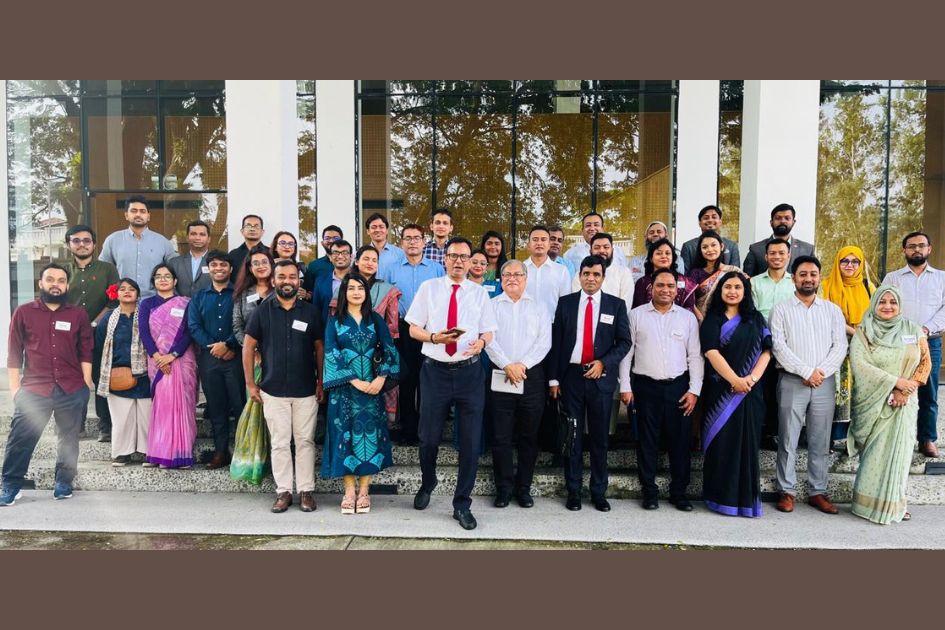
The participants represented 23 organisations across six broad institutional sectors: government, international and development organisations, private sector and banking, academia and research, civil society and media.
Their professional fields included economic relations, disaster management, environment and climate change, agriculture, fisheries, livestock, local government infrastructure, banking and finance and water modelling.
Organisers said bringing such a diverse group together was intended to encourage cross-sector learning and strengthen institutional ownership of climate projects.
That diversity is particularly important because climate finance proposals often require contributions from multiple sectors, combining technical climate evidence, public policy, financial structures, social safeguards and implementation capacity.
The programme’s broader commitment was described as “Accelerating Climate Finance Mobilisation by Designing Strategic & Investment-Ready Climate Projects”, accompanied by a climate literacy action theme: “From Vision to Approval: Unlocking GCF Finance through High-Impact Concept Notes.”
Pitching 35 concepts
The five-day process culminated in participants presenting their concept notes through five-minute pitches before mentors and evaluators.
The final presentations tested not only whether participants had completed the technical sections of their proposals, but whether they could explain the climate problem, proposed intervention, financing need, expected impact and investment logic in a concise and convincing way.
Mentors provided feedback and assessed the concepts before selecting the 10 recognised proposals.
Three were awarded Diamond status, three Gold and four Silver.
The evaluation, however, was designed as part of an ongoing development process rather than a final judgement on whether the projects would qualify for GCF financing.
Course management also provided one-to-one consultations and hands-on support aimed at helping participants develop proposals capable of becoming more bankable.
Organisers said the larger objective was to build a continuing national pool of climate finance professionals who could help Bangladesh move from identifying climate vulnerabilities and project ideas to preparing technically sound, financially credible and internationally competitive proposals.
For the first cohort, the next challenge begins after the training: refining the 35 initial concepts, strengthening their evidence and financing logic and determining which could eventually develop into proposals suitable for Bangladesh’s climate finance pipeline.




