

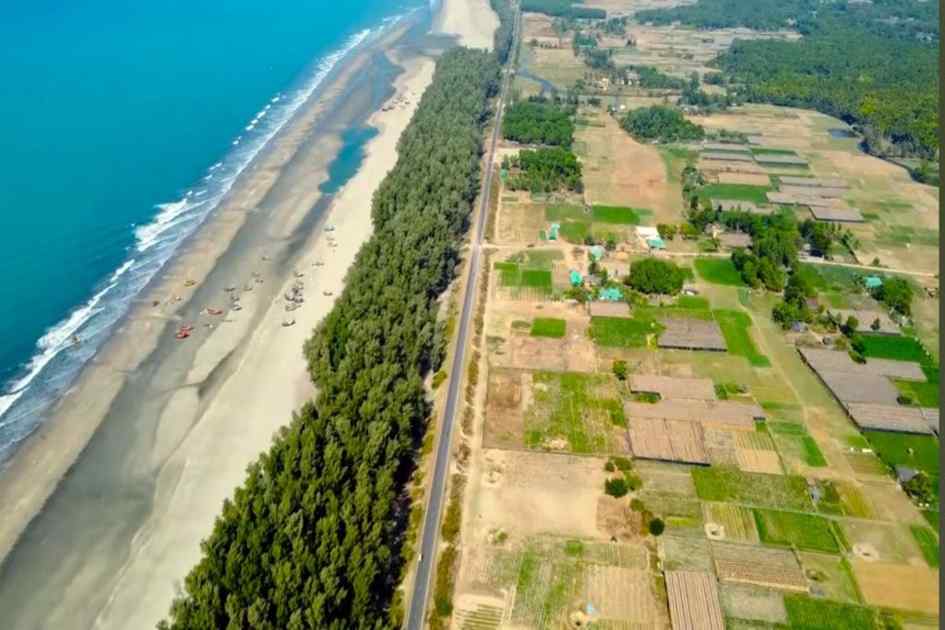

Around 6,500 trees are being felled along the 79km Marine Drive in Cox’s Bazar as part of a four-lane expansion, raising alarm among environmentalists over ecological risks and compliance with environmental regulations.
Thousands of trees are being cut along a scenic coastal highway in southeastern Bangladesh as authorities expand a major tourism road project, raising environmental concerns among activists and conservationists.
The tree felling is taking place along the Marine Drive road in Cox’s Bazar, a major tourist destination known for its long sea beach and diverse coastal ecosystems.
Bangladesh, along with many other countries, pledged at the United Nations Climate Change Conference COP26 to work toward ending deforestation by 2030. Environmentalists say future infrastructure projects must be carefully planned to ensure development does not come at the cost of critical ecosystems.
The 79-kilometre Marine Drive connects Cox’s Bazar with Teknaf. A 32-kilometre stretch of the road, from Kolatoli in Cox’s Bazar town to Patuar Tek, is currently being widened from about 5.5 metres to around 10.3 metres as part of a four-lane expansion project.
As part of the development work, around 6,500 trees, mostly rows of casuarina lining the scenic highway, are set to be removed from both sides of the road. Officials said more than 4,000 trees have already been cut while the remaining trees have been marked for removal in areas including Cox’s Bazar Sadar, Inani and Ukhiya.
Marine Drive is considered one of the most scenic coastal highways in Bangladesh and attracts large numbers of tourists each year due to its views of the sea, hills and forested landscapes.
During a recent visit to the Himchhari and Darianagar sections of the road, several trees were seen marked for cutting while others had already been felled and left beside the highway. Many of the trees are estimated to be around 15 years old.
Rokon Uddin Khaled Chowdhury, executive engineer of the Roads and Highways Department in Cox’s Bazar, said the road expansion project aims to accommodate increasing traffic and tourism in the region. The project cost has been estimated at around Tk 1,092 crore.
However, questions have been raised over whether proper environmental assessments were conducted before the tree removal began.
According to the Department of Environment, road construction projects longer than 10 kilometres fall into the high-impact category under Bangladesh’s environmental regulations and require an Environmental Impact Assessment.
Environmental activists say such an assessment was not conducted for this particular expansion project.
Sharif Jamil, member secretary of the environmental organisation Dhara Dharitri Rokkhay Amra, warned that cutting thousands of trees in Cox’s Bazar could set a concerning precedent.
He said the region is one of Bangladesh’s most ecologically sensitive areas, combining forests, wildlife habitats, hills and coastal ecosystems.
“If thousands of trees are cut without proper environmental assessment in such a sensitive area, it will be a very bad example,” he said.
Officials involved in the project said there are plans to plant significantly more trees after the construction work is completed. According to project sources, nearly 38,000 trees are expected to be planted along the expanded road corridor.
Meanwhile, the Inter Services Public Relations Directorate said environmental impact analyses are conducted for projects implemented by the Bangladesh Army, and that discussions have been held with the government regarding the road’s realignment.
Environmental concerns have been growing in Bangladesh over large-scale tree felling linked to development projects. Studies indicate that hundreds of thousands of trees have been cut across the country in recent years for infrastructure development, raising increasing alarm among environmental groups.
Cox’s Bazar has already faced environmental pressure in recent years including forest loss after nearly one million Rohingya refugees took shelter in forested areas of Ukhiya and Teknaf in 2017.
Commenting on the issue, Sohanur Rahman, executive coordinator of YouthNet Global, said development projects must balance infrastructure needs with environmental protection.
“Cox’s Bazar is one of the most environmentally important coastal regions in Bangladesh. Large-scale tree cutting without strong environmental safeguards risks damaging ecosystems that support biodiversity and climate resilience,” he said.




