

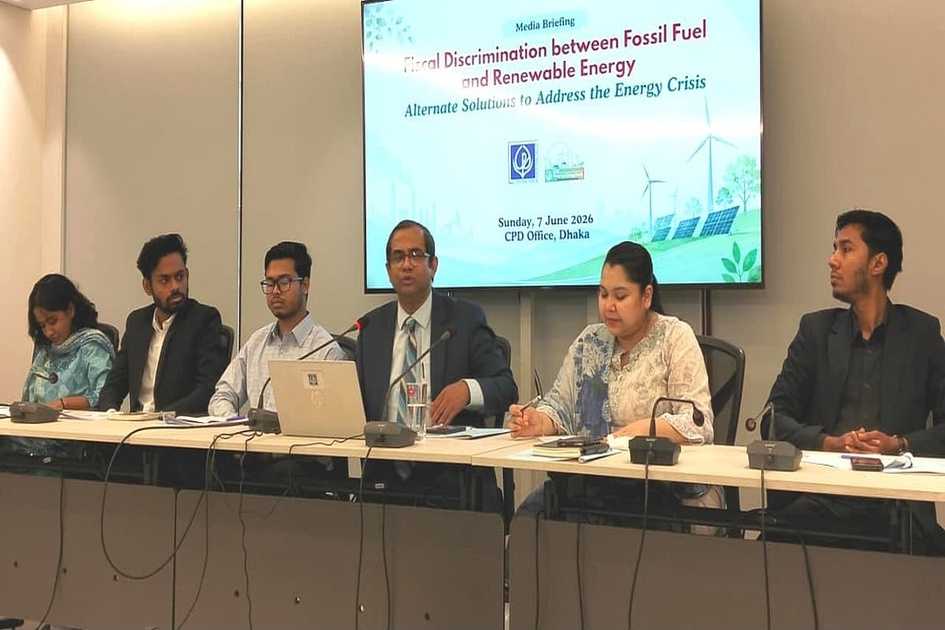



CPD says Bangladesh’s tax system favours fossil fuels over renewables, warning that high duties on clean technologies are slowing investment and weakening the country’s energy transition.
Bangladesh’s fiscal system continues to structurally favour fossil fuels over renewable energy, creating a significant barrier to the country’s clean energy transition, according to the Centre for Policy Dialogue (CPD). The think tank said this imbalance is weakening long-term energy security and slowing investment in clean technologies despite growing policy commitments to renewables.
At a media briefing in Dhaka on Sunday, CPD Research Director Khondaker Golam Moazzem presented a study titled “Fiscal Discrimination Between Fossil Fuel and Renewable Energy: Alternate Solutions to Address the Energy Crisis”, prepared by CPD’s Power and Energy Study Team. He said Bangladesh needs urgent fiscal reforms, including a phase-out of tax privileges on liquefied natural gas (LNG) imports and the introduction of targeted green subsidies and incentives in the upcoming national budget for FY2026-27.
The study found a sharp and systemic imbalance in the taxation of fossil fuels and clean energy technologies. Based on the National Board of Revenue (NBR) tariff schedule for FY2025-26, the analysis covered 50 products across solar, wind, energy storage, electric vehicles, grid infrastructure, fossil fuels and power generation equipment. It showed that LNG imports face a total tax incidence of just 9.5 percent due to VAT exemptions and low advance income tax, while lithium-ion batteries are taxed at 61.8 percent and some electric vehicles and grid components face tax burdens exceeding 93 percent.
While solar and wind equipment face moderate tax rates of 28 to 31 percent, the study highlighted that enabling technologies essential for scaling renewable energy, such as batteries, transformers, transmission systems and electric vehicles, are subject to significantly higher taxation. Researchers said this creates a structural cost disadvantage that discourages investment in the supporting infrastructure needed for large-scale clean energy deployment.
“This is not a neutral tax structure. It is discriminatory and it is costing Bangladesh its energy future,” Moazzem said, adding that policy inconsistencies are widening the gap between renewable energy ambitions and actual fiscal incentives.
The report also pointed to substantial fiscal advantages for fossil fuels. LNG imports benefit from full VAT exemption, resulting in an estimated annual revenue loss of around Tk 16.72 billion, while coal imports also receive significant tax relief. Researchers said these incentives reflect a deeper structural bias in the fiscal framework that prioritises fossil fuel dependence.
A subsidy analysis based on Bangladesh Power Development Board (BPDB) data for FY2024-25 found that fossil fuel-based power generation continues to receive substantial financial support. Oil-fired power plants receive the highest average subsidy at Tk 20.18 per kilowatt-hour, with some facilities receiving up to Tk 39 per kilowatt-hour. While renewable energy projects also receive per-unit support, they do not benefit from capacity payments and face significantly higher upfront costs due to taxation on equipment and storage systems.
The study warned that Bangladesh’s fiscal structure creates a “double loss” by reducing potential government revenue through fossil fuel tax exemptions while simultaneously discouraging renewable energy investment through high import duties on essential technologies. Researchers said this mismatch is slowing the transition to a cleaner and more resilient energy system at a time when energy insecurity is rising.
Calling for urgent reform, CPD urged the government to adopt a comprehensive green fiscal policy in the next national budget. It recommended a phased removal of fossil fuel tax exemptions, significant reductions in tariffs on renewable energy technologies and supporting infrastructure and the introduction of targeted fiscal incentives for energy storage systems, electric vehicles and grid expansion. The think tank also stressed that fiscal policy must be aligned with Bangladesh’s long-term climate commitments to ensure a just and sustainable energy transition.




