

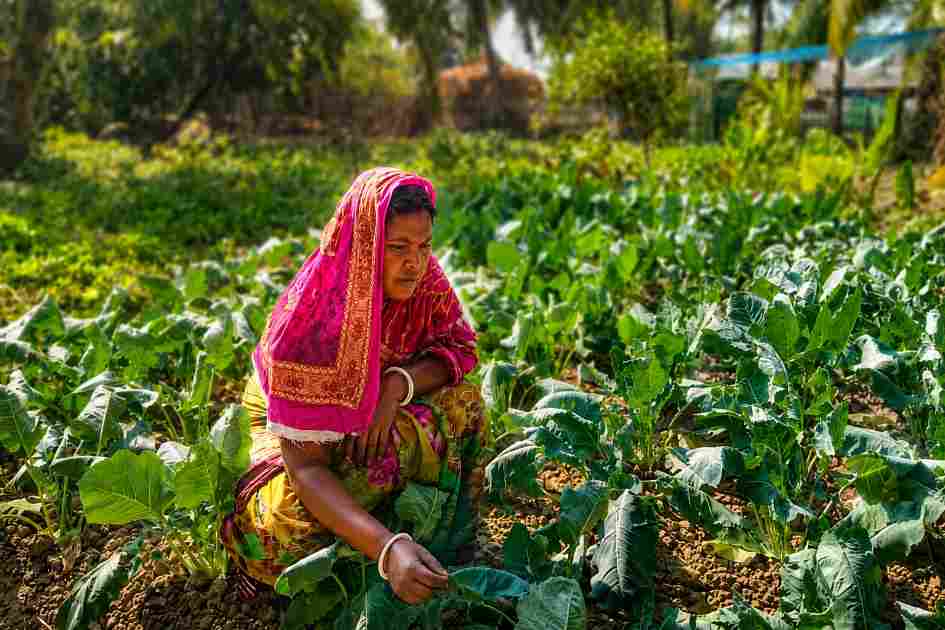

In coastal Khulna, Zharna Sarkar turns rainwater harvesting, homestead gardening and duck farming into a path toward safer water, stronger income and climate resilience for her family.
A Daily Search for Safe Water
Every morning in the coastal village of Jirbunia in Khulna, southwestern Bangladesh, began with a familiar struggle for 36-year-old Zharna Sarkar.
Before preparing breakfast, caring for her young son or tending to household chores, she would set out to find drinking water.
Sometimes she walked long distances to reach a freshwater source. On other days, she relied on neighbors, hoping they would spare a pitcher of water for her family.
“Safe water felt like a luxury,” Zharna recalled. “I spent hours every day collecting water and even then, we often became sick after drinking it.”
Water Everywhere, But Little Safe to Drink
For families living along Bangladesh’s climate-vulnerable coast, water is everywhere, but safe water is increasingly difficult to find.
Rising sea levels, frequent cyclones, tidal surges and saltwater intrusion have contaminated rivers, ponds and groundwater across large parts of Khulna and Satkhira districts. The growing salinity crisis has turned access to freshwater into one of the region’s most pressing climate challenges.
Researchers studying coastal Bangladesh found that women fetch drinking water in nearly 78.4 percent of households, highlighting how water scarcity disproportionately affects women and girls.
Like many women in coastal Bangladesh, Zharna became the primary provider of water for her household, which includes her husband, son and elderly father-in-law.
The Hidden Cost of Water Scarcity
The burden consumed several hours every day. It also carried hidden costs.
Time spent collecting water meant less time for education, income-generating activities and family care. Meanwhile, drinking saline or contaminated water increased health risks and household medical expenses.
Studies have linked rising salinity in coastal Bangladesh to a range of health concerns. At the same time, researchers warn that climate-driven salinization is becoming an increasingly serious threat to both livelihoods and public health.
Bangladesh is often described as one of the countries most vulnerable to climate change. Nowhere is that vulnerability more visible than in the southwestern coastal belt.
Although rivers, canals and ponds surround many villages, much of the water is too saline for drinking. During the dry season, families often travel kilometres to collect freshwater.
Salinity Threatens Farms and Families
The situation has become increasingly difficult for farming households like Zharna’s.
Agriculture was once the family’s primary source of income. But rising soil salinity reduced crop yields year after year, creating financial uncertainty and threatening food security.
“We were losing crops and safe water was becoming harder to find,” Zharna said. “It felt like everything was getting more difficult.”
A Turning Point Through Adaptation Support
A turning point came when Zharna became involved in Bangladesh’s Gender-responsive Coastal Adaptation Project, an initiative led by the Ministry of Women and Children Affairs with support from the Green Climate Fund and the United Nations Development Programme.
The project seeks to strengthen the resilience of climate-vulnerable coastal communities, particularly women, by improving access to safe drinking water and climate-adaptive livelihoods. It has already provided climate-resilient water solutions to more than 30,000 households across Khulna and Satkhira.
Through the project, Zharna received a 2,000-litre rainwater harvesting tank installed beside her home.
For the first time in years, safe drinking water was available just steps from her front door.
“Now I don’t have to spend hours searching for water,” she said. “The water is here at home.”
Health, Time and Savings
The change was immediate. Family members experienced fewer water-related illnesses, including diarrhoea and gastric problems. Medical expenses declined and valuable hours were freed up each day.
“Before, we spent money on medicine frequently,” she said. “Now those costs have gone down and my family is healthier.”
According to UNDP, reliable access to safe water creates significant benefits for women and girls by reducing the time spent collecting water and allowing them to invest that time in education, livelihoods and other productive activities.
For Zharna, access to water became the foundation for something larger.
From Backyard Gardening to Income
After joining the project’s Padma Women’s Livelihood Programme alongside 25 other women, she received training in homestead gardening, climate-resilient agriculture, aqua geoponics, organic compost production and small business development.
The training helped her transform her backyard into a small vegetable farm.
Today, the family grows a variety of vegetables that provide both nutritious food and additional income.
In January 2025 alone, Zharna earned 2,675 Bangladeshi taka, about US$22 at the time, by selling vegetables.
“Before, we bought vegetables from the market,” she said. “Now we grow our own food and sell the extra produce.”
The earnings may seem modest, but in a rural community where climate impacts have disrupted traditional livelihoods, they represent an important source of financial stability.
Ducks, Eggs and New Confidence
The success encouraged her to diversify further.
Using savings from vegetable sales, she purchased ducklings and began raising ducks for eggs and meat. She now sells surplus eggs to neighbours and hopes to expand the small enterprise in the future.
“The number of ducks is growing,” she said. “I hope they will bring even more income for my family.”
Women as Agents of Adaptation
The Gender-responsive Coastal Adaptation Project was designed around a simple idea: women are often among those most affected by climate change, but they can also be powerful agents of adaptation.
The initiative has formed more than 1,000 women’s livelihood groups and installed thousands of climate-resilient water facilities across coastal Bangladesh. Women receive technical training, support for livelihood development and access to climate-resilient technologies that strengthen household resilience.
For Zharna, those interventions have translated into greater confidence and independence.
She now contributes directly to household income, saves money regularly and maintains a bank account in her own name.
“Before, I felt helpless,” she said. “Now I feel capable. Being able to contribute to my family gives me confidence.”
Resilience Beyond Survival
The climate challenges facing coastal Bangladesh remain immense.
Salinity continues to spread across agricultural land and freshwater sources. Millions of people remain vulnerable to water insecurity, extreme weather and livelihood losses.
Yet stories like Zharna’s demonstrate that adaptation is not only about surviving climate change. It is also about creating opportunities despite it.
A woman who once spent hours each day searching for drinking water now grows vegetables, raises ducks, earns an income and plans for the future.
Her journey illustrates how targeted climate investments, especially those focused on women, can transform vulnerability into resilience.
In a region on the front lines of climate change, that transformation may be one of the most powerful adaptation tools of all.




