

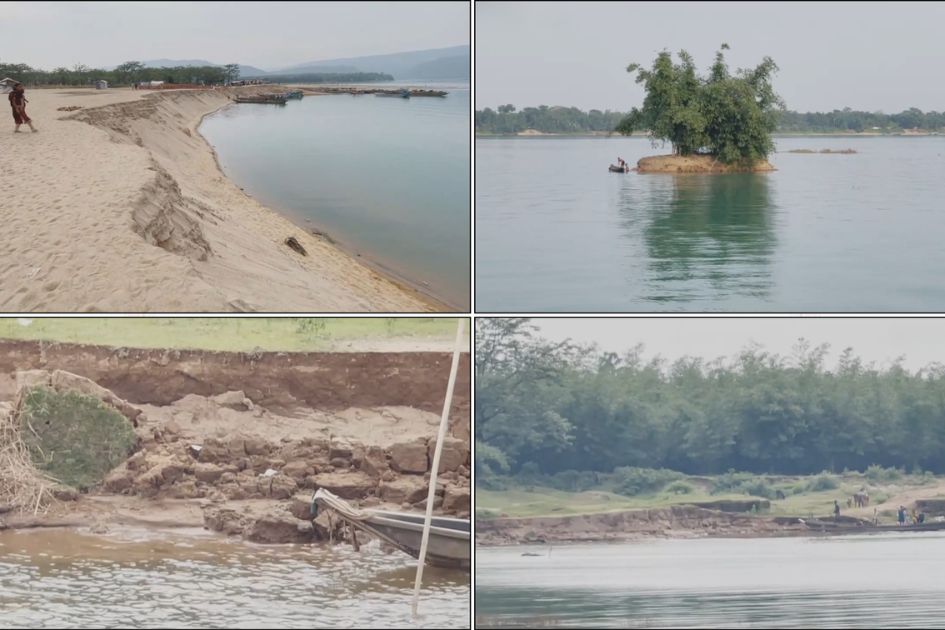



Illegal sand extraction along Sunamganj’s Jadukata River is accelerating erosion, endangering 20 villages, homes, farmland and the country’s largest Shimul Garden, prompting urgent calls for government intervention.
Illegal sand extraction along the banks of the Rupeshwari Jadukata River in northeastern Bangladesh has triggered severe erosion, placing at least 20 villages, thousands of homes, agricultural land and the country’s renowned Zainal Abedin Shimul Garden at risk, according to local residents and environmental activists.
Residents and visitors allege that sand is being extracted from the riverbanks every night using dredgers and locally made sieve machines under the protection of influential groups. Hundreds of boats are reportedly transporting the sand away, accelerating riverbank collapse and threatening homes, roads, government housing projects, orchards and forested areas along both sides of the river.
For the past two months, sand miners have been operating around the clock using locally built equipment, including shovels, buckets, shallow pump machines fitted with sieves and other extraction methods. Witnesses say dredgers and so-called bomb machines are often used under the cover of darkness, while during the day boats anchor along the banks and workers dig deep pits with hand tools. The practice has caused extensive erosion, with hundreds of wooden cargo boats and steel vessels gathering along the riverbank to load sand.
The worsening erosion has put the villages of Ghagtia, Manigaon, Lamashram, Rajagaon, Sohala, Miar Char, Bariktila, Laurergarh, Binnakuli and Garkatis, among others, under serious threat. Roads, homes, cropland, educational institutions and a bridge currently under construction at a cost of hundreds of millions of taka are also at risk, residents said.
Many families affected by the erosion have already begun relocating salvaged materials from their damaged homes, including rusted corrugated metal sheets, bamboo structures and timber. Villagers say the sand extraction syndicate has cut riverbanks directly in front of residential areas, causing large sections of land to collapse into the river.
Residents allege that the syndicate’s influence has prevented meaningful resistance, while homes, cattle sheds, hay storage facilities, kitchens, farmland and bamboo groves continue to disappear into the water.
The erosion has exposed the roots of numerous trees along the riverbank, with some bamboo clusters already collapsing into the river. Local people fear that if sand extraction continues, the once-green river corridor could eventually turn into a barren landscape.
Among the areas facing the greatest danger is the internationally known Zainal Abedin Shimul Garden, considered the largest shimul garden in the country. Thousands of silk cotton trees and adjacent lemon orchards are at risk of being swallowed by the river. The river is steadily advancing toward the garden from the north and east. Residents say that if another 100 meters of riverbank is cut away on the eastern side, the front section of the garden could collapse into the river.
Originating in the Khasi and Jaintia hills of Meghalaya in northeastern India, the Jadukata River was once only 57 meters wide. However, continuous riverbank cutting and sand extraction over the past three decades have expanded its width to between 200 meters and more than one kilometer in some sections.
Demanding protection of the river, cancellation of sand quarry leases and the declaration of the area as an Ecologically Critical Area (ECA), affected residents and environmental activists have organized human chains in Sunamganj and Sylhet. They claim that fear of influential individuals has discouraged public opposition and have called for intervention from the highest levels of government.
Asked about the issue, Md Saiful Islam, an inspector at the district Department of Environment, cited a court order as a barrier to enforcement.
“Because of a court order, we are unable to take action against those extracting sand using bomb machines, dredgers and sieve machines,” he said.
Additional Superintendent of Police Sujon Sarkar said stopping riverbank cutting and illegal sand extraction was beyond the capacity of the police alone.
Sunamganj Deputy Commissioner Mohammad Minhajur Rahman, however, said authorities were preparing joint operations involving multiple agencies to stop the destruction.
“Mobile court drives have now been instructed to impose prison sentences instead of fines,” he said.
The river has already claimed lives. Two people were killed earlier while extracting sand from the Jadukata River when a riverbank collapsed and buried them under sand.
This post is republished from Somoy News.




