

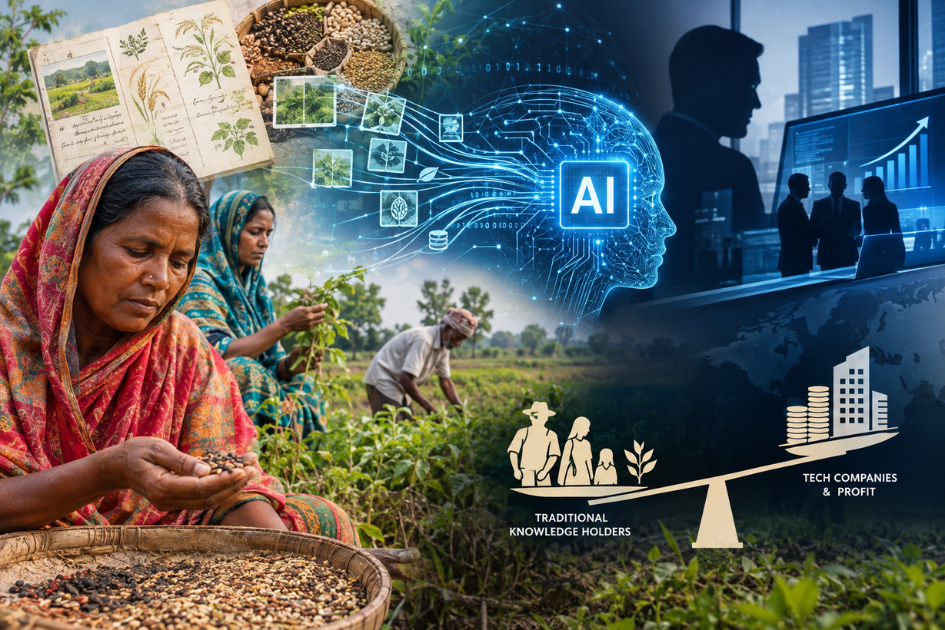



As AI systems increasingly draw on traditional knowledge, questions of consent, ownership, accountability and fair benefit-sharing are exposing gaps in existing laws.
When farmer Alpana Rani Mistry of Dhumghat village in Shyamnagar upazila of Satkhira, in Bangladesh’s coastal region, spends years fighting salinity and preserving locally adapted seeds, and when farmer Mst Sultana Khatun in the drought-prone Barind region spends years building a living seed repository of 194 indigenous crop varieties in a community seed bank, that knowledge does not belong to them alone. It belongs to their communities. The people of their villages also have a stake in it. Passed down through generations and sustained through years of local practice, this knowledge has become part of a shared inheritance.
For decades, farmers have learned to read the language of the soil. They can sense approaching rain by observing the sky, recognise the right time for cultivation from the smell and condition of the soil, identify which indigenous seeds can survive drought, and know which leaves or plants can help control pests. They did not acquire this knowledge from a laboratory. They inherited much of it from their parents and grandparents and developed it further through their own experience. To them, this knowledge is not merely information. It is a history of life, culture and survival.
Today, such knowledge is increasingly finding its way into the vast datasets used by artificial intelligence. We ask a question and receive an answer within seconds. We then assume that AI “knows”. But how much do we understand about the politics behind this knowing? Who informed it? Whom did it learn from? Who gave permission? And who owns the economic value created from that knowledge?
An incident involving a farmer in China’s Anhui province brings this question into disturbing focus. After following AI-generated advice on the use of herbicides and pesticides, the farmer reportedly lost sesame seedlings across nearly 25 acres of land. The same AI later indicated that the chemical used was harmful to broad-leaved crops such as sesame. The mistake, therefore, was not confined to a virtual space. It reached the real soil, the real crop and the real life of a real farmer.
There have also been lawsuits and legal disputes involving alleged harmful or misleading AI advice in medicine, law, financial decision-making and mental health. In some cases, people have alleged that AI-related advice contributed to delays in seeking medical treatment or intensified mental distress. In another well-known case, lawyers submitted fabricated legal authorities generated by ChatGPT to a court and were fined. The question, therefore, is no longer simply how intelligent AI is. The more important question is: when AI causes harm, who bears the political and legal responsibility? Against whom should a farmer seek justice? The machine? The algorithm? The technology company? Or the farmer himself, because he trusted the advice generated by AI?
Existing legal systems are still struggling to fully respond to this new reality. Establishing the harm, identifying the responsible party and securing compensation can be extremely difficult. But this is precisely where the deeper political question emerges. If a technology can cause harm when it makes a mistake, and if that technology learns from human knowledge, then who has rights over the knowledge from which it learns?
Imagine that farmers in a remote village of Bangladesh have preserved an indigenous rice variety for a hundred years. They know how it survives drought, how its seeds should be stored and when they should be planted. A researcher documents that knowledge. Later, the information is uploaded to the internet. An AI system learns from it. Millions of people around the world ask that AI questions and receive answers based on that knowledge.
Now ask: who receives the value of that knowledge?
Does the farmer receive anything? Does the village community receive anything? Or does the knowledge become data, and the data become a resource that increases the wealth and technological power of a private company?
This is where an uncomfortable similarity emerges between the economy of AI and the logic of old colonialism.
Colonialism once claimed: the land is ours, the forests are ours and the minerals are ours, because we are powerful. Today’s data economy sometimes presents a remarkably similar logic in more sophisticated language: the information is online, therefore it is available for use; the knowledge has been published, therefore it is data; the data have been obtained, therefore they are raw material for technology.
But being on the internet does not mean being ownerless.
An Indigenous woman may have carried the medicinal knowledge of her community from one generation to another. A fisher may have spent decades learning the behaviour of a river. A farmer may have spent a lifetime working with seeds. If we simply declare their knowledge “open data”, what are we actually doing?
Are we making knowledge free, or are we stripping the knowledge holders of their rights?
This is where the responsibility of the state begins.
If the state can enact laws to protect citizens’ rights over land, labour and natural resources, why should there be no legal framework to protect the rights associated with collective knowledge? Why should a company be able to take the knowledge of a community, build technology from it and generate commercial value while the community’s consent, recognition and share of the benefits remain optional?
If our AI policies are written only in the language of investment, innovation, startups and the digital economy, then where are the farmers? Where are Indigenous communities? Where are women who carry local knowledge? Where is rural society?
AI must advance. But at whose cost?
If technological progress turns the knowledge of powerful groups into valuable assets while treating the knowledge of marginalised communities as free raw material, then this is not merely technological progress. It is the construction of a new infrastructure of inequality.
The Nagoya Protocol and recent initiatives by the World Intellectual Property Organization have created important policy foundations for protecting traditional knowledge and genetic resources. Yet there is still no universal international mechanism that automatically guarantees the consent, ownership rights and royalties of knowledge holders for all traditional knowledge used in AI training.
Technology is therefore moving faster than law. Bangladesh has an opportunity to act rather than leave this legal and ethical vacuum to others. We need a system in which communities give consent before their traditional knowledge is digitised; in which they have a say in how that knowledge is used; in which benefits are shared when commercial value is created; and in which there are effective mechanisms for determining liability and providing compensation when knowledge is misused or causes harm.
Above all, we must stop treating community knowledge merely as “data”. Because behind data are people.
Behind algorithms are histories. And behind an AI-generated answer there may sometimes be a hundred years of experience accumulated by an entire village. If we erase that history and make the algorithm the sole owner of value, AI may become more intelligent, but our society will not become more just. The time has come to decide: will AI serve people, or will it use people’s knowledge to create new centres of power?
This is not merely a question of technology. It is a question of ownership. It is a question of class. It is a question of the state. It is a question of justice.
The farmer whose knowledge is valuable enough to teach an AI system must not remain an invisible supplier of data in the AI economy. If future wealth is created from his knowledge, he must have rights in that future. And if that knowledge generates commercial value, he should have a fair share of the benefits, including royalties where appropriate. Because history tells us that colonialism did not take only land. It also took knowledge. Will we now allow the same history to be repeated in the hands of algorithms? The time has come to determine who owns the knowledge that is ours.




