


Least developed countries are pressing for stronger climate finance, adaptation support and mitigation commitments, with Bangladesh facing many of the same climate justice priorities.
The world’s least developed countries have drawn a clear political line ahead of COP31. The next climate summit cannot be another exercise in making promises. It must become a test of whether those promises are translated into finance, implementation and protection for people already living on the front lines of climate change.
The Dili Ministerial Declaration on Climate Change, adopted following high-level strategy and ministerial meetings in Timor-Leste, sets out a common agenda for the Least Developed Countries ahead of the 31st United Nations Climate Change Conference.
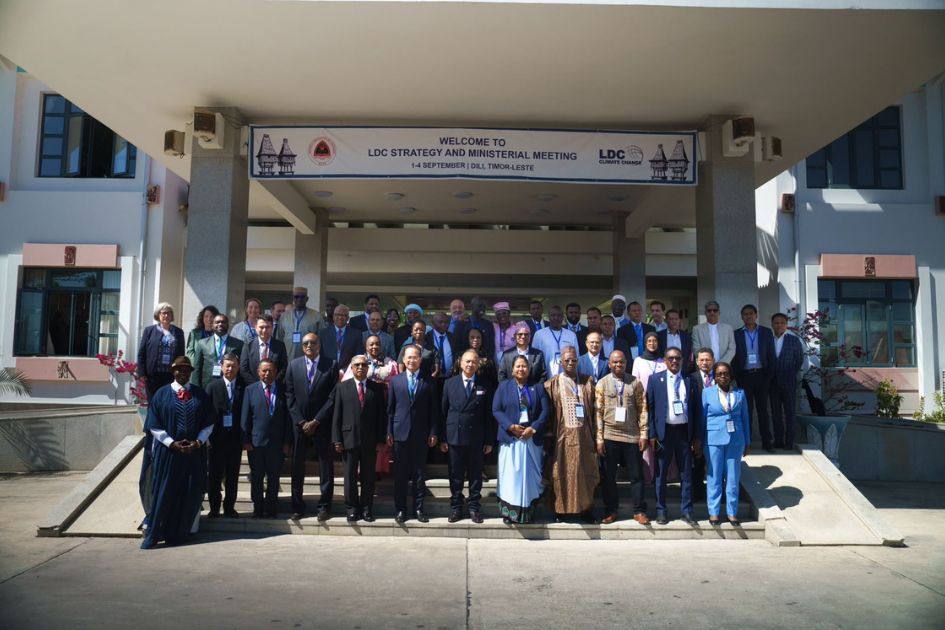
Representatives from 44 LDCs participated in the Dili discussions from September 1 to 4, with Timor-Leste chairing the group. The declaration brings together the bloc’s priorities on mitigation, climate finance, adaptation, loss and damage, just transition, science and implementation of national climate commitments.
Its significance lies not simply in the adoption of another declaration, but in the attempt to redefine what vulnerable countries expect from COP31: less recognition of vulnerability and more delivery of climate action.
A fragile moment for international cooperation
The declaration comes as the global climate regime faces a difficult geopolitical and financial environment.
LDC ministers highlighted growing geopolitical instability, mounting debt vulnerabilities, economic uncertainty and declining development assistance and climate finance. For countries with limited fiscal space and high exposure to climate shocks, these pressures can make the implementation of climate policies considerably harder.
The contradiction is increasingly difficult to ignore. Despite their relatively small contribution to cumulative global greenhouse gas emissions, LDCs are among the countries most exposed to climate impacts, from floods, droughts and cyclones to sea level rise, food insecurity and ecosystem degradation.
For these countries, international solidarity is not an abstract diplomatic principle. It is closely connected to whether communities can adapt, whether governments can invest in resilient infrastructure and whether development gains can be protected from increasingly severe climate shocks.
The Dili Declaration therefore seeks to strengthen the LDC Group’s collective negotiating position before COP31, while placing implementation at the centre of the climate debate.
NDC 3.0: ambition must be matched by delivery
The next generation of Nationally Determined Contributions, known as NDCs 3.0, is one of the central issues in the LDC position.
The group is calling on Parties to accelerate the preparation and implementation of ambitious NDCs and expects major emitters in particular to strengthen mitigation efforts in line with the Paris Agreement and the goal of keeping the 1.5°C limit within reach.
But ambition on paper will not be enough.
NDC 3.0 must be supported by credible policies, institutions, technology, investment and international cooperation. For vulnerable countries, the value of a climate plan ultimately depends on whether it can be implemented at national and local levels.
This is where the Dili agenda moves beyond the familiar cycle of climate declarations. The question is no longer simply whether countries can announce more ambitious targets. It is whether those targets are backed by the means of implementation required to deliver them.
1.5°C is a survival threshold
For the LDCs, the 1.5°C limit is not merely a negotiating number.
It is increasingly connected to the limits of adaptation, escalating loss and damage, food and water security, livelihoods and the survival of vulnerable communities.
Every fraction of additional warming can intensify climate risks. As warming increases, the room available for adaptation becomes narrower and the economic and social consequences of climate impacts become harder to absorb.
That is why the LDC call for stronger mitigation action carries particular political weight. Keeping 1.5°C within reach requires rapid emissions reductions, especially from countries and sectors with the greatest capacity and responsibility to act.
The LDC position also reinforces the importance of science-based decision-making and stronger links between climate negotiations and the latest scientific assessments.
Climate finance: from announcements to access
If mitigation ambition is one side of the COP31 debate, climate finance is the other.
The Dili Declaration places strong emphasis on implementation of the New Collective Quantified Goal on climate finance, known as the NCQG, and calls for substantially greater, predictable, accessible and grant-based public finance for LDCs.
For vulnerable countries, the distinction between announced finance and accessible finance is critical.
Money can be pledged internationally without necessarily reaching communities in time. Complex application procedures, limited institutional capacity, fragmented funding streams and high transaction costs can prevent countries with the greatest needs from accessing available resources.
This is why LDCs are pressing for finance that is not only larger in scale but also simpler, faster, more predictable and better aligned with national priorities.
Grant-based finance is particularly important for countries facing debt vulnerabilities. Climate action should not leave vulnerable developing countries carrying additional debt for a crisis they did little to create.
The declaration also calls for stronger resources for mechanisms addressing climate impacts and for greater support through institutions including the Fund for Responding to Loss and Damage, the Least Developed Countries Fund and the Green Climate Fund.
For COP31, the political question will be whether climate finance can move closer to the countries and communities that need it most.
Adaptation and loss and damage
Adaptation remains a defining priority for the LDCs.
Many vulnerable countries are already adapting to impacts that are no longer theoretical. Communities are modifying agriculture, strengthening infrastructure, responding to water stress and preparing for increasingly severe climate hazards.
But adaptation has limits.
When climate impacts exceed the capacity of communities and ecosystems to cope, the issue moves into the territory of loss and damage. This is why the LDC position gives increasing importance to both adaptation finance and effective international support for loss and damage.
The challenge for COP31 will be to ensure that adaptation does not remain the less-funded side of climate action and that the mechanisms established to address loss and damage can deliver meaningful support.
Just transition must include development and jobs
The LDC agenda also places just and equitable transition within the broader climate discussion.
For developing countries, the energy transition cannot be reduced to replacing fossil fuels with renewable energy. It is also about jobs, energy access, affordability, skills, social protection and maintaining development opportunities.
A just transition must therefore ensure that climate action does not shift disproportionate economic costs onto countries and workers with limited capacity to absorb them.
This is especially relevant for countries seeking to expand renewable energy, improve energy efficiency, reduce air pollution and create decent green jobs while continuing to meet development needs.
For LDCs, the transition must be both climate-compatible and development-compatible.
Science must guide the next phase
The Dili Declaration also reinforces the importance of scientific evidence in guiding international climate policy.
The LDCs are seeking timely scientific inputs to ensure that future negotiations remain aligned with the best available evidence and with the objectives of the Paris Agreement.
The call for stronger links between IPCC science and the next phase of the Global Stocktake reflects a broader concern: climate policy cannot move at the pace of diplomatic compromise while the physical climate system continues to change.
Scientific assessments must inform decisions on mitigation, adaptation, finance and loss and damage, not simply provide background information after political decisions have already been made.
Why Dili matters for Bangladesh
The priorities emerging from Dili have direct relevance for Bangladesh.
As a highly climate-vulnerable developing country, Bangladesh has a strong interest in keeping 1.5°C within reach, securing predictable and grant-based climate finance, strengthening adaptation and resilience, ensuring meaningful support for loss and damage and translating NDC 3.0 into implementation.
Bangladesh’s climate agenda also increasingly intersects with energy transition, renewable energy, air pollution, urban resilience and employment.
A credible just transition must therefore address both climate and development realities. This means expanding clean energy while protecting energy access, creating decent green jobs, developing skills for the future labour market and reducing the health and economic costs associated with pollution.
The gender dimension must also remain visible. Climate action should be gender-responsive and, where necessary, gender-transformative, recognising the unequal impacts of climate change while challenging the social norms and power structures that deepen vulnerability.
Meaningful engagement of women, girls, youth, men and boys can strengthen locally grounded climate action and environmental stewardship.
For Bangladesh and other vulnerable countries, these are not separate negotiating issues. They are interconnected parts of climate justice.
COP31: the delivery test
The Dili Declaration arrives after more than a decade in which international climate negotiations have produced targets, frameworks, pledges and declarations.
The persistent problem has been the gap between commitment and implementation.
That is why the real significance of Dili may not lie in the declaration itself. It lies in the political benchmark it sets for COP31.
The LDCs are asking for greater mitigation ambition from major emitters, credible and implementable NDCs 3.0, protection of the 1.5°C goal, stronger adaptation action, meaningful support for loss and damage, predictable and accessible climate finance and a just transition that protects development opportunities.
The test at COP31 will be whether these priorities can move from negotiating language into decisions, resources and action.
For the LDCs, success will not simply be measured by how ambitious the final text sounds.
It will be measured by whether finance reaches vulnerable countries, whether climate plans are implemented, whether communities receive support for unavoidable impacts and whether global mitigation remains consistent with the 1.5°C survival threshold.
Dili has set the benchmark. COP31 will reveal whether the international climate regime is ready to move from promises to delivery.