

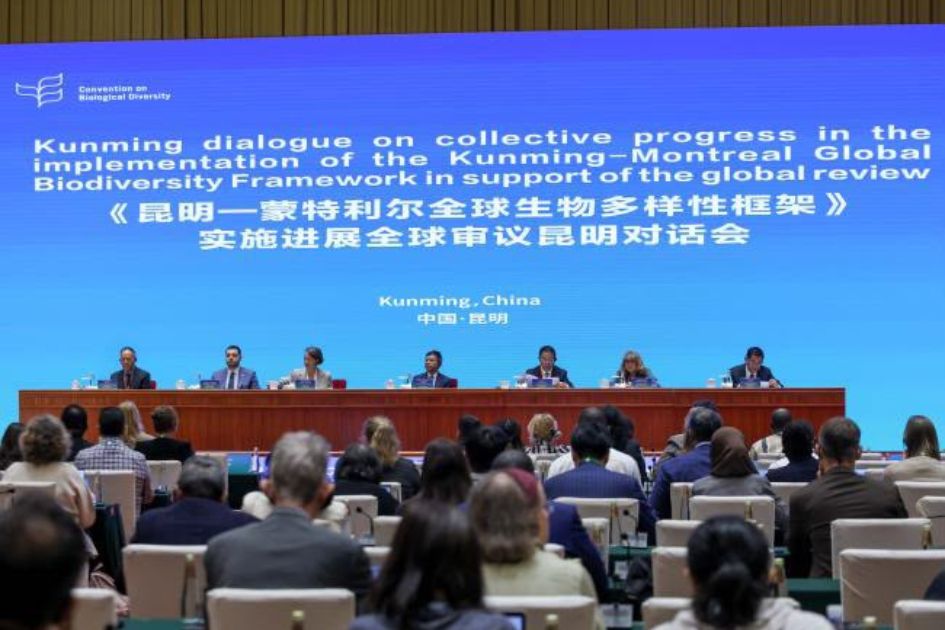



Countries at the Kunming Dialogue are examining finance, technology, capacity and governance gaps ahead of the first global review of the biodiversity framework at COP17.
Global efforts to halt biodiversity loss are not moving at the pace required to meet the 2030 targets, speakers warned as countries and stakeholders gathered in Kunming, China, for a three-day dialogue on the implementation of the Kunming-Montreal Global Biodiversity Framework (GBF).
Four years after the landmark framework was adopted, the Kunming Dialogue is bringing the biodiversity process back to the city where it began, with a focus on closing gaps between national commitments and collective global action.
The GBF, adopted in 2022, sets four long-term goals and 23 targets for 2030 aimed at halting and reversing biodiversity loss. The current dialogue is examining how far countries have progressed and what needs to change before the first global review of the framework at the 17th meeting of the Conference of the Parties (COP17) to the Convention on Biological Diversity (CBD).
COP17 will be held in Yerevan, Armenia, from October 19 to 30, where countries will assess collective progress in implementing the framework.
CBD Executive Secretary Astrid Schomaker delivered one of the clearest warnings at the opening of the dialogue.
“We are not moving collectively with the pace needed,” she said.
Schomaker said the global report on collective progress shows that the GBF has generated unprecedented engagement but has also revealed gaps between national targets and collective global targets.
She stressed that accelerating implementation would depend on countries having the necessary resources, capacities and technologies.
‘A new call for action’
Huang Runqiu, China’s Minister of Ecology and Environment and Co-Chair of the Kunming Dialogue, said the meeting represented more than a return to the geographical starting point of the biodiversity process.
It was an opportunity for countries to “reembrace our aspirations, reaffirm our pledges, and a new call for action,” he said.
Huang noted that positive trends have emerged since the adoption of the framework, but these have yet to translate into the transformative governance outcomes needed to address the biodiversity crisis.
He called for stronger political resolve, a greater sense of urgency and practical measures to accelerate action.
The message from the opening session was therefore not simply about making new commitments but about turning existing commitments into results before the 2030 deadline.
Nature protection and development
Wang Yubo, Governor of Yunnan Province, called for joint efforts to advance global biodiversity governance.
Yunnan is one of China’s most biodiversity-rich regions and has been at the forefront of the country’s efforts towards ecological conservation, he said.
Wang stressed that environmental protection and economic development should not be treated as separate priorities. He highlighted poverty reduction, inclusive prosperity and the fair and equitable distribution of ecological benefits as important elements of nature conservation.
Nathalie Provost, Canada’s Secretary of State for Nature and Co-Chair of the Kunming Dialogue, also emphasised the importance of action at the local level.
She said Canada’s strategy for protecting nature recognises that responsibility is shared among provinces, territories, municipalities and Indigenous Peoples.
Provost highlighted the importance of local stewardship alongside international cooperation in protecting ecosystems and biodiversity.
In a video message, Fabio Arjona, Colombia’s Minister of Environment and Sustainable Development, said conserving nature should also create opportunities for communities.
He cited Colombia’s initiatives linking water, biodiversity and communities, saying such approaches can contribute to water security and territorial development.
COP17 must turn science into action
Hambardzum Matevosyan, Armenia’s Minister of Environment and incoming COP17 President, said the scientific and technical recommendations emerging from recent CBD meetings must ultimately be translated into policies and action on the ground.
He recalled the outcomes of recent meetings of the CBD’s subsidiary bodies in Nairobi and said those recommendations should provide a foundation for practical implementation.
Matevosyan said the first global review at COP17 should not simply become an assessment of what countries have failed to achieve.
Instead, he said, it should serve as a catalyst for determining what needs to be achieved next.
The review will therefore be an important test of whether the GBF’s global ambitions are being translated into concrete national and local action.
Implementation gaps under scrutiny
Throughout the first day, delegates worked in breakout groups to examine the main gaps identified in the global report and discuss ways to strengthen implementation.
The discussions covered how the GBF targets have been reflected in national targets and commitments and how countries have determined their scope and coverage.
Participants also examined the lack of means of implementation, including challenges related to finance, capacity and technology.
Action and implementation formed another major area of discussion, with participants sharing experiences of initiatives and partnerships that could help countries deliver their national commitments more effectively.
Delegates also discussed data and knowledge systems needed to support evidence-based decision-making and implementation.
Another key focus was how to strengthen whole-of-government and whole-of-society approaches while respecting the circumstances and priorities of countries, Indigenous Peoples, local communities and other stakeholders.
The informal format allowed participants to move between different topics and exchange experiences openly.
The outcomes of the discussions will be compiled by facilitators and forwarded to COP17 to inform the global review process.
With only a few years remaining until the 2030 deadline, the Kunming Dialogue has placed the focus firmly on implementation.
The challenge for countries is no longer simply to demonstrate that biodiversity commitments exist but to show that those commitments are producing measurable change on the ground.
COP17 will provide the first major global assessment of that collective effort and the Kunming discussions are intended to help ensure that the review becomes a starting point for faster action rather than merely a record of missed targets.




