

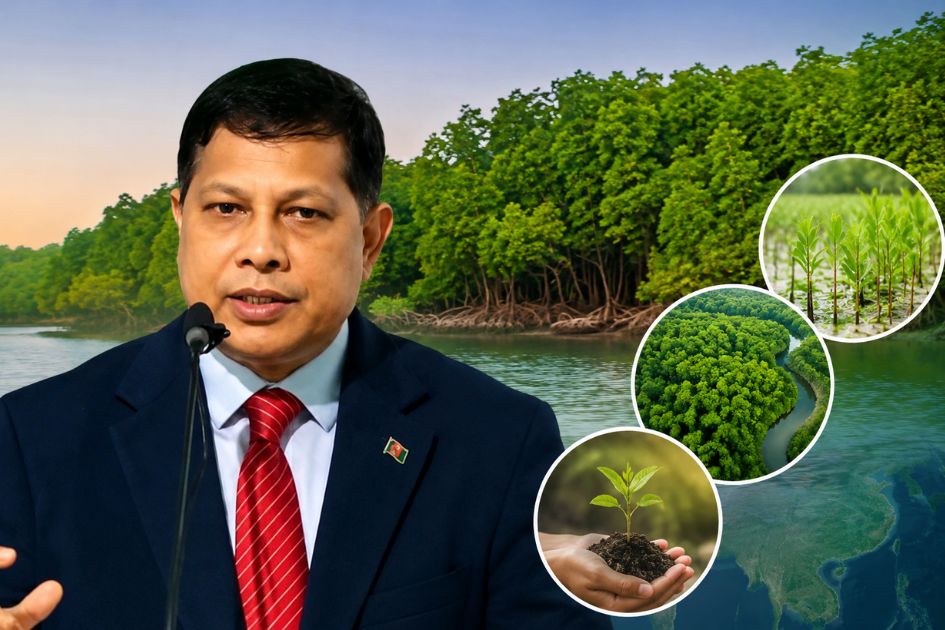



The Sundarbans offers a vital pathway for climate resilience through mangrove restoration, biodiversity conservation, and blue carbon finance, supporting ecosystem protection, coastal communities, and Bangladesh’s sustainable development goals.
The Sundarbans, a UNESCO World Heritage Site and the world’s largest continuous mangrove ecosystem, stands at the frontline of climate vulnerability and resilience. It provides vital ecosystem services, including coastal protection, carbon sequestration, biodiversity conservation and livelihood support for millions of coastal communities. Yet, it is increasingly under pressure from climate change impacts, sea-level rise, salinity intrusion, reduced freshwater flow, pollution and unsustainable resource extraction.
Aligned with the theme “Inspired by Nature, for Climate. For Our Future.”, mangrove restoration in the Sundarbans represents a powerful nature-based solution for both climate mitigation and adaptation. Mangroves act as a natural coastal defense against cyclones and storm surges, reduce erosion and serve as highly efficient blue carbon sinks. Their restoration is therefore a strategic investment in ecosystem resilience, disaster risk reduction and long-term climate security, fully consistent with Bangladesh’s Nationally Determined Contributions (NDCs) and ecosystem-based adaptation priorities.
The Sundarbans also offers significant potential for blue carbon finance. With strengthened Measurement, Reporting and Verification (MRV) systems aligned with international standards, Bangladesh can access results-based climate finance through voluntary carbon markets and Article 6 mechanisms under the Paris Agreement. Revenues generated from carbon credits can be reinvested in ecosystem restoration, adaptive management and enhancing the resilience of vulnerable coastal populations.
International experience from countries such as Indonesia, Vietnam, Kenya and Costa Rica highlights that successful nature-based solutions depend on strong governance, inclusive community participation and credible carbon accounting systems supported by sustainable financing mechanisms.
For Bangladesh, key priorities include developing a comprehensive national blue carbon framework, scaling up restoration of degraded mangrove and buffer zones, strengthening MRV and coastal carbon accounting systems, enhancing community co-management and equitable benefit-sharing and expanding access to international climate finance through both voluntary markets and Article 6 mechanisms.
Safeguarding the Sundarbans is therefore not only an environmental responsibility but also a strategic climate investment. Its protection is essential for ensuring ecological integrity, climate resilience and a sustainable and secure future for generations to come.
About the Writer
Mohammad Navid Safiullah is an Additional Secretary at the Ministry of Environment, Forest and Climate Change, Government of Bangladesh.




