

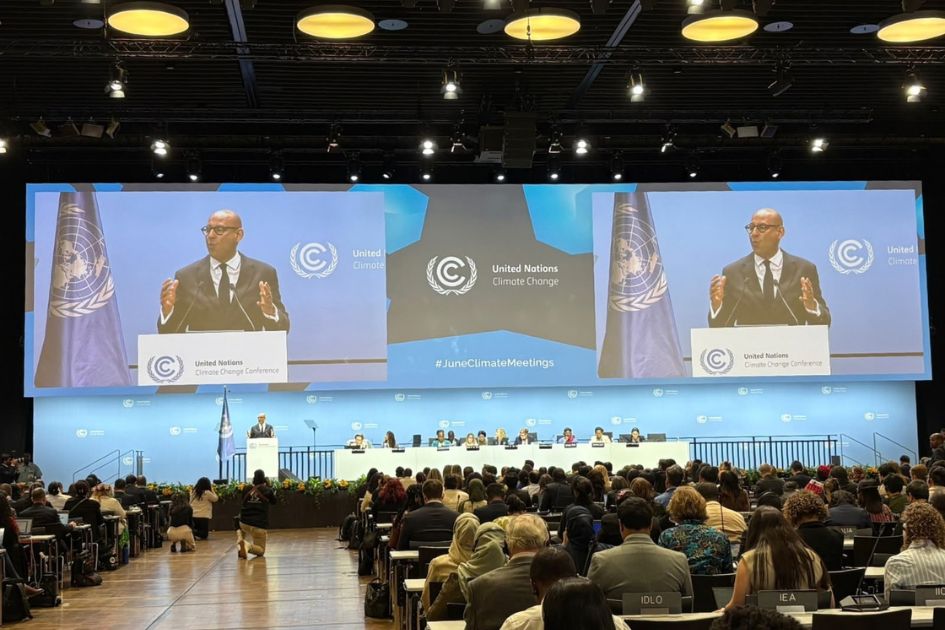

UN climate talks in Bonn begin with growing pressure to turn pledges into action, as negotiators focus on finance, adaptation, energy transition and implementation ahead of COP31 in Türkiye.
The 64th sessions of the Subsidiary Bodies (SB64) under the United Nations Framework Convention on Climate Change (UNFCCC) opened in Bonn on Monday, June 8, marking the start of two weeks of negotiations that will shape the agenda for COP31, scheduled for November in Antalya, Türkiye.
More than 7,000 participants, including government negotiators, civil society representatives, business leaders and investors, are expected to take part in the talks, which are widely seen as a key test of whether the global climate regime can shift from negotiation to implementation at the pace required by escalating climate impacts.
The talks open amid mounting pressure to close the gap between climate pledges and delivery while deepening tensions over finance, equity and the speed of the global energy transition.
UN urges focus on implementation, not renegotiation
Opening the session, UN Climate Change Executive Secretary Simon Stiell urged governments to focus on implementing existing commitments rather than reopening past agreements.
He warned that accelerating climate impacts, economic instability and geopolitical tensions are increasing the urgency for action, pointing to recent deadly heatwaves, the ongoing effects of El Niño and rising fossil fuel costs linked to geopolitical conflict.
Stiell said continued dependence on fossil fuels is undermining both economic stability and energy security, cautioning that it is effectively “importing inflation and economic instability” while leaving communities increasingly exposed to climate disasters.
He stressed that SB64 must advance work on the Global Goal on Adaptation, the Belém Adaptation Indicators, implementation of the first Global Stocktake, climate finance arrangements including the Adaptation Fund and emerging frameworks for a just transition.
Stiell also called for stronger engagement between the UN climate process and the real economy, including governments, investors, cities and civil society, to accelerate practical climate action across energy, food systems, urban resilience and methane reduction.
“Tackling the global climate crisis is the hardest but most important thing humanity has ever tried to do together,” he said, adding that progress is both urgent and essential.
Energy security and transition dominate ministerial messaging
In a separate opening address, Australia’s Minister for Climate Change and Energy, Chris Bowen, framed the current global context as one shaped by energy insecurity driven by fossil fuel dependence and geopolitical shocks.
He pointed to recent supply disruptions and price volatility as evidence that fossil fuel-based systems are increasingly fragile and economically exposed.
Bowen argued that while governments are managing short-term crises, climate change remains the defining long-term challenge and that the energy transition is not in conflict with energy security but central to achieving it.
He said accelerating renewable energy, electrification and modernised grids can strengthen energy security, reduce inflationary pressures and improve economic resilience.
He highlighted the rapid global expansion of renewable energy and battery storage, noting that clean energy investment now represents the majority of global energy investment flows.
Bowen stressed that renewable technologies such as solar and wind provide structural advantages because they are not dependent on geopolitically vulnerable supply routes.
He underscored that COP31 must focus on implementation and acceleration, particularly in scaling electrification across industry, transport and households while improving access to clean energy in developing and vulnerable countries.
He also emphasized cooperation with the Pacific, describing COP31 as a platform that will elevate the voices of small island and vulnerable states, particularly on adaptation, oceans and climate finance.
Civil society calls for rights-based and just transition
Alongside government interventions, civil society groups urged negotiators to embed human rights and civic participation more firmly in climate action.
They pointed to recent developments, including the UN General Assembly’s endorsement of the International Court of Justice’s advisory opinion on climate obligations, which reaffirmed the relevance of human rights frameworks in climate governance.
Civil society actors also referenced COP30 outcomes, where governments agreed to develop a Just Transition Mechanism aimed at aligning climate action with social justice, labour rights and equitable economic transformation.
They further highlighted momentum from a coalition of 57 states and thousands of civil society organisations advocating fossil fuel phase-out pathways and implementation road maps, alongside discussions under Brazil’s COP30 Presidency.
Human rights organisations stressed that climate transition policies must ensure the meaningful participation of affected communities, protect civic space and safeguard climate-impacted populations and environmental defenders.
They warned that transitions not grounded in rights risk deepening inequality and weakening the effectiveness of climate action.
A stronger rights-based approach, they argued, is essential to ensure that climate solutions deliver both environmental and social justice outcomes.
Outlook: SB64 as a test of implementation
The Bonn talks are expected to set the tone for COP31 negotiations, with key priorities including climate finance, adaptation, mitigation work programmes, just transition frameworks and the operationalisation of Global Stocktake outcomes.
Delegates are also expected to advance discussions on aligning national climate plans with investment flows, including calls for updated 2035 Nationally Determined Contributions ahead of COP31.
As negotiations begin, the central challenge remains whether the UN climate process can accelerate from pledge-making to delivery at the speed demanded by worsening climate impacts.
The outcome of SB64 will be closely watched as a test of whether multilateral climate governance can deliver practical implementation at scale while balancing equity, finance and ambition.




