

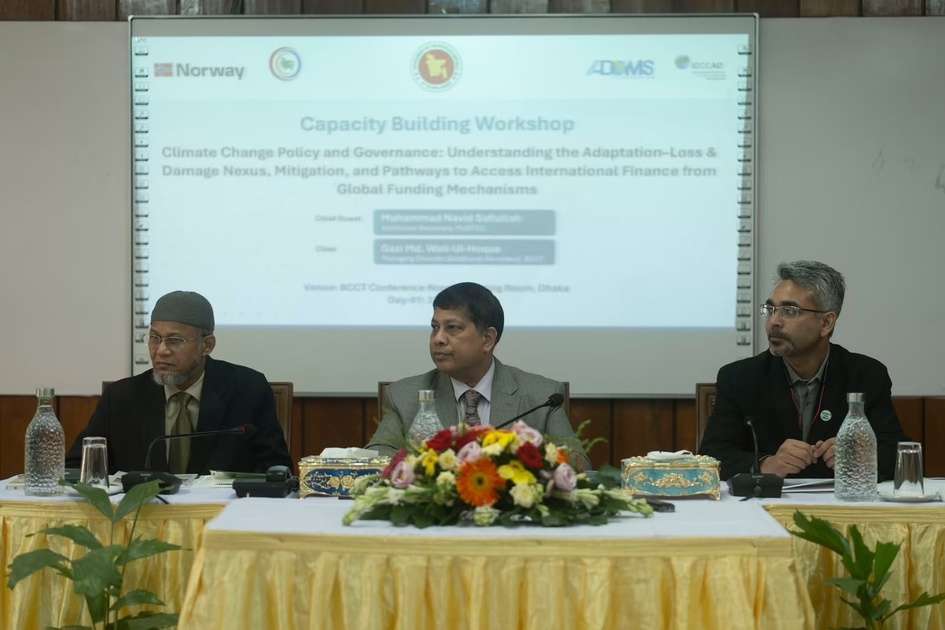



Supported by Norway, the initiative will train officials and climate stakeholders on loss and damage finance systems, access requirements and governance pathways to support vulnerable communities.
Facing increasingly severe climate impacts, including floods, cyclones, heatwaves, salinity intrusion, and climate-induced displacement, Bangladesh is strengthening its systems to access and manage climate finance for addressing loss and damage.
A high-level two-day capacity-building workshop on Climate Change Policy, Governance, and Finance began in Dhaka on Tuesday, with support from The Royal Norwegian Embassy to enhance Bangladesh’s readiness to navigate the growing challenges of climate finance and loss and damage.
The two-day workshop brings together government officials, climate experts, policymakers, and stakeholders involved in climate policy, governance, and finance to discuss global climate finance mechanisms, institutional preparedness, and pathways for accessing support for vulnerable communities.
Co-hosted by the Bangladesh Climate Change Trust (BCCT) and the ADAMS Foundation with support from Norway, the initiative focuses on one of the most critical challenges for climate-vulnerable countries: building technical and institutional readiness to access, manage, and effectively utilize finance for loss and damage.
The ADAMS Foundation is leading the implementation of the capacity-building initiative, working with national and technical partners to enhance climate governance, knowledge sharing, and finance readiness.
The partnership aims to improve understanding among government officials and climate stakeholders about the evolving global loss and damage finance architecture, including funding mechanisms, access requirements, governance systems, and implementation pathways.
Turning Climate Policies into Effective Action
Opening the workshop, Mohammad Navid Safiullah, Additional Secretary at the Ministry of Environment, Forest and Climate Change (MoEFCC), emphasized that strengthening institutional and human capacity is essential for translating Bangladesh’s climate policies into effective action.
He said climate change is no longer a distant future threat for Bangladesh but a present-day reality affecting millions of people. While Bangladesh has developed key national frameworks, including the National Adaptation Plan (NAP), Nationally Determined Contributions (NDCs), the evolving NDC 3.0 process, the Bangladesh Climate Development Partnership (BCDP), and the Locally Led Adaptation Framework (LLAF), the priority now is ensuring effective implementation.
“Climate ambition can only be realized through strong institutions, skilled professionals, and effective implementation. Investing in capacity today is an investment in Bangladesh’s climate-resilient future,” Safiullah said.
He highlighted the importance of strengthening knowledge, skills, coordination, and innovation among institutions responsible for climate governance. He also thanked the Bangladesh Climate Change Trust, ICCCAD, ADAMS Foundation, and The Royal Norwegian Embassy for organizing the workshop and encouraged participants to apply the knowledge gained to strengthen climate governance and accelerate climate action in Bangladesh.
Bangladesh’s updated climate commitments under the NDC process outline its mitigation and adaptation priorities under the Paris Agreement, while frameworks such as the National Adaptation Plan and Locally Led Adaptation Framework aim to strengthen resilience among communities most vulnerable to climate impacts.
Gazi Md. Wali-Ul-Hoque, Managing Director (Additional Secretary) of the Bangladesh Climate Change Trust (BCCT), welcomed the initiative and highlighted the need for stronger institutional coordination, improved technical knowledge, and strategic partnerships to help Bangladesh secure adequate resources for addressing climate-induced losses and damages.
He emphasized that accessing international climate finance requires not only global commitments but also strong national systems, skilled institutions, effective coordination, and the ability to develop and implement climate programs that respond to community needs.
Norway Bangladesh Partnership to Strengthen Climate Finance Readiness
The workshop follows a grant agreement signed on July 7, 2026, between the Royal Norwegian Embassy in Dhaka and the ADAMS Foundation to support capacity-building efforts on climate policy, governance, and finance.
The initiative builds on Norway’s broader commitment to global climate action. At COP28 in Dubai in 2023, Norway pledged NOK 270 million to the newly established Loss and Damage Fund, supporting efforts to assist developing countries facing severe climate impacts.
Established under the UN climate process, the Loss and Damage Fund aims to provide financial support to developing countries facing climate impacts that cannot be avoided through adaptation alone.
For countries like Bangladesh, the challenge is not only the availability of climate finance but also building the institutional systems required to access, manage, and deliver resources effectively to communities experiencing climate impacts.
The new partnership brings together technical expertise from the International Centre for Climate Change and Development (ICCCAD), a globally recognized institution working on climate adaptation and loss and damage. The program is designed to be locally led, gender-responsive, and youth-inclusive, supporting Bangladesh’s long-term climate governance and finance readiness.
As climate impacts continue to reshape the lives and livelihoods of coastal communities, riverine populations, farmers, women, and young people across Bangladesh, organizers said the initiative will help establish a stronger national platform for climate governance.
The partnership aims to enable Bangladesh to better access international climate finance and ensure that resources reach communities most affected by the climate crisis while strengthening the country’s pathway toward climate justice and resilience.




