

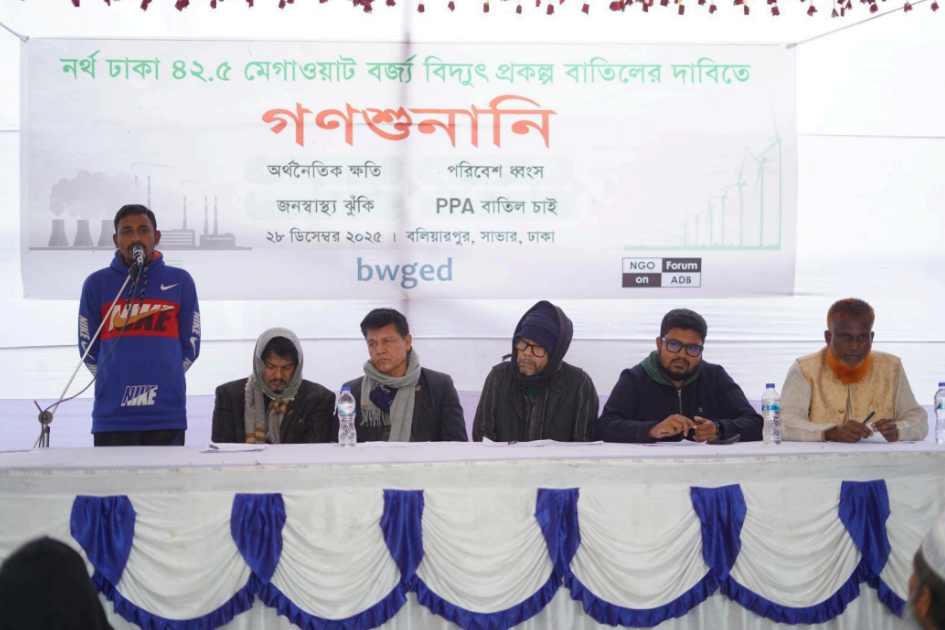



A Dhaka public hearing unanimously urged cancelling the Aminbazar waste-to-energy project, warning of health risks, high power costs, economic strain and lack of transparency for local residents and future generations.
A public hearing in Dhaka on Sunday unanimously called for the immediate cancellation of a 42.5 megawatt waste-to-energy power plant being built in Aminbazar, declaring the project dangerous, costly and against public interest.
The decision was announced after a day-long public hearing held at the Konda School field in Aminbazar on December 28, where local residents, environmental activists, health experts and economists reviewed the North Dhaka 42.5 MW waste-based power project from environmental, public health, economic and legal perspectives.
Participants concluded that the plant would impose serious health risks on Dhaka’s population and undermine the rights of future generations. Speakers said the project, located in a densely populated area, would worsen air pollution in a city already ranked among the most polluted in the world.
The hearing was told that electricity generated from the plant would cost about Tk 25.56 per unit, more than double Bangladesh’s current average generation cost of around Tk 12 per unit. The higher cost would ultimately be passed on to consumers through taxes and electricity bills.
“This is the most expensive and dirtiest power produced in the name of clean energy,” said Mohammad Noman, campaign officer of the Coastal Livelihood and Environmental Action Network, known as CLEAN, who presented the project brief at the hearing.
According to the presentation, the 25-year project would cost the government more than 2 billion US dollars, all payable in foreign currency. Speakers warned that such a commitment would further strain Bangladesh’s economy at a time of acute dollar shortages.
A comparative analysis presented at the hearing showed that the Aminbazar plant would cost about 11 million dollars per megawatt, while the same capacity could be developed through solar power at only 0.7 to 1 million dollars per megawatt. With the same investment, more than 22 times the electricity could have been generated using renewable alternatives.
It was stated that an investment of $ 467 million in rooftop solar could generate approximately 932 megawatts of electricity, while ground-mounted solar could produce 466 megawatts and wind power around 321 megawatts. Speakers said this demonstrated that the waste-to-energy project was economically irrational and loss-making.
Legal and transparency concerns were also raised. Participants said environmental and social impact assessments had not been properly conducted or disclosed, no public health risk assessment had been carried out and the project had been approved without an open tender process.
Concerns were also voiced over a clause requiring Dhaka North City Corporation to pay penalties if waste supply targets were not met, potentially placing long-term financial risks on the city.
Health experts warned that the planned incineration of nearly 3,000 tonnes of waste per day in Aminbazar would release carbon dioxide, dioxins, furans and fine particulate matter, posing severe health risks to children, women, the elderly and pregnant women.
They also pointed out that Dhaka’s waste is collected without source separation, resulting in high moisture content and low calorific value, making efficient power generation technically unrealistic and increasing the risk of project failure from the outset.
At the end of the hearing, participants unanimously adopted a set of binding demands. These included the immediate cancellation of the North Dhaka 42.5 MW waste-to-energy project, suspension and cancellation of all future construction plans due to delays and broken commitments, cancellation of the power purchase agreement, and withdrawal of financing by the Asian Infrastructure Investment Bank and the New Development Bank.
They also demanded the formulation of a science-based and sustainable waste management plan and renewable energy master plan for Dhaka, mandatory public consultation and consent on environmental and public health impacts, and strict adherence to tender and transparency rules for all future power and infrastructure projects.
The hearing was moderated by Alamin Pranto, founder of Start to Scale Up and For the Light. The keynote address was delivered by CLEAN campaign officer Mohammad Noman.
Local residents, including Dr Shahin, Imran Molla, Al Amin, Enamul and Robin, gave testimonies as affected community members.
The hearing panel included Mihir Bishwas, joint secretary of Bangladesh Poribesh Andolon; K M Asif Iqbal Akash, lecturer at State University of Bangladesh and research fellow at IPD; Mohammad Shahdat Hossain, principal of Kunda Ideal School, Al Mayami; staff reporter of Daily Mukto Khobor, and Mahbub Alam, executive director of SHIELD.
They shared their views and experiences on the environmental, health and economic impacts of the project.
Based on the unanimous opinion of local residents, the chief adjudicator declared that people did not want a waste-based power plant in the name of development. They wanted affordable electricity, clean air and a fair and safe future.
The closing remarks were delivered by Mostafizur Rahman Russell, finance and administration coordinator of CLEAN, reiterating the demand for the immediate cancellation of the Aminbazar waste-to-energy power plant.




