




Bangladesh is preparing its first standardised framework to measure economic and non-economic climate losses, strengthening national planning and access to international finance.
Bangladesh is developing a standardised national framework to assess climate-induced loss and damage, with officials stressing the need for reliable data and stronger institutional coordination to help the country access international climate finance.
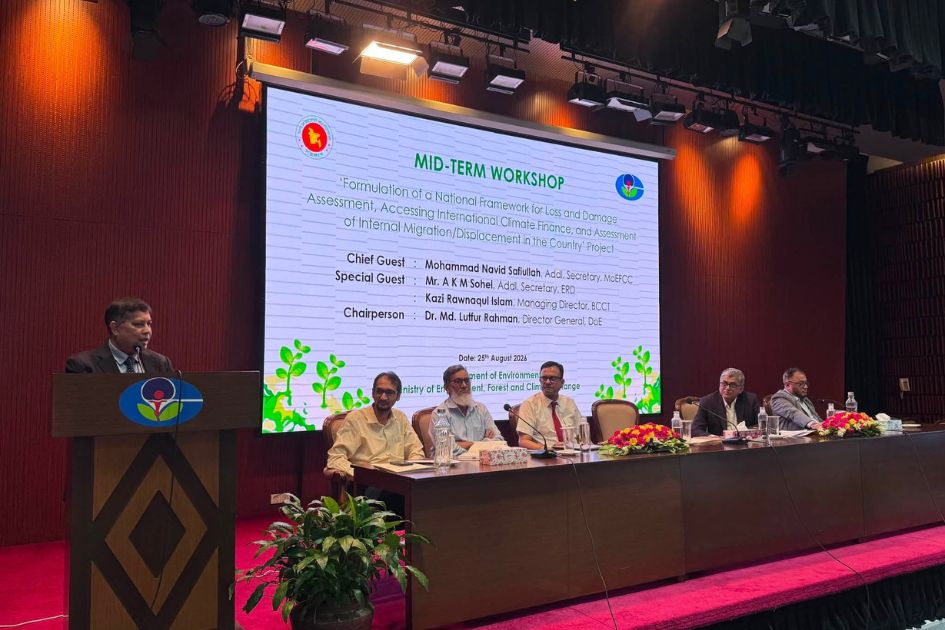
The mid-term workshop of the project, titled “Formulation of a National Framework for Loss and Damage of Bangladesh”, was held on Tuesday, 25 August 2026, at the auditorium of the Department of Environment in Agargaon, Dhaka.
The project is being implemented by the Department of Environment with technical support from the Centre for Environmental and Geographic Information Services (CEGIS) and financed by the Bangladesh Climate Change Trust Fund. It aims to prepare Bangladesh’s first standardised and evidence-based national framework for assessing loss and damage.
Mohammad Navid Safiullah, Additional Secretary for Climate Change at the Ministry of Environment, Forest and Climate Change, attended the workshop as chief guest. A K M Sohel, Additional Secretary and Wing Chief for the United Nations at the Economic Relations Division (ERD), and Kazi Rawnaqul Islam, Managing Director of the Bangladesh Climate Change Trust, attended as special guests. Dr Mohammad Lutfur Rahman, Director General of the Department of Environment, chaired the workshop.
The workshop opened with remarks by Mirza Shawkat Ali, Director for Climate Change and International Convention at the Department of Environment. He outlined the background, importance and objectives of the project and called on stakeholders to participate actively in the discussions.
Motaleb Hossain Sarker, Executive Director (Acting) of CEGIS, said the framework belonged to the Government of Bangladesh and that CEGIS was serving only as a technical consultant.
He said the framework was not being developed from scratch but would draw on existing knowledge, data and institutional capacity in Bangladesh. Stakeholder views, he added, would carry considerable weight in shaping it.
Md Mahmud Hossain, Project Director and Deputy Director of the Department of Environment, gave a presentation titled “An Overview of Loss and Damage in Bangladesh”, covering the project’s objectives, progress to date and national relevance.
Kazi Rawnaqul Islam stressed the need for institutional action at the national level to address climate-induced loss and damage. He also highlighted the importance of using the country’s own resources to finance research of this kind.
A K M Sohel discussed recent developments in the international architecture for loss and damage financing. He said the Economic Relations Division serves as Bangladesh’s national focal point for the Fund for Responding to Loss and Damage (FRLD), and that proper institutional procedures must be followed to access international funds.
He said national preparations should take into account Article 8 of the Paris Agreement and the areas of cooperation under the Warsaw International Mechanism. He also emphasised the need for a national asset inventory, clear sectoral ownership and coordination among relevant divisions when developing a financing strategy.
In his address, Mohammad Navid Safiullah said securing international finance was of great importance to Bangladesh in addressing climate-induced loss and damage, but that access required reliable data and strong institutional coordination.
He stressed the need to address data gaps at the grassroots level, strengthen local engagement and establish a closer link between loss and damage work and the carbon market. He also called for a coherent national framework to advance climate justice.
Dr Mohammad Lutfur Rahman, chairing the workshop, outlined the operational pillars of the FRLD and the key considerations involved in accessing the fund. He emphasised government ownership and inter-agency coordination in implementing the project and directed that views raised during the workshop be properly reflected in the framework.
During the technical session, Riasat Amin, a hydrologist and climate change expert at CEGIS, delivered an analytical presentation on Bangladesh’s proposed National Framework for Loss and Damage.
Mirza Shawkat Ali moderated a panel discussion involving representatives from the Ministry of Environment, Forest and Climate Change, the Ministry of Disaster Management and Relief, the Department of Disaster Management, the Centre for Participatory Research and Development and the International Organization for Migration. An open discussion with participating stakeholders followed.
Senior officials from ministries, divisions, departments and agencies attended the workshop alongside representatives of academia and research institutions, development partners, civil society and private organisations and members of the media.
Bangladesh has so far had no standardised national method for assessing climate-induced loss and damage. As a result, economic losses as well as non-economic losses affecting livelihoods, health, education, culture and displacement have largely gone uncounted.
The proposed framework is intended to address that gap by producing a complete, science-based and comparable national picture of loss and damage. It is also expected to support more evidence-based national planning, budget allocation and post-disaster recovery while providing a credible and acceptable basis for Bangladesh to seek its fair share of international climate funds, including the FRLD.




