

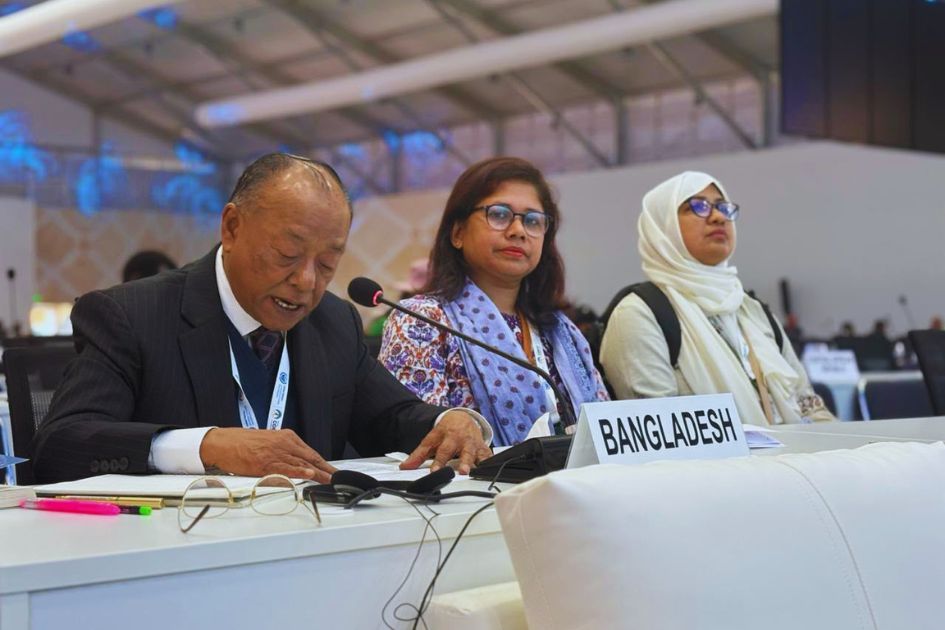



Minister Abdul Awal Mintoo said drought-prone northwest Bangladesh and salinity-hit coastal areas need stronger finance, technology and basin-based cooperation to protect water, farming and livelihoods.
Bangladesh has urged the international community to establish stronger regional cooperation, ensure fair sharing of water resources and accelerate technology transfer as drought, water scarcity and land degradation intensify worldwide.
Environment, Forest and Climate Change Minister Abdul Awal Mintoo made the call while addressing the ministerial dialogue titled “Accelerating Drought Resilience” during the 17th Conference of the Parties (COP17) of the United Nations Convention to Combat Desertification (UNCCD) in Ulaanbaatar, Mongolia on Tuesday.
The UNCCD COP17 is a major global platform addressing desertification, land degradation and drought, bringing together governments to discuss ecosystem restoration, climate adaptation and measures to protect communities facing growing environmental risks.
The United Nations has warned that increasing drought frequency and intensity, driven by climate change, are threatening food production, water security, livelihoods and ecosystems across the world.
Addressing the session, Mintoo said drought resilience requires stronger international partnerships, sustainable water management, equitable access to water resources and greater support for technology transfer.
“Drought and land degradation are closely interconnected in Bangladesh,” the minister said, highlighting that the country’s northwestern region is facing recurring droughts and declining groundwater levels, while coastal areas are experiencing rising salinity intrusion affecting agricultural land and freshwater sources.
He said floods and river erosion are further intensifying climate-related challenges for vulnerable communities across Bangladesh.
A Country Facing Climate Pressure From Two Fronts
Mintoo said Bangladesh is experiencing climate pressure from opposite directions. In the northwest, changing rainfall patterns, recurring droughts and falling groundwater levels are reducing water availability and threatening agricultural production. Along the coast, rising sea levels and reduced river flows during dry seasons are allowing saline water to enter farmland and drinking water sources.
For millions of farmers and rural communities, groundwater depletion, unpredictable rainfall and salinity intrusion are directly affecting food production, livelihoods and access to safe water.
According to the minister, around 5.46 million hectares of land in northwestern Bangladesh are drought-prone. He said excessive groundwater extraction through nearly 16,000 deep tube wells has contributed to declining water tables in several areas.
To address these challenges, Bangladesh has restricted new irrigation activities in stressed regions and introduced climate-informed agricultural advisory services through the Bangladesh Agro-Meteorological Information Service (BAMIS).
The system monitors drought indicators and provides farmers with crop-specific recommendations through SMS, voice calls and mobile applications, helping communities make timely decisions during climate stress.
Bangladesh’s Adaptation and Nature-Based Solutions
The minister highlighted Bangladesh’s nature-based solutions under the National Green Mission, including a target to plant 250 million trees across the country.
He said the government has also launched initiatives to excavate and re-excavate around 20,000 kilometres of canals, rivers and water bodies over the next five years to increase surface water availability, restore ecosystems and reduce pressure on groundwater resources.
“Bangladesh’s experience in restoring water systems and strengthening ecosystem-based resilience can provide valuable lessons for other countries facing water stress,” Mintoo said.
Addressing the coastal crisis, he said mangrove expansion under the National Green Mission is being advanced as a natural defence against climate impacts, particularly rising salinity and extreme weather events.
Call for Fair Water Sharing Across Borders
Emphasising the importance of transboundary water cooperation, Mintoo called for effective basin-based water management in the Ganges-Brahmaputra-Meghna basin, which supports hundreds of millions of people across South Asia.
“Ensuring adequate water flow during dry seasons is essential not only for water security but also for combating land degradation,” he said, urging countries sharing river basins to consider fair water distribution as a central pillar of drought preparedness.
Bangladesh’s appeal comes amid growing global concerns over competition for freshwater resources as climate change alters river flows and increases pressure on transboundary water systems.
Mintoo stressed that cooperative management of shared rivers is essential for regional stability, sustainable agriculture and long-term climate adaptation.
Climate Finance and Global Solidarity
Mintoo said countries facing the most severe climate impacts are often those that have contributed the least to global greenhouse gas emissions and require greater access to climate finance, technology and international support.
He called for a fairer global response where vulnerable countries receive predictable finance, technology transfer and capacity-building support to address climate-induced risks.
The minister said Bangladesh’s National Adaptation Plan has identified drought management as a priority area up to 2050.
Welcoming the initiative to establish the International Drought Resilience Observatory, he proposed linking Bangladesh’s BAMIS data with the global platform to strengthen early warning systems and climate-informed decision-making worldwide.
The proposed observatory aims to improve global drought monitoring, data sharing and early warning systems to help countries prepare for climate-related water stress.
Mintoo also called for stronger international technology transfer to develop and expand drought- and salinity-tolerant crop varieties to support climate-resilient agriculture.
“Bangladesh is facing serious risks from drought and land degradation. We need a preparedness-driven, adequately financed and regionally coordinated international framework for drought resilience,” Mintoo said.
Bangladesh urged UNCCD member states to move beyond commitments and establish a fully resourced drought resilience framework backed by finance, science, technology and stronger regional partnerships.
The dialogue was attended by ministers, deputy ministers and heads of delegations from various countries. Representatives from international and regional organisations, including the Food and Agriculture Organization (FAO), UN Economic and Social Commission for Asia and the Pacific (ESCAP), International Organization for Migration (IOM), UNICEF, UN Office for Disaster Risk Reduction (UNDRR), UN Development Programme (UNDP), International Fund for Agricultural Development (IFAD), Asian Infrastructure Investment Bank (AIIB) and African Union also participated as observers.
Bangladesh called on the global community to turn commitments into action by ensuring that drought resilience becomes a shared responsibility supported by finance, science, technology and international cooperation.




