

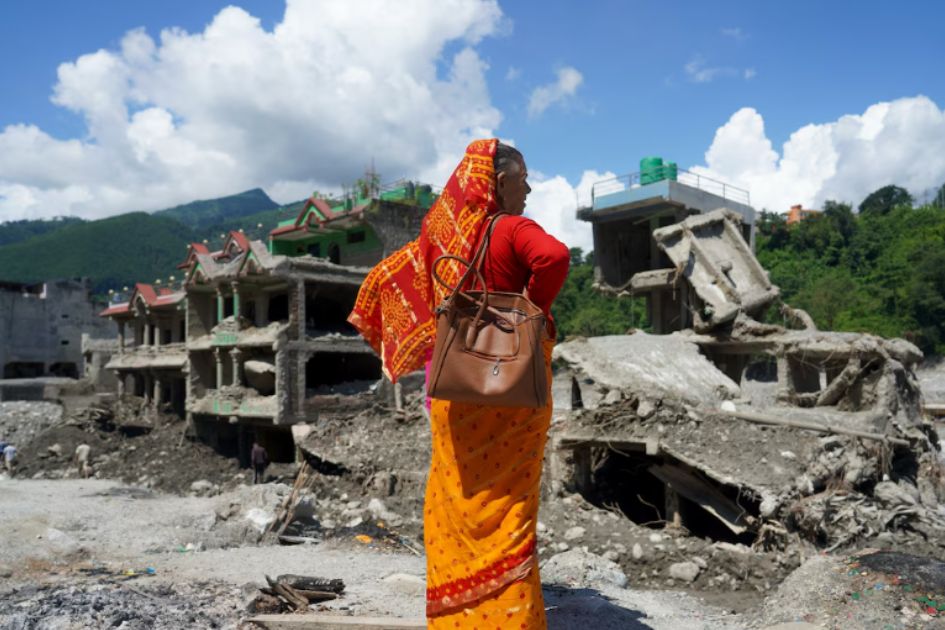



Nepal is seeking loss-and-damage funding after a climate-linked Himalayan disaster, highlighting the widening gap between vulnerable countries’ needs and available international finance.
Nepal is seeking international funding to help recover from a devastating disaster in the Himalayan Rasuwa district, arguing that climate change helped create the conditions for the collapse and that the country should not bear the cost alone.
A two-square-kilometre mass of glacier ice and rock collapsed from Langtang Lirung mountain in the days, weeks, months and years before a debris flow swept into the valley, killing more than 1,300 people and leaving another 5,000 missing.
An international team of researchers that rapidly assessed the disaster for World Weather Attribution, an initiative examining the role of climate change in specific extreme weather events, concluded that global warming had helped condition the slope for failure.
For Nepal and other small nations, such attribution studies provide important evidence in efforts to secure funding to cope with the effects of a warming planet.
Nepal’s ministries of finance and environment sent a joint letter on August 31 to the United Nations’ Fund for Responding to Loss and Damage, established in 2022 to support victims of the climate crisis.
The government estimates that recovery from the Rasuwa disaster will cost $4.8 billion, equivalent to more than 11 percent of Nepal’s gross domestic product. It is seeking $20 million, the maximum amount countries can request from the fund, for immediate recovery and preparations for future disasters.
Nepal presented the request as an issue of climate justice rather than aid. Its foreign minister said the country had paid “the ultimate price for a global crisis [it] did not create.”
The attribution study found that atmospheric warming of 2 degrees Celsius, well above the global average, had thawed permafrost holding cracked rock walls together, while glacier ice had thinned and retreated. Rain was also falling at elevations where it had previously fallen only as snow.
Rainwater and meltwater then lubricated fractures deep within the rock, further destabilising the slope.
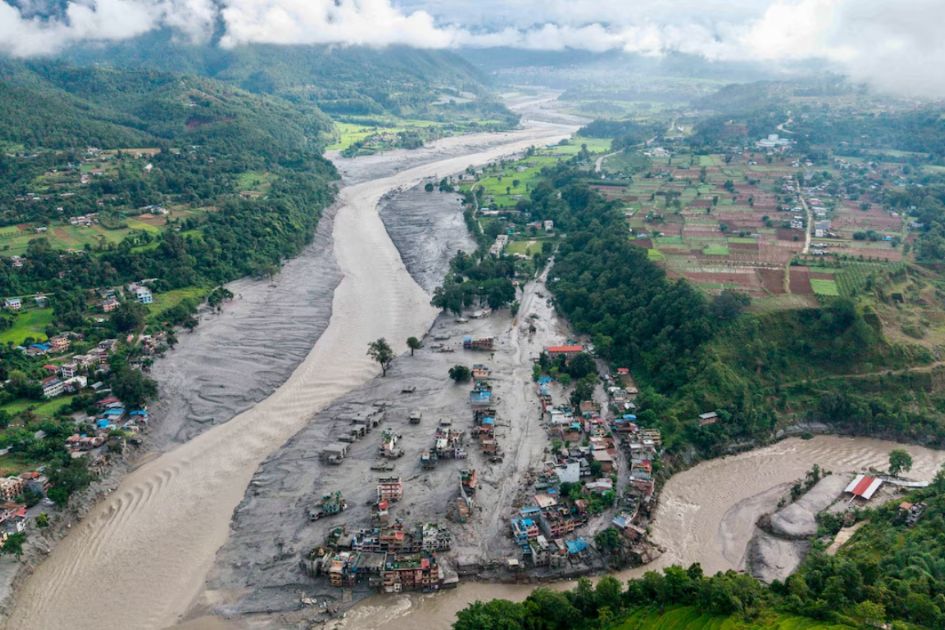
“We conclude this was a geologically vulnerable slope,” said Walter Immerzeel, a mountain hydrologist at Utrecht University in the Netherlands and a coauthor of the study, during a press conference. “But it was destabilized further by glacier retreat and permafrost thaw, and with excessive meltwater and exceptional warmth in the final period before the failure.”
The warming was driven by human-generated greenhouse gas emissions. The Rasuwa disaster is “yet another warning sign,” the report said, that climate change is transforming high mountain environments and creating conditions for cascading hazards.
Andrew Pershing, a climate scientist not involved in the study and chief program officer at Climate Central, which also conducts attribution research, compared climate change’s influence on the Rasuwa disaster with increasingly frequent and severe wildfires in the American West.
In both cases, “climate is this preconditioner that’s putting weight on the scale towards the event,” he said. “It’s making these places much more unstable and risky to be around.”
The researchers said Nepal’s flood warning system was unable to match the speed and volume of the debris flow that surged down the valley.
“Events of this magnitude ultimately exceed the limits of adaptation,” they wrote, arguing that international “recovery and reconstruction support in impacted communities has now become an unavoidable part of climate response.”
Nepal produces less than 0.1 percent of annual global greenhouse gas emissions but is experiencing the effects of climate-warming gases firsthand, said Basanta Raj Adhikari, director of the Center for Disaster Studies at Tribhuvan University’s Institute of Engineering in Nepal.
Because Nepal has contributed so little to the emissions that helped create the conditions for the disaster, its leaders do not believe the country should be solely responsible for paying for the recovery.
Scientists in Nepal have long known that the country is vulnerable to rising temperatures. Nepal regularly experiences glacial-lake outburst floods, which have also been scientifically attributed to climate change.
“We have all the evidence,” Adhikari said. “So, of course we need compensation, we need funds to combat climate change in the name of mitigation or adaptation,” he said.
Recovery efforts will include rebuilding infrastructure such as roads and hydropower plants, as well as relocating and rebuilding communities.
Nepal also wants to establish new monitoring systems capable of identifying and tracking unstable rock slopes and glaciers and providing timely warnings to downstream communities, in an effort to prevent a disaster of the same scale from happening again.
Since 2022, wealthy nations have pledged $822 million to the UN’s loss and damage fund. But 119 countries have since requested assistance totalling $2.8 billion.
Early proposals for what eventually became the fund were framed as a form of global insurance, under which countries would contribute according to their emissions. Fierce debate followed, however, and major high-emitting countries in the European Union and the United States rejected liability for damage caused by their greenhouse gas emissions in other countries.
The current voluntary fund, explicitly based on international cooperation, emerged from that compromise.
But the arrangement has left governments and communities that contributed little to climate change struggling to meet the costs of its impacts. The UN fund remains far short of what Nepal needs.
As communities affected by climate change seek compensation, courts in the United States and Europe have seen a rise in climate litigation in recent years.
Attribution science, including the recently published World Weather Attribution report, is increasingly being used to connect emissions from specific polluters with particular harms.
In 2023, Multnomah County in Oregon sued more than a dozen oil companies over their role in the deadly 2021 Pacific Northwest heat dome, which climate attribution research had found was “virtually impossible” without climate change.
Worldwide, 3,600 such cases have been filed in 62 jurisdictions and 28 international courts. No plaintiff has yet won a liability case.
Scientists have nevertheless become better and faster at determining whether and how climate change contributed to individual disasters. Climate models can now establish definitively that a particular heatwave would not have occurred without human-caused warming and can then trace contributions to that warming to specific polluters.
But attribution science is more difficult outside Europe and North America, where long-term datasets are generally more robust. The challenge is particularly acute for complex events involving cascading hazards, such as the Rasuwa disaster.
“Cause and effect can get very murky in these events,” Pershing said.
Pre-existing weaknesses in the bedrock, climate-related factors and potentially the lingering effects of the nearby 2015 Gorkha earthquake all contributed to the collapse.
Scientists lack subsurface temperature measurements, data on water pressure within fractures and other key information needed to quantify precisely how much climate change contributed. Doing so would be “almost impossible,” Immerzeel said.
Scientists nevertheless say the disaster in Nepal shows strong signs of a rapidly warming planet and points to a growing risk of more sudden and devastating events in mountainous regions.
“The climate is changing in the Himalayas, and it’s not only the fate of the Nepali Himalayan people. There are more than two billion people living downstream, all these places are in increasing vulnerability as these events are increasing,” Adhikari said.
“We are in existential threat due to climate change. We need to save our civilization in high-mountain Asia.”
This post is republished from NATIONAL GEOGRAPHIC.
.




