

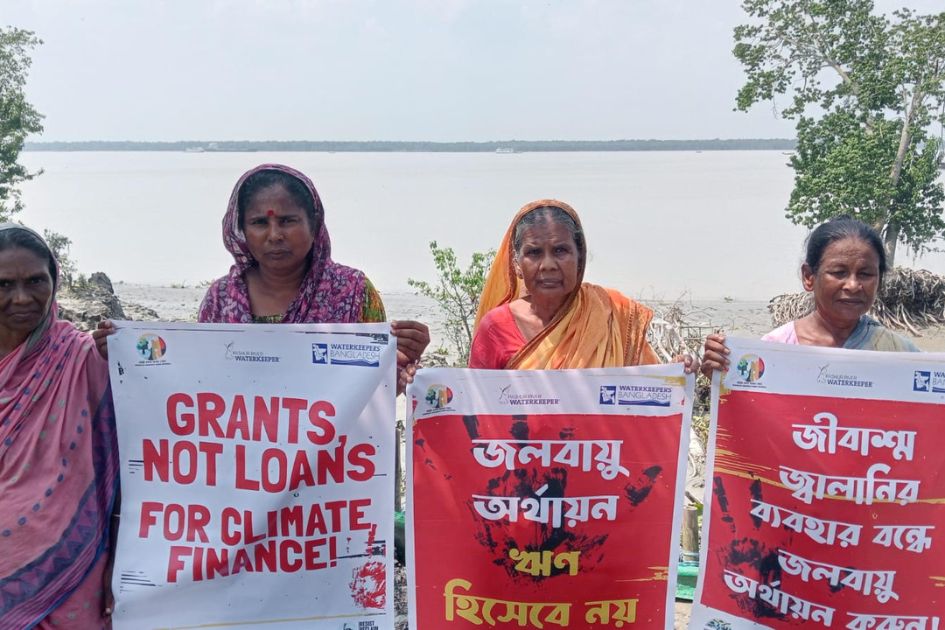



Environmental groups in Mongla urged a shift from fossil fuels to renewable energy, while calling for the closure of the Rampal coal-fired power plant over environmental and public health concerns.
A human chain was held in Mongla on Friday calling for an end to new fossil fuel projects and financing, climate justice, greater investment in renewable energy and a rapid, just energy transition.
The event was organised at Kanainagar on the bank of the Pashur River by Dharitri Rakshaya Amra (Dhara), Pashur River Waterkeeper and Waterkeepers Bangladesh as part of the Global Week of Action.
The protest was held as part of a global movement ahead of the 81st session of the United Nations General Assembly (UNGA 81) and COP31.
The human chain began at 11 am, with environmental campaigner Md Nur Alam Sheikh, a central leader of Dhara and Pashur River Waterkeeper, chairing the gathering.
Among those who addressed the event were Dhara leaders Asima Mondal and Brishti Sarker, Pashur River Waterkeeper organiser Reshma Khatun, Abdul Rashid Howlader, general secretary of the Fishermen’s Association, and Mehedi Hasan of Waterkeepers Bangladesh.
Speakers called for Bangladesh to move away from fossil fuel dependence and build a green future based on clean, just and renewable energy.
They also called for the closure of the Rampal coal-fired power plant, saying it is harmful to the environment and public health and threatens the Sundarbans.
In his address, Nur Alam Sheikh called for an end to financing for fossil fuel projects and urged investment in renewable energy to address the climate crisis and ensure a rapid and just energy transition.
He further said that reliance on imported fossil fuels had, in the past, enabled some businessmen, bureaucrats and politicians to create oligarchs, leading to looting in Bangladesh’s financial sector and the establishment of what he described as a system of corruption and theft.
“There is no alternative to renewable energy to ensure energy security and sovereignty,” he said.
He expressed hope that the government would quickly curb what he described as systems of looting and corruption and make Bangladesh self-sufficient in energy by harnessing solar power.




