

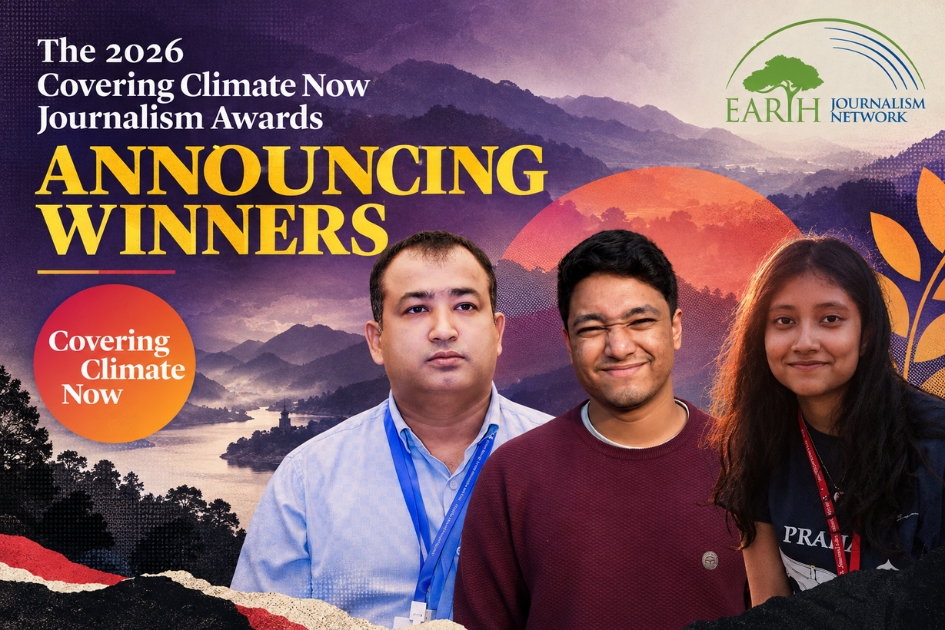



Bangladeshi journalists Usraat Fahmidah and Rifat Anik also recognised for reporting on the struggles of Banishanta’s women
The Earth Journalism Network’s cross-border investigation “Dark Side of the Boom”, whose Bangladesh reporting was carried out by Shamsuddin Illius for The Climate Watch, has won a 2026 Covering Climate Now Journalism Award.
The project was recognised in the Large Projects & Collaborations category. Two other Bangladeshi journalists, Usraat Fahmidah and Rifat Anik, won in the Extreme Weather category for their multimedia work “Where Land Disappears”, published by Asian Dispatch. The official winners’ list credits all three journalists.
The awards, announced on September 17, recognise reporting that connects climate change with public accountability, economic decisions and people’s daily lives. This year’s programme named 49 winners, selected from more than 1,200 entries submitted by journalists across dozens of countries.
A panel of 120 journalists from more than 30 countries judged the entries, according to Covering Climate Now’s announcement.
Led by Internews’ Earth Journalism Network, “Dark Side of the Boom” brought together 14 newsrooms across 11 countries to investigate the environmental consequences of Asia’s expanding digital economy.
The collaboration examined the infrastructure behind artificial intelligence, cloud computing and other digital industries, focusing on electricity demand, water consumption and pressures on communities. The Climate Watch contributed the Bangladesh investigation, connecting the country’s technology ambitions with questions about resource security and environmental oversight. The Climate Watch’s account of the collaboration documents its participation.
The winning project comprises 18 stories. Judges described it as “brilliant” and “highly original”, praising its field reporting, expert insights and accessible presentation. The award citation names Sam Schramski alongside Illius and the other contributors.
Illius’s report, “Digital Dreams, Parched Reality: The Hidden Cost of Bangladesh’s Data Industry Gold Rush”, was published on November 5, 2025.
Reporting from Kaliakoir Hi-Tech Park in Gazipur, the investigation examined how investment in data centres was increasing demand for electricity and groundwater. It questioned whether Bangladesh’s ambition to become a digital hub was being matched by adequate environmental safeguards.
The report cited ministry figures showing 48 data centres, comprising 22 public and 26 private facilities. Despite repeated requests, officials could not provide their combined electricity and water consumption.
It also documented concerns from surrounding communities about declining groundwater levels and interviewed specialists who urged stronger oversight, renewable power and water recycling.
The investigation included the government’s position. Faiz Ahmad Taiyeb, then special assistant to the chief adviser overseeing the telecommunications and ICT ministry, acknowledged concerns about the sector’s business and environmental sustainability. He said making all data storage domestic would increase pressure on national resources.
By examining both investment promises and resource constraints, the Bangladesh report placed environmental accountability at the centre of a debate often dominated by technological progress and commercial opportunity.
The latest award follows earlier recognition for the collaboration. In June, “Dark Side of the Boom” won the SOPA 2026 Award for Excellence in Reporting on the Environment in the Regional/Local category, as The Climate Watch reported.
The project also received recognition through a special citation for journalistic innovation from the 2026 Osborn Elliott Prize jury. That citation acknowledged collaborative reporting involving the Earth Journalism Network and participating newsrooms, including The Climate Watch. It was separate from the main Osborn Elliott Prize, which went to The New York Times journalist Vivian Wang. The Climate Watch’s June report detailed the distinction.
Shamsuddin Illius said, “This recognition reinforces why we must examine the environmental costs behind promises of digital progress. Bangladesh needs technological advancement, but that progress must protect people’s access to water and energy.”
He also mentioned “Working with The Climate Watch and the Earth Journalism Network allowed us to connect local realities with a regional investigation. This honour belongs to the entire reporting team and the communities who trusted us with their stories.”
In 2022, one of Illius’s story got honorable mention at the Covering Climate Now Award.
Fahmidah and Anik’s winning work turns to a different form of environmental insecurity: the erosion of homes and livelihoods in Banishanta, southern Bangladesh.
The CCNow citation describes women facing repeated displacement, mounting debt, declining incomes and deteriorating mental health as rising waters threaten their community. Judges praised the reporting for showing how climate damage reaches beyond physical destruction to affect families and future generations.
Asian Dispatch’s publication credits identify Fahmidah as reporter and Anik as video producer. The story was produced with support from Internews’ Earth Journalism Network, linking both winning projects to its support for environmental reporting.
The publication also credits Kritika Goel as editor and Anoushka Dalmia as story producer. Its combination of written reporting and documentary work brings the community’s experiences to audiences through multiple formats.
Now in its sixth year, the Covering Climate Now awards recognise work across 14 subject categories, alongside collaborations and individual honours.
This year’s Journalists of the Year are Kim Min-wook, Roli Srivastava and Sammy Roth. The Guardian’s Fiona Harvey received the programme’s second Lifetime Achievement award.
Announcing the results, CCNow co-founder Kyle Pope said celebrating strong climate journalism was especially necessary as some newsrooms reduced coverage despite increasingly urgent impacts. He said the winning work offered a model for renewed engagement with the climate story. CCNow’s announcement emphasised that public-service role.




