

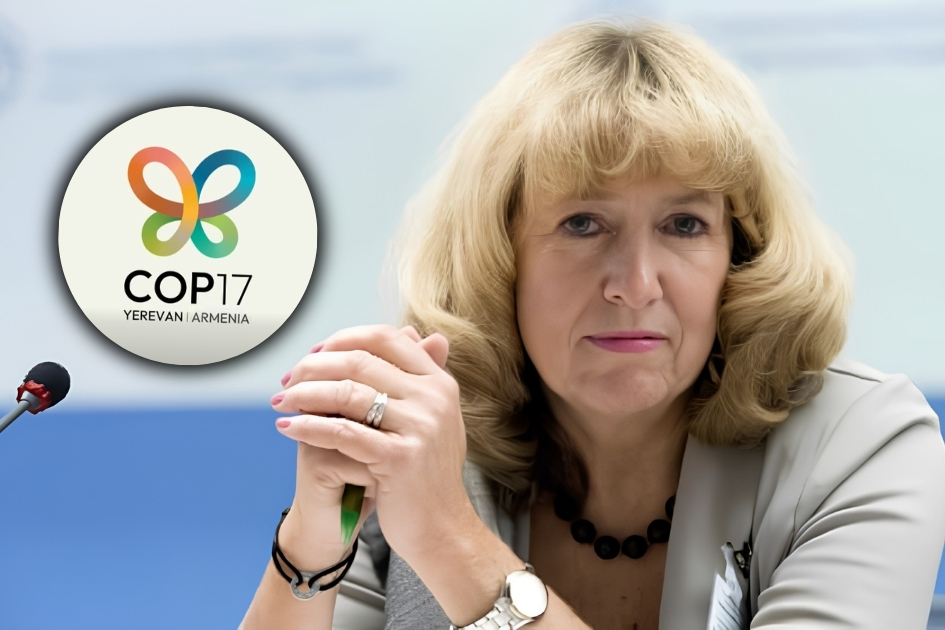



Ahead of COP17, the CBD is highlighting gaps between biodiversity commitments and implementation, with financial alignment and harmful subsidies emerging as key challenges.
The world must urgently redirect financial flows away from activities that damage nature and align them with global biodiversity goals, the UN’s biodiversity chief has said.
Astrid Schomaker, Executive Secretary of the UN Convention on Biological Diversity (CBD), said the challenge was not simply a shortage of finance, but the way existing public and private resources are being allocated.
Speaking at a press conference organised by the CBD Secretariat on September 11, following the Kunming Dialogue held from September 7 to 9, Schomaker said governments must examine whether investments, subsidies and public spending are supporting or undermining efforts to halt biodiversity loss.
Her remarks come ahead of the 17th Conference of the Parties to the Convention on Biological Diversity, or COP17, scheduled to be held in Yerevan, Armenia, from October 19 to 30.
From commitments to implementation
COP17 will provide an important opportunity to review progress in implementing the Kunming-Montreal Global Biodiversity Framework, adopted in 2022 with 23 global targets to be achieved by 2030.
The framework covers areas including ecosystem restoration, conservation, sustainable use of biodiversity, finance, harmful incentives and the integration of biodiversity into broader economic and development planning.
Governments are now undertaking the first global stocktake of implementation of the framework, examining national targets, policies, finance and institutional arrangements.
Emerging findings show that more than 70 percent of countries have submitted national reports, while more than 90 percent have established biodiversity targets aligned with the global framework.
However, the figures also highlight a more difficult question: whether those national commitments are sufficiently ambitious, financed and implemented to deliver the global targets.
Jillian Campbell, Head of Planning, Monitoring and Knowledge at the CBD Secretariat, has noted that national targets do not always reflect the full scope and ambition of those agreed internationally.
The gap between agreed targets and implementation is expected to feature prominently in discussions at COP17.
Finance at the centre of the challenge
Schomaker identified the structure of global financial systems as one of the biggest barriers to faster biodiversity action.
“The biggest elephant in the room of all of that is the misalignment of financial systems,” she said.
Her remarks point to a central contradiction in biodiversity finance. Governments and international institutions are trying to mobilise additional resources for conservation and restoration while substantial financial flows continue to support activities that place pressure on ecosystems.
The challenge, therefore, is not only to raise more money for nature but also to change the direction of existing capital.
Schomaker said sufficient financial resources exist in the global economy, but the key question is where those resources are being directed.
This puts greater attention on whether governments, businesses and financial institutions can align their investment decisions with biodiversity commitments rather than treating biodiversity finance as a separate pool of environmental funding.
Rethinking harmful subsidies
Asad Naqvi, Secretary of the Subsidiary Body on Implementation, has highlighted harmful subsidies as one area where governments could make significant progress without depending solely on new sources of finance.
Some subsidies in sectors such as agriculture and fossil fuels may incentivise practices that increase pressure on ecosystems and natural resources.
Reforming or redirecting such support could therefore reduce drivers of biodiversity loss while also freeing resources for more sustainable activities.
Under the Kunming-Montreal Global Biodiversity Framework, countries have committed to identifying, eliminating, phasing out or reforming incentives harmful to biodiversity and reducing them by at least $500 billion annually by 2030.
The framework also calls for mobilising at least $200 billion annually from domestic, international, public and private sources for biodiversity-related action.
Together, the two targets reinforce a broader shift in the biodiversity debate: mobilising new finance will have limited impact if larger financial flows continue to work against nature-related goals.
The Kunming discussions also underscored that biodiversity cannot remain solely the responsibility of environment ministries.
Decisions taken in finance, agriculture, infrastructure, energy and development can have major consequences for ecosystems, making biodiversity increasingly relevant to national budgets, investment decisions and economic planning.
COP17 to test delivery of 2030 goals
The findings of the first global stocktake are being compiled in the forthcoming State of Biodiversity Action report, which is expected to provide governments with a broader assessment of progress ahead of discussions in Yerevan.
COP17 is expected to examine how far countries have moved from adopting targets to delivering measurable implementation, particularly in areas such as finance, policy alignment and institutional coordination.
With only four years remaining until the 2030 deadline, the central test is increasingly one of delivery.
The international community has already agreed a comprehensive set of biodiversity targets. The more difficult task now is to ensure that national policies, public spending and financial systems move in the same direction.
How far governments can realign those systems with biodiversity objectives will be a critical measure of progress under the Kunming-Montreal Global Biodiversity Framework.




