

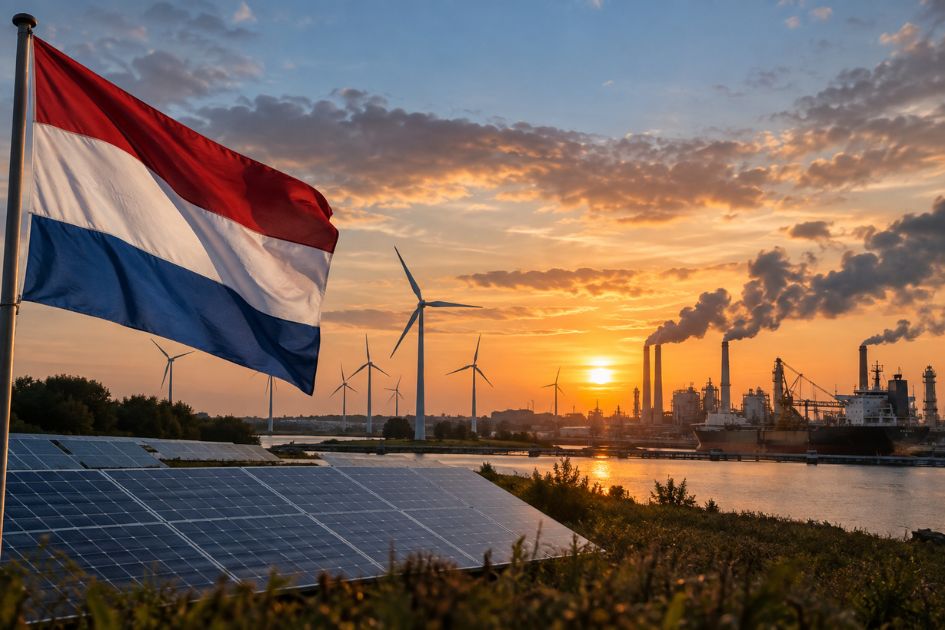



The plan boosts renewables and electrification while retaining gas use and new extraction, drawing criticism over missing deadlines for ending fossil fuels.
The Netherlands has unveiled a national roadmap for moving away from fossil fuels, setting out a rapid expansion of renewable energy and electrification but stopping short of binding deadlines for ending fossil fuel use and production.
The roadmap is part of the country’s new National Energy System Plan, known as the Nationaal Plan Energiesysteem, or NPE. The plan aims to accelerate the transition away from fossil fuels and eventually phase them out, while making energy supplies more resilient by reducing dependence on imports.
According to an analysis by Greenpeace Netherlands, 350.org and Oil Change International, the NPE is the Netherlands’ “national roadmap” for the transition away from fossil fuels, responding to calls made at COP30 and the Santa Marta conference earlier this year.
The Netherlands is the second country after France to publish a fossil fuel transition roadmap. It co-hosted the Santa Marta conference with Colombia earlier this year and has been among the most vocal countries calling for an accelerated phase-out of fossil fuels.
The plan identifies the transition’s benefits for health, climate, the environment and economic resilience, including lower import bills. It also says energy system costs will rise during the transition but would rise in the absence of a transition as well.
Energy resilience is established as a core design principle, with the plan arguing that the country needs to move away from a system heavily dependent on fossil fuel imports. “The fastest and best route to greater resilience is to reduce the need for fossil fuel imports,” it says.
But the plan does not establish a binding end date for fossil fuel use. In its extended version, “phase-out” is defined as the phase-out of oil, natural gas and coal in the Netherlands’ energy and feedstock system “to eventually zero, and to minimise fossil use in 2050.”
The plan also distinguishes climate neutrality from being fossil-free. It refers to carbon capture and storage and carbon removal technologies, as well as fossil fuel use for feedstocks, or non-energy use. It says carbon removal should be minimised and efforts to reduce emissions maximised.
The NPE also fails to set a binding end date for fossil fuel production and allows new gas extraction projects.
The plan says natural gas remains necessary during the transition to a climate-neutral energy system. The Dutch government prefers gas with the smallest climate impact and lowest dependency on other countries and aims to produce as much of the required gas as possible on its own soil.
Current and future gas extraction in the Netherlands is to remain below domestic gas demand. Because domestic gas use exceeds production, the plan says liquefied natural gas imports will remain necessary despite their higher climate footprint.
Gas demand is forecast to remain high in 2040, declining from 935 petajoules in 2025 to 610 petajoules in 2040. The NPE states that “The Netherlands will still use fossil energy, even though in declining amounts, when sustainable chains take over the role of fossil fuels.”
At the same time, the plan sets out a sharp expansion of renewable energy capacity. Total renewable capacity is expected to rise from 38 gigawatts today to 140 gigawatts in 2040.
Solar photovoltaic capacity is projected to triple between now and 2040. Offshore wind capacity is expected to increase from 4.8 gigawatts to 36.5 gigawatts in 2040, while onshore wind capacity is expected to double, partly through upgrading existing turbines.
Unlike the previous NPE, however, the new plan does not outline fully carbon dioxide-free electricity generation by 2040.
Coal use for electricity generation is prohibited by 2030. After 2030, coal will only be used for steel production. Plans for Tata Steel aim to halve coal use by 2037, after which the remaining use will be phased out.
The phase-out of oil is described as relatively “certain” in the mobility sector compared with other sectors, with the plan referring to the European Union’s ban on fossil fuel-based cars from 2035. It also addresses “transport poverty”, mentioning public transport among other solutions.
Stientje van Veldhoven, the Netherlands’ minister of Climate Policy and Green Growth and co-host of the Santa Marta conference, said the government was translating its international commitments into a national plan.
“When we co-hosted the Santa Marta conference earlier this year, we pledged that leadership on transitioning away from fossil fuels must be backed by concrete action, not just ambitious words. With this actualized National Energy System Plan, we are following through on that promise by laying out a responsible roadmap for phasing out fossil reliance while building a resilient, renewable economy,” a spokesperson for Van Veldhoven said.
Laurence Tubiana, chief executive of the European Climate Foundation, said the Dutch roadmap was an important step but required clearer timelines for reducing fossil fuel production and use.
“As our economies are battered by a major fossil fuel energy crisis, and after another record-breaking summer, the case for exiting fossil fuels could not be clearer. The Netherlands’ roadmap is an important step in turning its commitment to move away from fossil fuels into practical national policy, following France’s lead. But it now needs to be matched by clear and credible timelines for reducing fossil fuel production and use, without which the roadmap risks falling short of the certainty needed to guide investment in the transition. The rest of Europe should now follow suit, with an EU-wide roadmap that can provide greater clarity, coordination and stronger investment signals across the continent,” Tubiana said.
Romain Ioualalen, global policy lead at Oil Change International, said the Netherlands had the capacity and responsibility to go further.
“The Netherlands has both the capacity and the responsibility to go further, as their roadmap omits oil and gas phaseout dates, doesn’t commit to ending gas production, and backtracks on electricity-free production by 2040. All European countries need to adopt ambitious, binding end dates for fossil fuel production and use, backed by public funding and strong policies to make the transition fast, fair, and achievable,” Ioualalen said.
Benoît Faraco, France’s special envoy for climate negotiations, said the Dutch plan could help maintain momentum ahead of COP31.
“It is encouraging that the Netherlands has presented its own, continuing to create momentum ahead of COP31. After a devastating summer of fires, floods and extreme heat, we know that solutions are at hand. Electrification of transport, building and the industry helps to reduce emissions and build growth and competitiveness, while reducing dependency and social impact of volatile fossil fuel prices. Diplomacy must be matched by real world planning and action. I hope that other countries will follow,” Faraco said.
Maarten de Zeeuw, a climate expert at Greenpeace Netherlands, said the plan did not yet amount to a complete pathway to a fossil-free economy.
“This plan contains important ingredients, but unfortunately it is not yet a recipe for a fossil-free Netherlands. This policy remains half-baked without a binding phase-out date for coal, oil, and gas. After playing a leading role on the world stage with the first-ever fossil fuel phase-out conference, the Netherlands risks its credibility by delaying a binding roadmap towards a fossil-free Netherlands,” de Zeeuw said.
The plan followed months of pressure from civil society groups for a clear fossil fuel transition roadmap. A coalition of 15 civil society organizations, led by Greenpeace Netherlands alongside Oxfam Novib and Milieudefensie, sent an open letter to the government in June.
Before the plan’s release, Yvo de Boer, former executive secretary of the UN Framework Convention on Climate Change from 2006 to 2010 and a former senior diplomatic and policy expert at the Dutch Ministry of Housing, Spatial Planning and the Environment, said the Netherlands needed to turn its climate commitments into implementation.
“The era of high-level diplomatic pledges has served its purpose; the task now is execution. By publishing a transparent, data-driven transition roadmap ahead of COP31, the Netherlands can protect its low-lying territory, give our industries long-term certainty, and provide the international community with a practical model for managed decarbonization. It is time to bring our climate leadership back home,” de Boer said.
De Zeeuw had also linked the call for a binding roadmap to the Netherlands’ exposure to climate risks.
“This summer was the hottest ever recorded in the Netherlands, bringing loss of life, smaller harvests and other damaging impacts to our doorstep. Yet the most catastrophic warming can still be avoided, when our political leaders decisively end the era of coal, oil and gas. That is why we are calling on the Dutch climate minister Van Veldhoven to show leadership by committing to a binding, time-bound roadmap to phase out fossil fuels. Investing in clean energy today is the only way to avoid unpayable climate costs tomorrow,” he said.
Anouk Strijd, an expert on fossil fuel phase-out and corporate climate accountability at Milieudefensie, said the roadmap should also impose stronger requirements on companies.
“The climate crisis can only be effectively tackled if corporations are no longer allowed to continue business as usual and undermine climate policy. Governments need to stand their ground and regulate these corporations strictly. As a major fossil fuel facilitator and emitter, the Netherlands must present a national fossil fuel phase-out roadmap that makes sure these corporations can no longer contribute to the climate crisis unchecked. It should include binding phase-out timelines for all fossil fuels, end the permitting of new gas projects, and require mandatory development and implementation of 1.5C-aligned climate transition plans, including a fossil fuel phase-out plan, from large corporations,” Strijd said.
Femke Sleegers of Reclame Fossielvrij, or Fossil Free Advertising, called for a ban on fossil fuel advertising.
“The Netherlands has made history by co-organising the first conference aimed at phasing out the supply and demand for fossil fuels. Minister Van Veldhoven must live up to expectations and present a roadmap that does justice to the urgency of the unfolding climate crisis. This must include a ban on advertising for fossil fuel products. After all, phasing out fossil fuels begins with stopping their promotion,” Sleegers said.
Bart-Jaap Verbeek, senior researcher on climate justice at SOMO, said a credible transition should address the social consequences of the fossil fuel phase-out as well as its legal and financial implications.
“As a country that has positioned itself as a leader on the global transition away from fossil fuels, the Dutch government must lead a process of responsible disengagement – not as a technical adjustment, but as a responsible and fair phase-out from a sector whose continued operation is incompatible with a livable future. That means full remediation of the harm already done, a just transition for workers and frontline communities, and ensuring those affected are not left to bear the costs. It also means dismantling legal shields like investor-state dispute settlement (ISDS), which allows fossil fuel companies to sue governments for taking legitimate climate action. A credible Dutch phase-out roadmap must define not just when fossil fuels end, but how the transition is made just, responsible and irreversible,” Verbeek said.
Maikel van Wissen, director of Advocates for the Future, said the country’s existing legal obligations should be reflected in decisions on fossil fuel projects, infrastructure and public investment.
“Last year, here in The Hague, the International Court of Justice made clear in its historic Advisory Opinion that states have stringent legal obligations to protect the climate system. The Netherlands already knows from the Urgenda case that climate obligations are not abstract targets for the distant future. A credible fossil fuel roadmap should translate those obligations into the decisions being taken today – on new oil and gas projects, fossil infrastructure and public investments. It should set out a clear pathway for a swift but controlled phase-out of fossil fuels, ensuring that decisions today do not lock-in fossil fuel use for decades to come,” van Wissen said.
The push for a clearer roadmap has increasingly been framed as a matter of national economic resilience. As a low-lying delta nation, the Netherlands has 70 percent of its gross domestic product generated in flood-vulnerable zones. Severe droughts recently tripled shipping costs along the Rhine and out of Rotterdam.
At the Santa Marta conference, private-sector parties also called for “binding national roadmaps that contribute to enabling businesses to plan and allocate capital to new green opportunities”, including Dutch Triodos Bank and sector organizations such as Glastuinbouw Nederland, the Dutch greenhouse horticulture sector.
Accelerating homegrown clean energy is projected to attract 31 billion euros annually in private investment through 2030, boosting the domestic economy while protecting households from global price shocks.




