

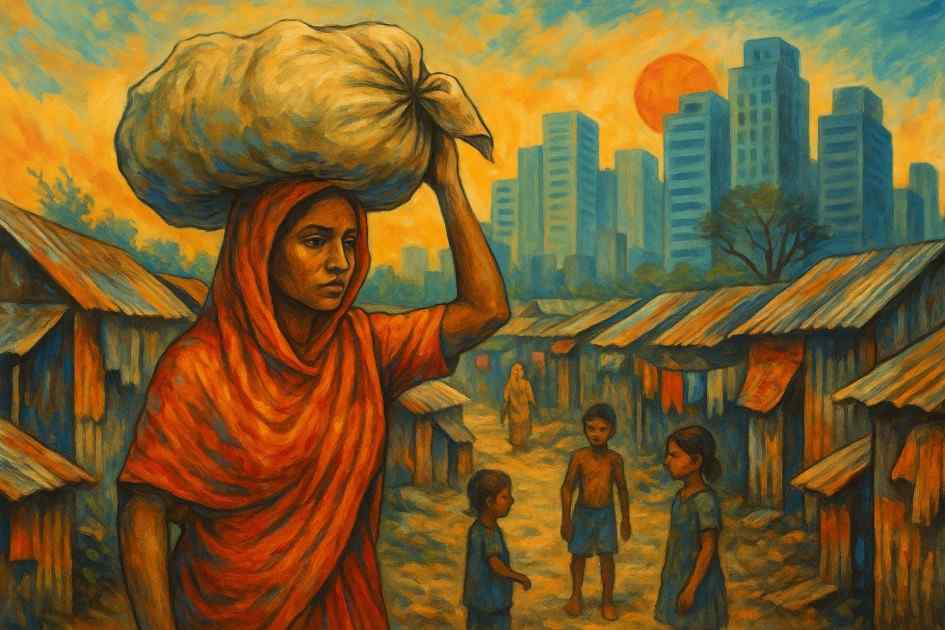

Dhaka’s hidden slums, from Duaripara to Jhilpara, shelter thousands displaced by floods and erosion. Families endure overcrowding, unsafe water, disease and hunger daily. Experts warn millions more may be displaced by 2050 unless urgent housing, health and policy solutions emerge.
On a humid afternoon in Mirpur’s Jhilpara slum, the narrow lanes are flooded with ankle-deep water. Children wade barefoot through the dirty stream, their laughter a fragile contrast to the frustration etched on their parents’ faces. Inside a one-room shack of corrugated tin, Parveen, a mother of three, surveys her home. The water has seeped in again, soaking the mats and rice sack tucked in the corner.
“Above all else, a person needs a place to call home,” she says quietly, holding her youngest child on her lap. “As slum dwellers, we are often undervalued. But we are human too. What we need most is a decent place to live, a home that provides safety and dignity.”
Parveen’s story is just one among 4.4 million in Dhaka’s 5000 hidden slums communities like Dhalibari, Duaripara, Jhilpara and Kallyanpur Pora Colony. While Korail, the city’s largest slum, occasionally attracts attention from researchers and NGOs, these smaller colonies remain invisible.
Yet they are filling with people displaced by the relentless advance of climate change: villagers forced out by floods, cyclones and river erosion, now struggling for survival in the capital.
From riversides to roadside shacks
For Ojufa, migration was never a choice. A farmer’s daughter from Bhola, she grew up accustomed to the river threatening their land each monsoon. But one year, the floods came harder and faster. The water swallowed her family’s home. “My father and grandfather lived stable lives working in the fields,” she recalls. “If not for the river erosion, we would still have our lands.”
Now, in a fragile hut in Duaripara, Rupnagar, she waits for the rains with dread. Heavy downpours often leave her waist-deep in water. She and her neighbors climb onto the elevated road, standing for hours until the water drains away. Work is scarce; some days she earns nothing. “All I want is a piece of land where I can live and work,” she says.
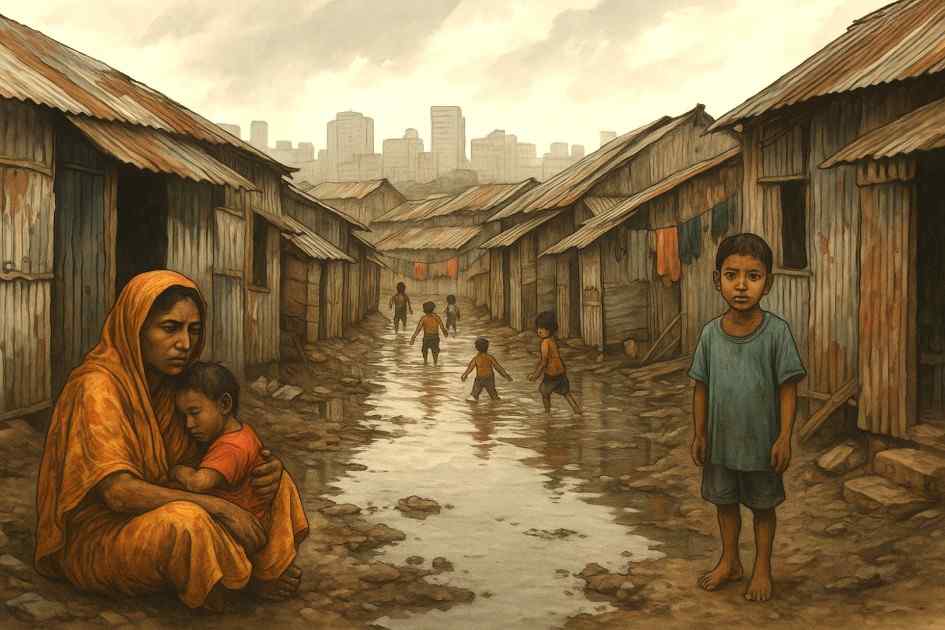
For Firoza Begum, life was also torn apart by floods. From Kishoreganj, she came to Dhaka with her husband, a rickshaw puller and four children. She tried to rebuild by renting a small shop, but it was taken from her. A Tk 50,000 fine pushed them deeper into debt. Her daughter abandoned her studies to support the family. “How can I possibly provide for my family with such little income?” Firoza asks, her eyes a mixture of despair and defiance.
And in a cramped room in Dhalibari slum, Manora Begum from Patuakhali pays Tk 6,000 a month for rent. Her husband has developed asthma since moving to the city. The family was struck by tragedy when her son-in-law died during a brutal heatwave. “Aid is often mismanaged, leaving those who need it most without support,” she says, her voice heavy with abandonment.
A city of invisible citizens
Dhaka engrosses 400,000 to 500,000 new residents each year, 70% of them climate migrants. Yet while the metropolis grows, the hidden slums remain excluded from development programs. In Dhalibari, Jhilpara and Pora Colony, overcrowding is severe six to eight people squeeze into rooms smaller than a single office cubicle.
Sanitation is almost nonexistent. Dozens share a single toilet. Stagnant sewage flows into narrow alleys, mixing with rainwater. Water, when available, is often contaminated. Families pay inflated prices for unsafe supplies, leading to rashes, stomach infections and chronic illness.
“The assistance promised by the government never reaches us. Corrupt individuals consume it all,” laments Anowara Begum, who pays Tk 2,000 each month for a shanty without clean water or electricity.
Health crises are constant. In summer, tin-roof homes turn into ovens. In the monsoon, families sit on their beds to avoid knee-deep water. Dengue and diarrheal disease spread easily and hospitals remain distant luxuries. Children drop out of school to work, while mothers forgo meals to feed their families.
Despite these daily struggles, the residents of Dhaka’s hidden slums remain politically invisible. They are not formally recognized and therefore excluded from aid, urban planning and housing programs. “They are the invisible citizens of Dhaka, with no voice in planning and no place in policy,” says one disaster management researcher.
The human cost of climate migration
These stories echo a growing national crisis. Bangladesh sits on the frontline of climate change. With just a 50 cm rise in sea levels, the country could lose 11% of its land by 2050, displacing as many as 18 million people. Already, 7.1 million Bangladeshis have been displaced by climate risks and the figure is projected to double by mid-century. In 2024, floods wiped out 1.1 million metric tons of rice, worsening food insecurity. Heatwaves, made 45 times more likely by climate change, now kill and sicken thousands, as in the case of Manora’s family.
These are not abstract statistics. They are the lived realities of families like Jesmin’s, who lost her riverside home and now struggles in Duaripara with her children and elderly parents. “All I ask for is a small piece of land and a home,” she says, her voice subdued.

For Hashi, displaced from Sirajganj, the struggle is about her children’s future. “If they can get an education, they can have a better life,” she says, though she cannot afford school fees. For Kalachad Prem from Netrokona, who spent Tk 120,000 treating his sons for dengue, survival itself is enough: “I don’t have big dreams. I just want to provide for my family and that’s enough.”
A crisis unfolding
Diplomats, academics and climate activists warn that Bangladesh cannot afford to ignore the plight of its displaced citizens.
Nayoka Martinez-Bäckström, Deputy Head of Development Cooperation at the Swedish Embassy in Dhaka, cautions said, “We can’t just do bits and pieces in the slums. Vulnerable populations are being forced from their homes and cities absorbing them are on the brink of collapse.”
Sohanur Rahman, Executive Coordinator of YouthNetGlobal, highlights the urgency of action said, “By 2050, over 18% of Bangladesh’s land will be underwater, displacing millions. We need accurate data, resilient urban hubs and essential services clean water, healthcare, safety nets for the displaced.”
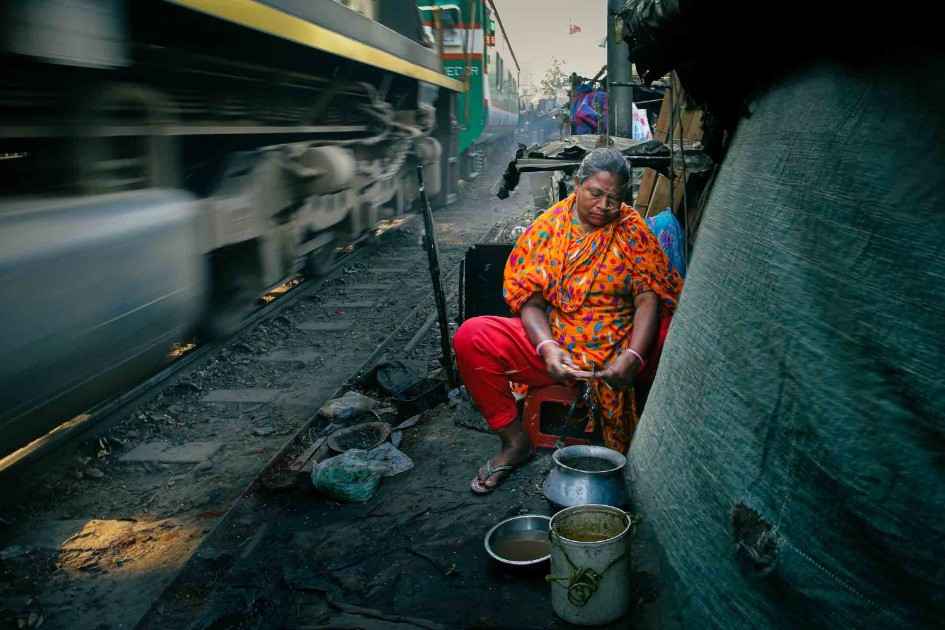
Dr. Mahbuba Nasreen, Pro-Vice Chancellor of Bangladesh Open University, emphasizes the role of youth told, “If the young people working in this project can come forward, they will not only challenge the impacts of climate change but also redefine solutions using indigenous knowledge.”
Farah Anzum, a climate communications specialist, connects the crisis to identity told, “Displacement is not just about losing homes. It severs cultural ties, livelihoods and relationships. Already 7.1 million are displaced; by 2050, it will double.”
Their warnings converge on one point: without urgent structural reforms, Bangladesh faces a humanitarian catastrophe.
Policy gaps and failures
Bangladesh has made progress in disaster management. Cyclone deaths have fallen dramatically thanks to early warning systems and shelters. Yet when it comes to climate-induced migration, the policy framework is failing.
The Disaster Management Act (2012), the Standing Orders on Disaster (SOD) and the National Plan for Disaster Management (NPDM) all exist. But local disaster committees lack funding and capacity. Bureaucracy and corruption stall relief. Most critically, climate migrants have no voice in the planning that affects their lives.
Despite global recognition of climate migration, Bangladesh has yet to adopt a comprehensive national policy for resettlement, livelihoods, or urban integration. For residents of hidden slums, this gap translates into a daily grind for survival.
Beyond survival: What must change
Experts and communities agree that the crisis demands more than temporary relief. Safe Housing, Replace fragile shanties with affordable, flood-resistant homes. Models exist, India’s “cool roofs,” China’s “sponge cities.” Skills training and microfinance to help displaced workers transition into stable jobs for earning livelihoods. Expand WASH infrastructure to stop preventable diseases. Free community schools and flexible learning centers to prevent a lost generation. Climate-resilient farming to slow migration at the source. Ensure migrants have a seat at the table in urban and disaster planning. As Bangladesh contributes less than 0.5% of emissions, international climate finance must support adaptation and resettlement.
The fight for dignity
In Dhaka’s hidden slums, every day is a negotiation with poverty, heat and water. Families displaced by forces beyond their control rising seas, broken embankments, eroding riverbanks now fight for survival in the shadows of a city that barely acknowledges them.
Yet their voices remain powerful. “All I want is a land where I can live and work,” says Ojufa. “If my children get an education, they can have a better life,” says Hashi. “We are human too. We need a decent place to live,” says Parveen.
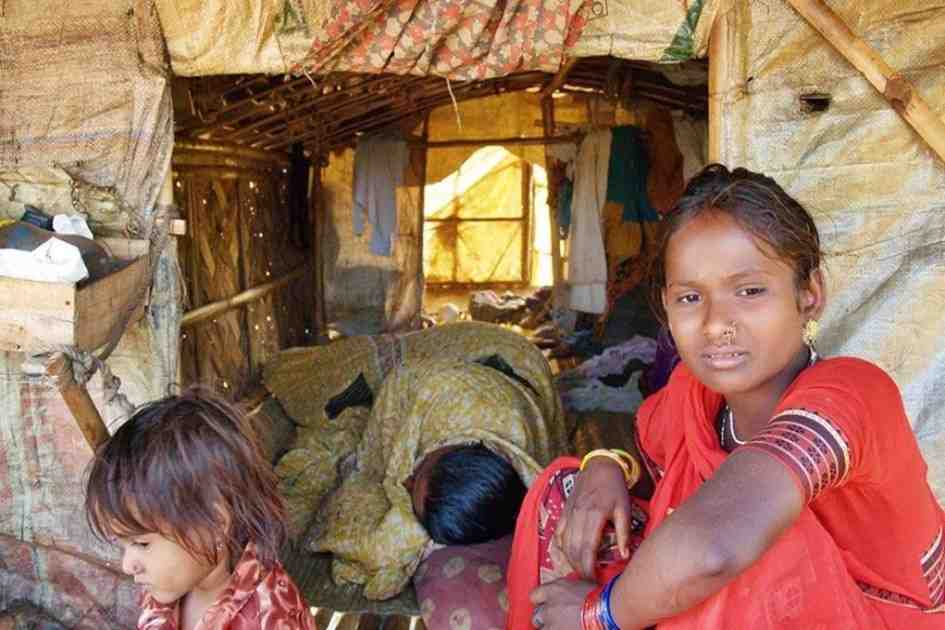
Theirs is not just a story of suffering, but of resilience, a reminder that the climate crisis is not only about melting glaciers or rising temperatures. It is about people: mothers skipping meals, fathers pulling rickshaws, children growing up in flooded alleys.
Unless Bangladesh and the world act with urgency, Dhaka’s hidden slums will remain both refuge and prison stark symbols of the human cost of climate change.
The story is based on a publication by INFLUENCERS, titled “Displaced by climate: The human cost”




