

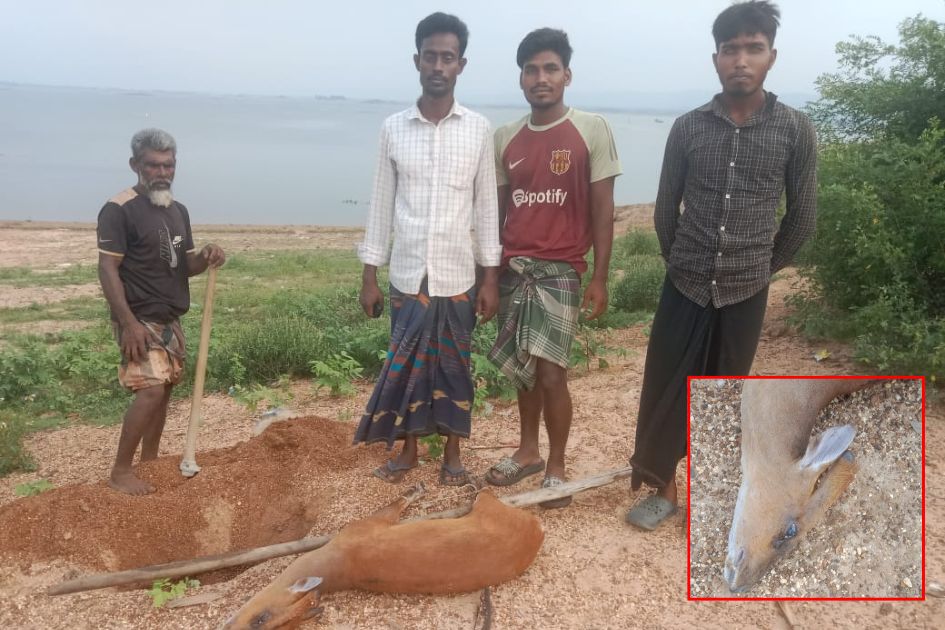



A rare barking deer was recovered dead from Kaptai Lake in Rangamati, prompting concerns over illegal hunting, habitat disturbance and growing threats to wildlife in Bangladesh’s southeastern hill forests.
A rare species of deer was recovered dead from the waters of Kaptai Lake in Bangladesh’s southeastern Rangamati district on Friday, triggering concern among local residents who suspect the animal may have jumped into the lake while trying to escape danger.
The deer was spotted floating near Dwip Kattali Bazar in Longadu upazila by local resident Muhammad Abdur Rashid on Friday afternoon, according to residents. News of the incident quickly spread through the area, drawing crowds to the lakeside.
Local businessman Mizan said residents were informed immediately after the animal was seen in the water. Locals later recovered the carcass from the lake and buried it beside a police camp following a decision by the market committee.
Residents believe the deer may have leapt into the lake to escape hunters or an attack by a wild predator. They suspect the animal died after remaining in the water for a prolonged period, possibly from physical exhaustion or a stroke.
Technology-assisted identification suggested the animal closely resembled the Indian muntjac, commonly known as the barking deer. In Bengali, the species is also known as “Kakar deer.” Its scientific name is Muntiacus muntjak.
Experts say barking deer are comparatively small in size with reddish-brown or light brown coats. Male deer typically have short antlers. The species is known for producing barking sounds similar to a dog when sensing danger, which is how it earned the name “barking deer.”
The species is commonly found in forests, shrublands and hilly regions across Bangladesh, India, Nepal and several Southeast Asian countries. Their diet mainly consists of grass, leaves, fruits and tender branches.
Wildlife experts say barking deer play an important role in maintaining ecological balance by dispersing seeds of forest plants. However, deforestation and illegal hunting have caused their numbers to decline alarmingly in many areas.




